Quick Answer
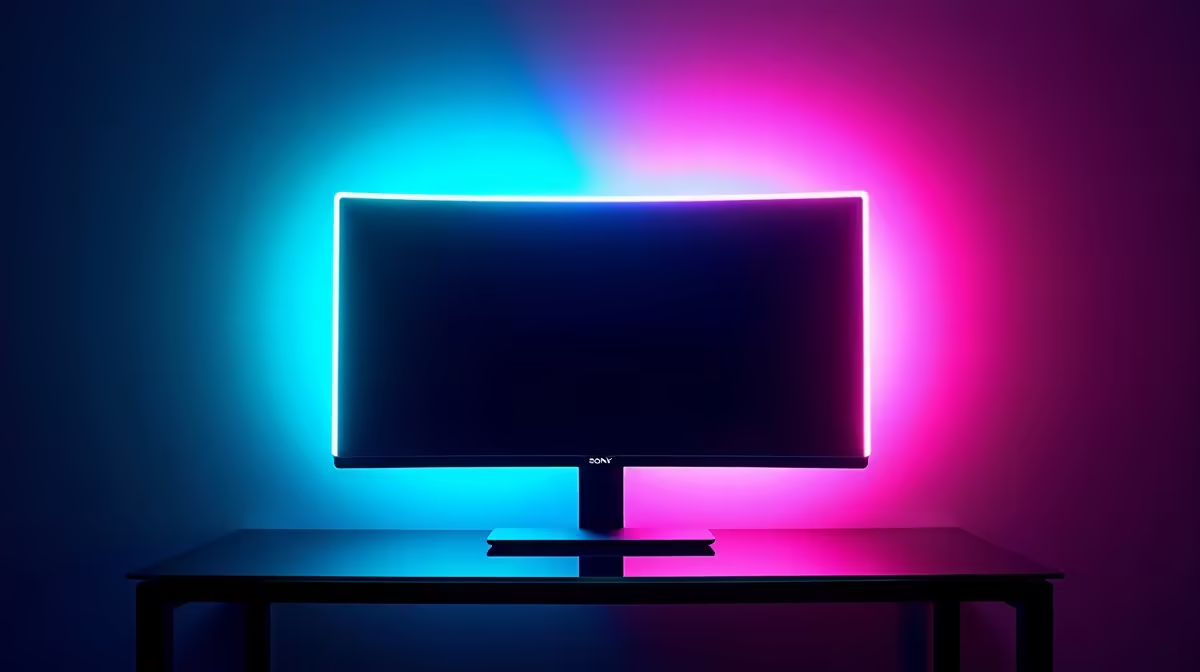
WOLED is LG's White OLED panel architecture, TrueBlack is LG's measured black level specification (below 0.0005 nits), and a glossy panel coating is the surface treatment that maximises colour fidelity in controlled lighting. Together they define the highest-contrast monitor experience currently available, but the glossy surface requires a managed lighting environment to be practical.
WOLED Architecture Explained 🔬
Unlike RGB OLED panels that use separate red, green, and blue organic emitters per pixel, WOLED uses a single white organic emitter per pixel with colour produced by a filter layer. The advantage is greater manufacturing consistency and longer lifespan because the white emitter degrades more uniformly. LG manufactures most WOLED panels for the gaming monitor market, with the architecture appearing in the LG UltraGear OLED series. At 32-inch 4K, WOLED panels deliver 99% DCI-P3 coverage, 240Hz or higher refresh rates, and black levels at or below the TrueBlack specification. Pricing for WOLED-based 32-inch 4K gaming monitors starts at approximately R18,000 and extends to R28,000 at Evetech depending on refresh rate and feature set.
TrueBlack Contrast: What the Numbers Mean 📊
LG's TrueBlack specification certifies a black level below 0.0005 nits. A premium mini-LED IPS monitor achieves approximately 0.02 to 0.05 nits with local dimming active. A standard IPS sits around 0.2 to 0.4 nits. TrueBlack WOLED is 40x to 100x darker in black areas than the best non-OLED alternatives. In a night scene in a story game, shadow areas are genuinely black rather than visible grey, and details like ambient occlusion and fog gradients become visible without backlight bloom. The contrast ratio is effectively infinite because the measured black level approaches zero.
Glossy Coatings and When They Help or Hurt 🌟
Glossy coatings transmit emitted light without the micro-scattering of a matte anti-glare surface. On WOLED displays this preserves colour saturation and the full TrueBlack contrast advantage at the screen surface. In a dark or dim gaming room, a glossy WOLED is visually superior to a matte WOLED of identical specification. In a bright environment, the glossy surface reflects ambient light sources, creating distracting reflections during dark scenes. South African gamers who play primarily in the evening or in rooms with dimmed lighting benefit from a glossy WOLED; those in brightly-lit or open-plan spaces should consider a semi-glossy alternative.
Position Your Monitor Away From Direct Light Sources ⚡
Place your WOLED gaming monitor perpendicular to windows and overhead lights rather than facing them. Angling the display so light sources fall outside its reflection cone eliminates most ambient reflection. A monitor arm allowing fine angle adjustment is particularly useful for glossy OLED panels in South African homes where room orientation varies.
FAQ
Is WOLED better than QD-OLED for gaming monitors?
Neither is categorically better. WOLED offers more uniform large-area brightness and established manufacturing, while QD-OLED achieves higher peak brightness and a slightly wider colour gamut. For story gaming and film uniformity, WOLED has the edge; for HDR highlights, QD-OLED's peak brightness shows up.
Does TrueBlack certification guarantee no blooming on WOLED?
Yes. Because each WOLED pixel controls its own light independently, blooming (the halo around bright objects on dark backgrounds) does not occur. This is the most visible practical difference between WOLED and any LCD, including mini-LED.
Can I use a glossy WOLED monitor for daytime office work?
If you can position the monitor away from direct window light and overhead lighting, daytime productivity is fine. If your desk faces a window, daytime reflections on a glossy surface are disruptive enough to warrant a matte or semi-glossy panel instead.
Interested in WOLED monitor technology?
Evetech stocks WOLED and QD-OLED gaming monitors with TrueBlack certification, browse the full OLED range online or in-store.