Quick Answer
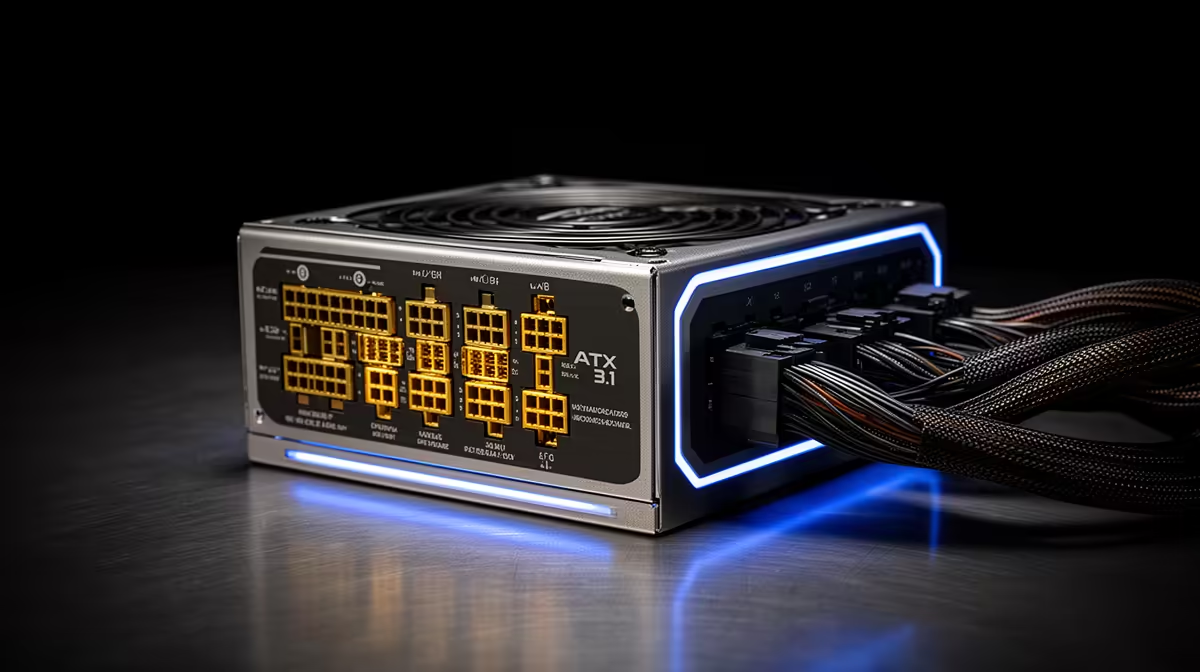
ATX 3.1 is Intel's updated PSU specification that mandates the 12V-2x6 connector, 200% transient tolerance for 100 ms, tighter 12 V rail regulation (plus or minus 3% under transients), and improved hold-up time requirements. It is the correct standard for any build using RTX 50-series or RX 9000-series GPUs.
ATX 3.1 Voltage Regulation Requirements 🔌
Voltage regulation defines how tightly the PSU holds its output rail voltages under varying loads. ATX 3.1 requires the 12 V rail to stay within plus or minus 3% under transient conditions, meaning during rapid load spikes the rail must not deviate more than 0.36 V from 12 V nominal. Previous ATX 2.x specifications allowed plus or minus 5%, which is adequate for steady-state loads but insufficient for GPUs that spike from 10% to 100% load in microseconds. Tighter regulation protects GPU core voltages during burst sequences, which correlates with improved stability in intensive gaming sessions and reduced coil whine from voltage noise.
The 12V-2x6 Connector Explained 🖥️
ATX 3.1 replaces the 12VHPWR connector (introduced in ATX 3.0) with the 12V-2x6. Both carry 600 W continuous power through 16 pins, but 12V-2x6 uses a revised sense pin arrangement that gives clearer feedback when the connector is fully seated, and an improved retention clip that is harder to partially insert. This addresses the incomplete insertion issue that caused insulation melting on early RTX 4090 installations. A native 12V-2x6 cable manufactured as part of the PSU carries the 600 W rating correctly; adapter cables from three 8-pin connectors do not meet the specification and are not suitable for RTX 5080 or 5090 builds.
Transient Tolerance and Why It Matters for Gaming 💡
Modern GPUs generate power transients during shader and rasterisation workloads that can peak at double the rated TDP for durations of 10 ms to 100 ms. An RTX 5090 rated at 575 W can spike to 1,150 W transiently. ATX 3.1's 200% transient tolerance specification means a 600 W connector must handle 1,200 W bursts for 100 ms without triggering protection circuits. Without this tolerance, games with rapid scene changes or particle-heavy effects can trigger OCP shutdowns that register as system crashes. South African gamers who experience unexplained crashes in titles like Cyberpunk 2077 or Alan Wake 2 with non-ATX-3.1 PSUs and RTX 50-series GPUs should consider this specification as a troubleshooting factor. ATX 3.1 units at 850 W to 1,200 W are priced at R2,800 to R6,500 and stocked at Evetech with local warranty support.
Check Your PSU Spec Sheet for Transient Rating ⚡
Not every PSU that claims ATX 3.0 compliance meets the full 200% transient tolerance. Budget ATX 3.0 units sometimes meet only the connector spec without the full transient headroom. The full ATX 3.1 specification document is publicly available from Intel; reputable brands publish their compliance test results, which is worth checking for a PSU that will power a flagship GPU.
FAQ
What is the difference between ATX 3.0 and ATX 3.1 in practical terms?
The connector changed from 12VHPWR to 12V-2x6 (safer retention), and voltage regulation requirements tightened. For most builders, the connector improvement is the most significant practical difference.
Is ATX 3.1 backward compatible with older GPUs using 8-pin connectors?
Yes. ATX 3.1 PSUs include standard 8-pin PCIe cables for older GPUs. The 12V-2x6 connector is additive; you are not forced to use it unless your GPU requires it.
How long will ATX 3.1 remain the current standard for new South African builds?
ATX 3.1 was ratified in late 2023 and will remain current through at least 2027 to 2028 based on Intel's typical specification cycle. Boards available in SA today on AM5 and LGA1851 platforms are fully ATX 3.1 compatible.
Building with modern components and want proper voltage regulation?
Browse the full range of ATX 3.1 power supplies at Evetech for safe, stable power delivery to your next-gen GPU.