Quick Answer
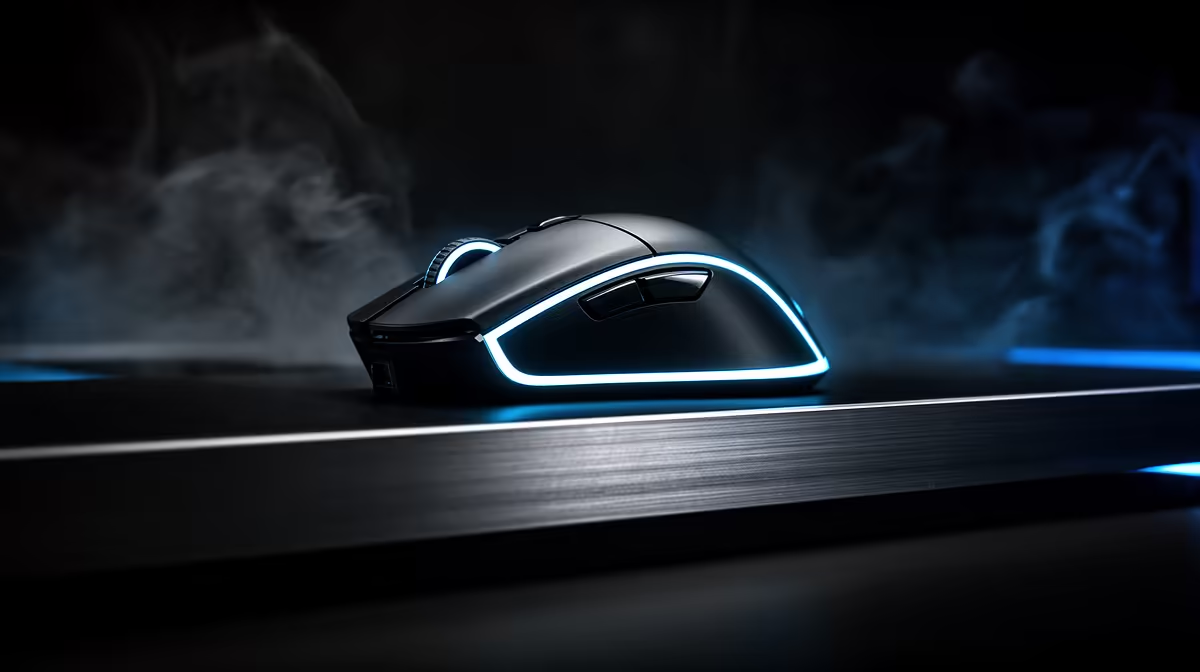
8,000 Hz wireless technology reports your mouse position 8,000 times per second via a proprietary 2.4 GHz connection, producing 0.125 ms position update intervals. This is the current highest polling rate available in wireless gaming mice and provides measurable cursor smoothness improvements over 1,000 Hz on 240 Hz monitors and above.
The Engineering Behind 8,000 Hz Wireless 🔧
Achieving 8,000 Hz wirelessly requires solving a fundamentally harder problem than doing it over a USB cable. Wireless must match USB's throughput over 2.4 GHz radio while maintaining sub-1 ms latency per packet and operating on battery power within a form factor under 80 grams.
Razer's HyperSpeed Ultra and similar implementations use a dual-channel RF approach where the dongle and mouse communicate across two frequency channels simultaneously, providing redundancy for any given packet. If one channel experiences momentary interference, the data arrives on the second. This approach, combined with faster onboard microcontrollers and RF chipsets, is what makes reliable 8,000 Hz wireless commercially achievable in 2026.
Performance Gains at Different Monitor Refresh Rates 📊
The benefit of 8,000 Hz wireless scales with your monitor's refresh rate. At 60 Hz (16.7 ms per frame), 1,000 Hz already provides 16 position reports per frame, which is more than enough. At 144 Hz (6.94 ms per frame), 1,000 Hz delivers 6 to 7 reports per frame, still adequate. At 240 Hz (4.17 ms per frame), 1,000 Hz delivers only 4 reports per frame. At 8,000 Hz the same 240 Hz frame receives 33 reports.
For 360 Hz gaming (2.78 ms per frame), 1,000 Hz provides fewer than 3 reports per frame, genuinely insufficient for smooth cursor reproduction during fast flicks. South African 360 Hz monitors are available from around R8,000 to R12,000, a tier where the additional R1,000 to R1,500 for an 8,000 Hz wireless mouse over a 1,000 Hz model is proportionally minor.
Battery, Weight, and Practical Trade-Offs 🔋
The real-world compromise of 8,000 Hz wireless is battery life. Running at 8,000 Hz continuously reduces battery life by 50 to 70 percent compared to 1,000 Hz on the same mouse. A mouse rated at 90 hours at 1,000 Hz might deliver 30 to 35 hours at 8,000 Hz. For South African gamers averaging 4 hours daily, this means charging every 7 to 9 days rather than every 22 days.
Weight management is also critical. Flagship 8,000 Hz mice like the Razer Viper V3 Pro weigh around 82 grams, slightly heavier than the lightest 1,000 Hz wireless options at 61 grams.
Use 4,000 Hz for Daily Play ⚡
Most 8,000 Hz wireless mice let you switch polling rates in software. Run 4,000 Hz for ranked and casual sessions (it delivers most of the 8,000 Hz benefit at 240 Hz) and reserve 8,000 Hz for tournaments. This doubles your battery life versus permanent 8,000 Hz operation.
FAQ
How do I enable 8,000 Hz on a compatible wireless mouse?
Open the manufacturer's companion software (Razer Synapse or equivalent) and locate the polling rate setting in the Performance or Mouse tab. Select 8,000 Hz from the dropdown. Some mice require a firmware update to unlock 8,000 Hz if the feature was added post-launch.
Is there a visible difference between 4,000 Hz and 8,000 Hz on a 240 Hz monitor?
The difference between 4,000 Hz and 8,000 Hz at 240 Hz is less pronounced than the difference between 1,000 Hz and 4,000 Hz. Most players report that 4,000 Hz is the threshold at which cursor motion feels noticeably cleaner at 240 Hz.
Are there any game compatibility issues with 8,000 Hz mice?
A small number of older game engines sample mouse input at fixed intervals that do not benefit from high polling rates. Most modern competitive titles including Valorant, CS2, Apex Legends, and Fortnite are designed to accept high-rate mouse input and use it appropriately.
Ready to game at the cutting edge of wireless input?
Evetech stocks 8,000 Hz wireless gaming mice for South African gamers who demand the fastest possible response. Browse the full wireless mouse range at Evetech.