Quick Answer
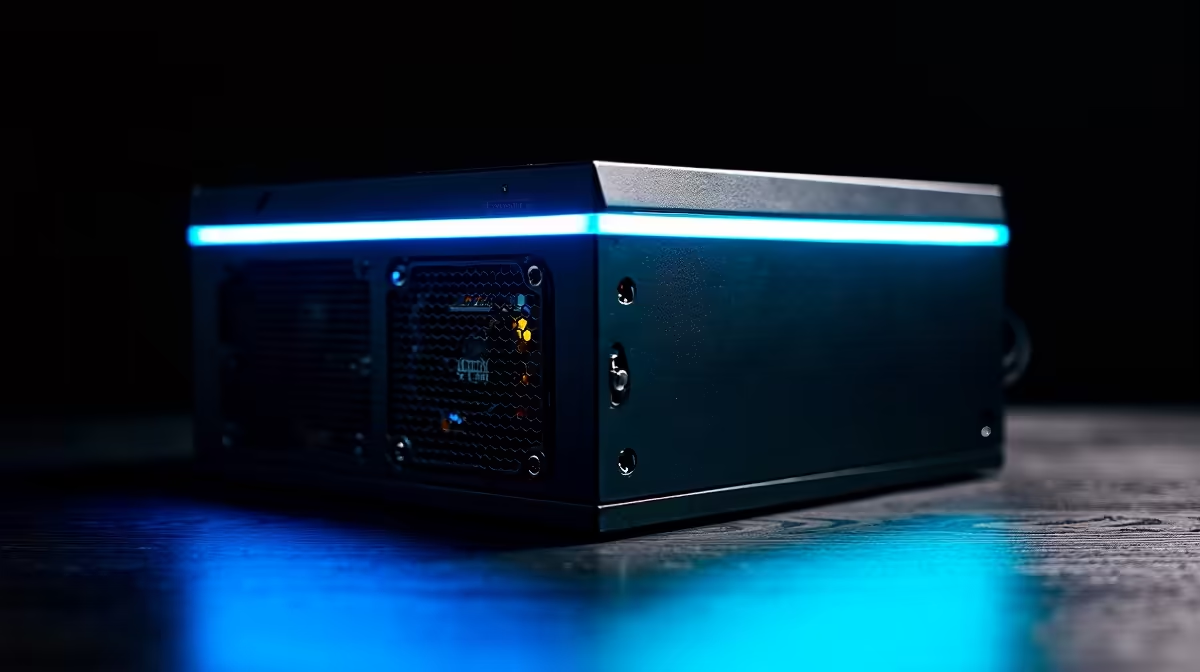
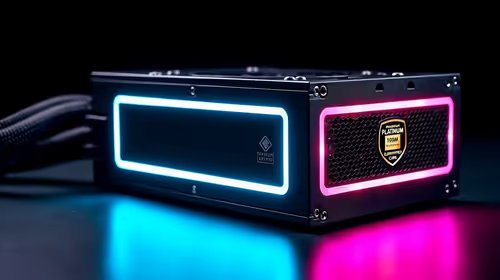
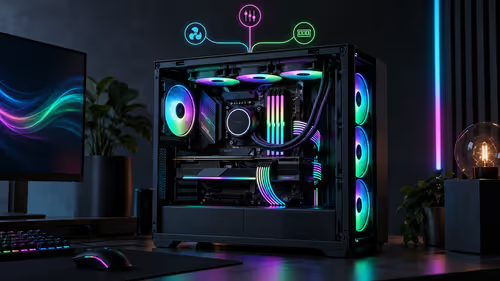
A fully modular PSU lets you install only the cables your build actually uses, eliminating the bundled surplus cables that most semi-modular and non-modular units force into the case. Removing unused cables reduces airflow restriction in the main chamber by 10% to 20% in a tightly packed mid-tower, lowering GPU and CPU temperatures by 2 to 5 degrees C in builds where cable management is otherwise constrained.
Modular vs Semi-Modular vs Non-Modular 🔧
Non-modular PSUs have all cables permanently attached. Semi-modular units fix the 24-pin ATX and CPU EPS cables and make peripheral cables detachable. Fully modular units make every cable detachable, including the 24-pin and EPS. For typical builds, semi-modular is sufficient and saves R200 to R500 over full modularity at the same wattage and efficiency tier. Full modularity pays off in large EATX workstation builds where cable routing is complex, ITX builds where every centimetre matters, and when using aftermarket sleeved cables. For a R40,000-plus South African build, full modularity is typically worth the small premium.
Cable Routing Techniques That Improve Airflow 💨
The goal of cable management is reducing impedance to airflow between intake fans and exhaust fans. Cables routed through the main chamber create turbulence zones that reduce effective airflow velocity across GPU heatsinks. Best practice is to route all cables through the rear compartment behind the motherboard tray and bring them to their destinations through the dedicated cable routing holes with rubber grommets. The 24-pin ATX cable should run along the motherboard tray edge rather than across the board face. GPU power cables should emerge through the lowest routing hole directly below the GPU power connectors to minimise their visible length in the main chamber.
PSU Shrouds and Airflow Separation 🖥️
Most modern mid-tower and full-tower cases include a PSU shroud that conceals the PSU and cable mass in the bottom of the case, separating the PSU's cooling airflow from the main chamber. For builds without a shroud, a fully modular PSU is even more important because unsecured cables directly block GPU intake or exhaust zones. Cable combs (small plastic clips that align individual wires within a sleeve) tighten parallel cable runs and reduce their effective cross-section through tight routing channels.
Route Before You Tighten ⚡
Connect all cables loosely at both ends before zip-tying anything. Route the full run through the rear compartment and confirm each cable reaches its connector with a few centimetres of slack. Only then tighten zip ties in sequence from the PSU end to the component end. This prevents a tight cable pulling the connector sideways under normal component vibration.
FAQ
Do aftermarket sleeved cables improve airflow over stock cables?
Sometimes. Aftermarket cables are often thinner in diameter and sit straighter due to memory wire inside the sleeve, reducing their footprint in the cable routing channel. Confirm the AWG rating before using them on high-current 12V-2x6 runs.
Can I mix cables from different PSU brands?
No. PSU cable pinouts differ between brands and sometimes between product lines from the same brand. Using a cable from one PSU on a different model can deliver power to wrong pins, causing immediate component damage. Always use cables specified for your exact PSU model.
Does cable length matter for voltage at the component?
At typical wire gauges (16AWG to 18AWG), resistance over cable length causes a small voltage drop, usually under 20mV. For high-current 12V-2x6 runs on a 575W GPU, use the shortest cable routing path possible to minimise resistive drop.
Planning a clean, high-performance build?
Evetech stocks fully modular PSUs from 850W to 1,600W with premium braided cable sets. A modular PSU is the first step to a clean, well-airflowed build that performs and looks the part.