Quick Answer
Axial-Tech fans use a shorter hub with more blade surface area than traditional PSU fans, generating higher static pressure at lower RPM. Dual ball bearing variants last significantly longer than sleeve bearing fans, with rated lifespans of 50,000 to 100,000 hours versus 30,000 hours or less for sleeve types.
How Axial-Tech Fan Design Improves PSU Cooling 🌀
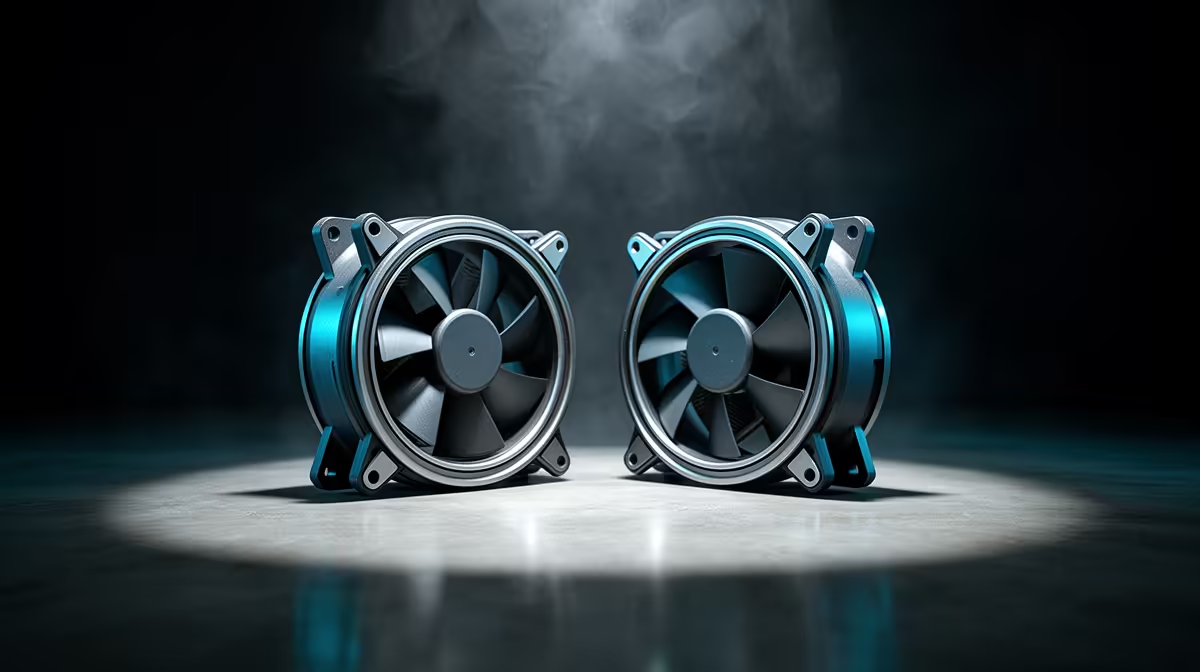
Traditional PSU fans are commodity axial blowers designed primarily for cost. Axial-Tech refers to a fan architecture, popularised by ASUS in their ROG Thor and Thor Platinum series, that borrows blade geometry from server-grade cooling. The wider blade surface and reduced hub diameter push a higher volume of air through the PSU's internal heatsinks at lower rotational speeds. Lower RPM means less acoustic noise at idle and moderate loads, a meaningful benefit in a quiet South African home office setup. Some units also feature a semi-passive or zero-RPM mode that stops the fan entirely below 30% to 40% load, so the PSU runs in complete silence during light desktop or media tasks.
Dual Ball Bearings vs Sleeve Bearings 🔧
Sleeve bearings use a thin film of lubricant between the shaft and housing. Over time that lubricant dries out, particularly in warm environments, causing increased friction, noise and eventually fan failure. Dual ball bearings use two sets of steel balls that physically separate the shaft from the housing, requiring no liquid lubricant and tolerating heat far better. ASUS rates their dual ball bearing PSU fans at 100,000 hours MTBF. At 24/7 operation that equates to over 11 years before the fan statistically reaches end of life. In South Africa, where dust and seasonal heat stress components more than in cooler climates, the durability advantage of ball bearings over sleeve types is amplified.
PSU Lifespan Factors Beyond the Fan 💡
Fan longevity is one part of the picture. Capacitor quality is arguably more important. Japanese brand capacitors, sometimes noted as 105 degree C rated on spec sheets, tolerate elevated temperatures without bulging or losing capacitance. Cheaper capacitors rated at 85 degrees C degrade faster in a warm South African summer where case internals can hit 45 degrees C without active cooling. PSUs carrying both quality capacitors and dual ball bearing fans regularly last eight to twelve years in normal gaming use, making a R4,000 to R5,500 premium unit a rational long-term investment compared to replacing a cheaper unit every three to four years.
Clean Your PSU Fan Annually ⚡
Dust accumulation on the PSU fan blades reduces airflow and forces the motor to work harder, shortening bearing life. Use a can of compressed air with the PC powered off and unplugged to clear the fan grille every twelve months. In dusty SA environments near construction or unpaved roads, every six months is safer.
FAQ
Does a zero-RPM mode mean the PSU runs completely without cooling?
No. PSUs with zero-RPM mode have passive heatsinks that dissipate heat during light loads without the fan. The fan kicks in automatically once load or temperature exceeds a set threshold, typically around 40% of rated wattage.
Are Axial-Tech fans exclusive to one brand?
The Axial-Tech name is a registered ASUS trademark. Other brands use similar high-pressure fan geometries under different names, but the specific Axial-Tech implementation is found only on ROG-branded PSUs.
How do I know if my PSU fan is a ball bearing type?
Check the product specification sheet for the PSU model. It will list bearing type under the fan section. Ball bearing units are almost always explicitly marketed as such because it is a premium selling point.
Looking for a PSU built to last the long haul?
Evetech stocks premium power supplies featuring quality fan designs and Japanese capacitors, suited to SA's demanding climate.