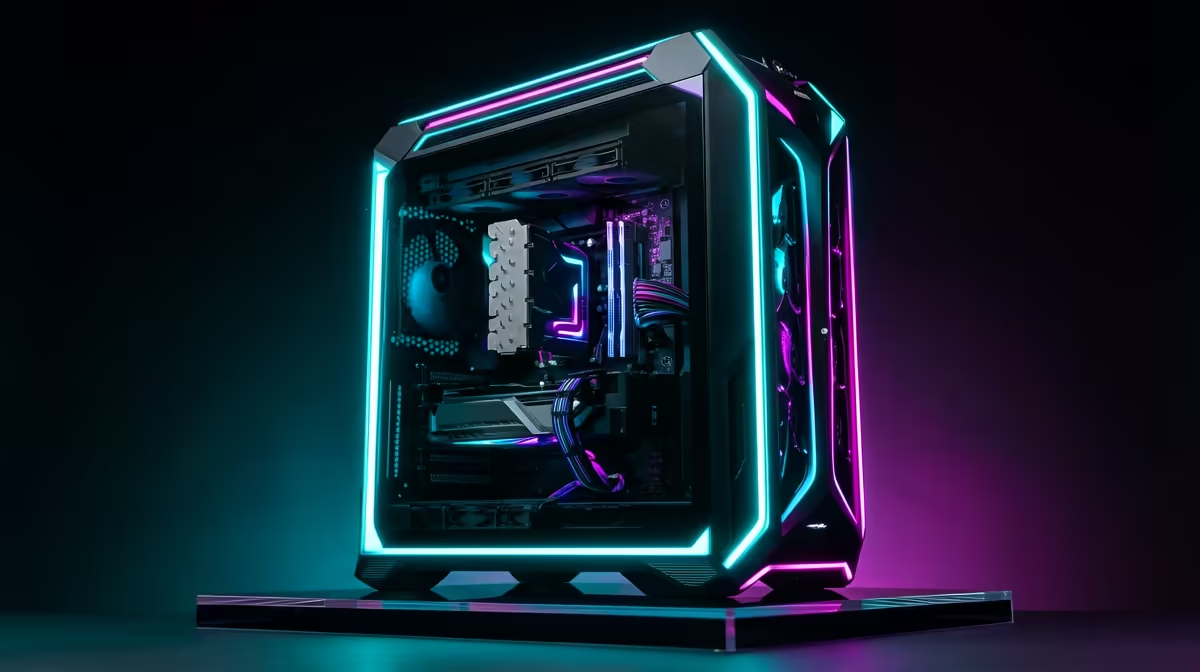
So, you’ve seen the videos. The mind-bending immersion, the heart-pounding action… the future of gaming is in Virtual Reality. But before you strap on a headset, there’s one big question every South African gamer asks: “Is my PC up for it?” Understanding VR gaming PC requirements can feel like decoding a secret language, but don’t stress. We’re here to break down exactly what you need to step into incredible new worlds. 🚀
Understanding the Core VR Gaming PC Requirements
Virtual Reality isn't like running a normal game on a monitor. Your PC has to render a separate, high-resolution image for each eye… and it has to do it at a rock-solid 90 frames per second (or more) to prevent motion sickness. This is why the hardware demands are so specific. A slight stutter that’s barely noticeable on a screen can completely break the immersion in VR.
Let's look at the key components that make or break the experience.
The Graphics Card (GPU): Your Virtual Eyeballs
This is the single most important part of your build. The GPU does all the heavy lifting, drawing the worlds you see. For a smooth experience, you can't cut corners here.
- Entry-Level VR: An NVIDIA GeForce RTX 3060 or AMD Radeon RX 6600 XT is a great starting point. They provide enough power for most popular VR titles like Beat Saber and VRChat on medium settings.
- Sweet Spot VR: For higher resolutions and more demanding games, an RTX 4060 or RTX 4070 is the sweet spot. This ensures you can crank up the settings in visually stunning titles, similar to the graphical fidelity needed for the best Cyberpunk 2077 gaming PCs.
- High-End VR: If you're using a high-resolution headset like the HP Reverb G2 or want to push titles to their absolute limit, an RTX 4080 or 4090 is the way to go.
The Processor (CPU): The Brains of the Operation
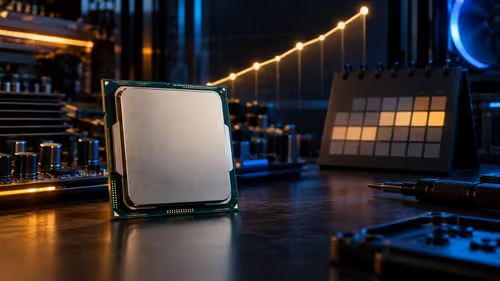
While the GPU handles the visuals, the CPU manages everything else: game logic, physics calculations, and positional tracking for your head and hands. A weak CPU will bottleneck even the most powerful GPU, leading to frustrating stutters. A modern 6-core processor like an Intel Core i5-12600K or AMD Ryzen 5 7600X is a solid baseline for a dedicated VR rig, providing enough power to handle complex simulations, much like the demands of our top-tier Microsoft Flight Simulator gaming PCs.
Memory (RAM): The Short-Term Workspace
For VR gaming, 16GB of RAM is the absolute minimum. It gives your system enough breathing room to handle the game, the operating system, and the VR software simultaneously. Loading the massive maps found in many modern titles requires plenty of fast memory, a challenge well-known to anyone building dedicated Call of Duty: Warzone 2.0 gaming PCs. For future-proofing and smoother multitasking, 32GB is quickly becoming the recommended standard.
Check Your Ports! 🔧
Most PC VR headsets connect via DisplayPort and a USB 3.0 (or higher) port. Before you buy a headset, double-check that your motherboard or GPU has the right connections. Some headsets are very particular about USB controllers, so a dedicated PCIe USB card can sometimes solve persistent tracking issues.
Essential Specs Beyond the Big Three
A powerful GPU, CPU, and plenty of RAM are crucial, but a few other components complete the picture for an optimal VR-ready PC.
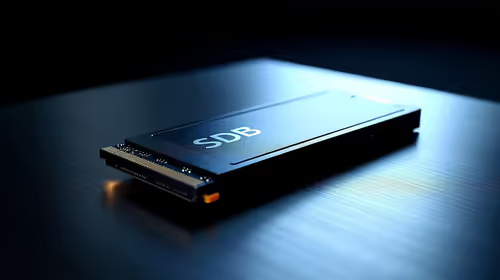
First, an NVMe Solid-State Drive (SSD) is non-negotiable. The lightning-fast loading times are essential for maintaining immersion. Waiting on a loading screen feels ten times longer when you’re standing in a virtual void. This speed is just as vital when dropping into the huge maps on the latest PUBG gaming PCs.
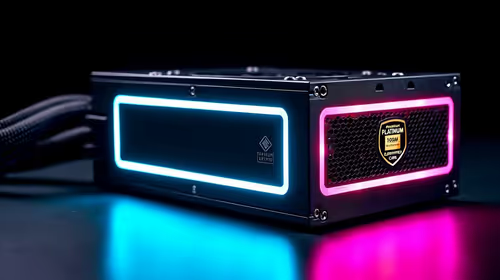
Your power supply unit (PSU) also needs to be up to the task, providing stable and sufficient power to your power-hungry components. Don't skimp here! A quality PSU from a reputable brand protects your entire investment. Whether you're building a rig for VR or for a classic like the ones on our GTA V gaming PCs page, a solid power foundation is key.
Matching Your Rig to Your Gameplay Style
Ultimately, the perfect VR gaming PC requirements depend on you. Are you looking to play fast-paced competitive shooters or explore vast, detailed worlds? A system built to deliver the high, stable framerates needed for our Counter-Strike 2 gaming PCs will also be excellent for rhythm and action VR games. ✨
Similarly, a balanced PC that can handle the sheer scale of modern titles—from the creative chaos on our Minecraft gaming PCs to the team-based action found on our Overwatch 2 gaming PCs—will have the versatility for any VR experience you throw at it.
The good news is that a PC powerful enough for a great VR experience will absolutely dominate traditional "flat-screen" gaming, easily crushing titles on our recommended Fortnite gaming PCs at high settings. It's an investment in every kind of gaming you love.
Ready to Step Into a New Reality?
Understanding VR gaming PC requirements is the first step. The next is finding a rig that brings those worlds to life without breaking a sweat. Explore our massive range of VR-Ready Gaming PCs and find the perfect machine to start your immersive adventure.