Quick Answer
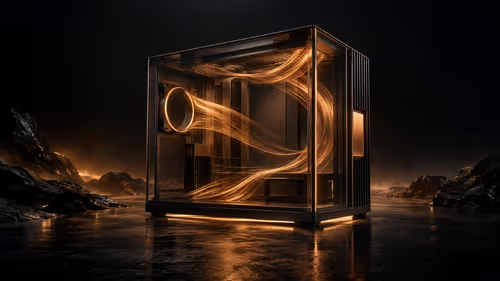
You need a full-tower or large mid-tower case with at least 460mm of stated GPU clearance, preferably 480mm or more, to safely fit a 450mm graphics card with cable routing room. Remove any front drive cage and confirm clearance is measured after cage removal, because many manufacturers quote the cage-removed figure.
Why 450mm GPU Clearance Is a Full-Tower Problem 📏
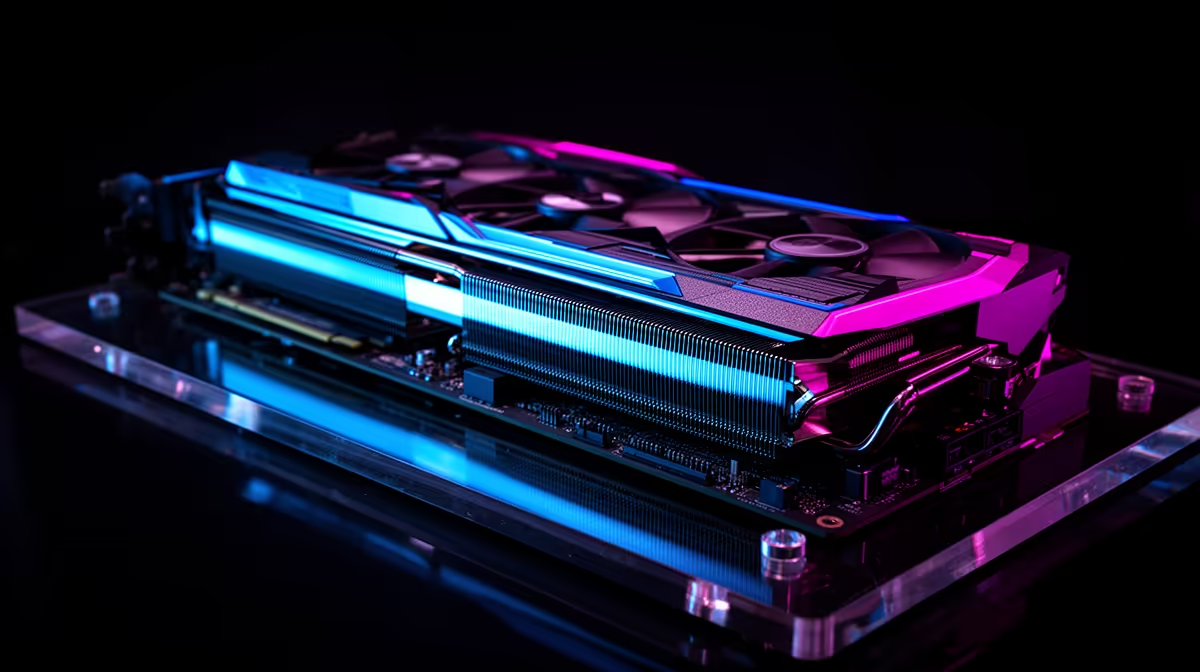
A 450mm graphics card is at the extreme end of current-generation GPU lengths. Most factory-overclocked triple-fan RTX 5090 variants from AIB partners measure between 370mm and 420mm, but some extreme-edition boards push past 430mm. If you are running one of those cards, you are in full-tower territory. A full-tower case in South Africa costs R2,800 to R5,500 and offers GPU clearance ratings of 440mm to 500mm after drive cage removal. Standard mid-towers rated at 360mm to 400mm will not physically accommodate a 450mm card. Forcing the card creates pressure on the PCIe slot, bends the motherboard, and risks permanent damage to a component worth R25,000 or more.
What to Check Before Buying the Case 🔍
Four measurements matter when planning for a 450mm GPU. First, stated GPU clearance with drive cage removed: this is the figure to compare against your card length. Second, clearance with cage installed: if you want internal storage, this number must exceed your GPU length, typically 380mm to 420mm on most full-towers. Third, PSU shroud height: a tall PSU shroud can reduce GPU clearance by 20 to 30mm at the card's rear if the card overhangs the bottom. Fourth, 16-pin power connector overhang: NVIDIA's 12VHPWR connector on RTX 50-series cards adds 20 to 40mm of connector depth depending on cable angle. Factor that into your clearance calculation and aim for 30mm of free space beyond the actual GPU PCB length.
How Case Internal Volume Affects Thermal Performance 🌡️
A full-tower case required for 450mm GPU clearance also brings thermal benefits. Greater internal volume means warmer air from the GPU has more room to mix and dissipate before reaching intake fans. This is especially relevant in South Africa during summer when ambient temperatures in unair-conditioned rooms regularly exceed 28 to 32 degrees Celsius. Full-tower cases typically support front 420mm radiators simultaneously with top 360mm radiators, enabling aggressive dual-loop or large single-loop cooling for the CPU while the GPU's triple fans exhaust freely into the case interior. That combination keeps an RTX 5090 below 80 degrees Celsius junction temperature even at peak summer ambient.
Use the GPU Brace Slot ⚡
A 450mm card is heavy enough to sag noticeably in the PCIe slot within months. Many full-tower cases include a built-in GPU support brace or bracket slot. If not, a standalone GPU sag bracket costs R200 to R450 from local stock and prevents long-term damage to both the PCIe slot and the GPU's own PCB from sustained mechanical stress.
FAQ
Does my motherboard PCIe slot affect GPU length?
No. The PCIe x16 slot length is standardised and does not limit GPU physical length. GPU length is only limited by the case interior, specifically the distance between the PCIe slot mounting point and the front of the case or any installed drive cage.
Can I remove the drive cage permanently in most full-tower cases?
Yes. Most modern full-towers have tool-free or screw-mounted removable drive cages designed to be taken out for large GPU fitment. Two to three 2.5-inch SSD mounting positions typically remain available on the back of the motherboard tray or PSU shroud after the cage is removed.
How much does a full-tower case suitable for a 450mm GPU cost in SA?
Expect to spend R3,000 to R4,500 for a quality full-tower with 460mm or more GPU clearance. Premium cases from top brands with ARGB fans and push-latch glass panels reach R4,500 to R5,500.
Need a case that can handle your massive GPU without cutting corners?
Evetech's full-tower case range includes options with 460mm-plus GPU clearance ready for the most demanding builds.