Quick Answer
Before installing a large PCIe 5.0 graphics card, verify your case's maximum GPU length and slot width, confirm your PSU has sufficient wattage and the correct 16-pin connector, check that your motherboard provides a PCIe 5.0 or 4.0 x16 slot in the correct physical position, and ensure CPU cooler clearance does not encroach on the first PCIe slot.
Physical Case and Slot Clearance 🔧
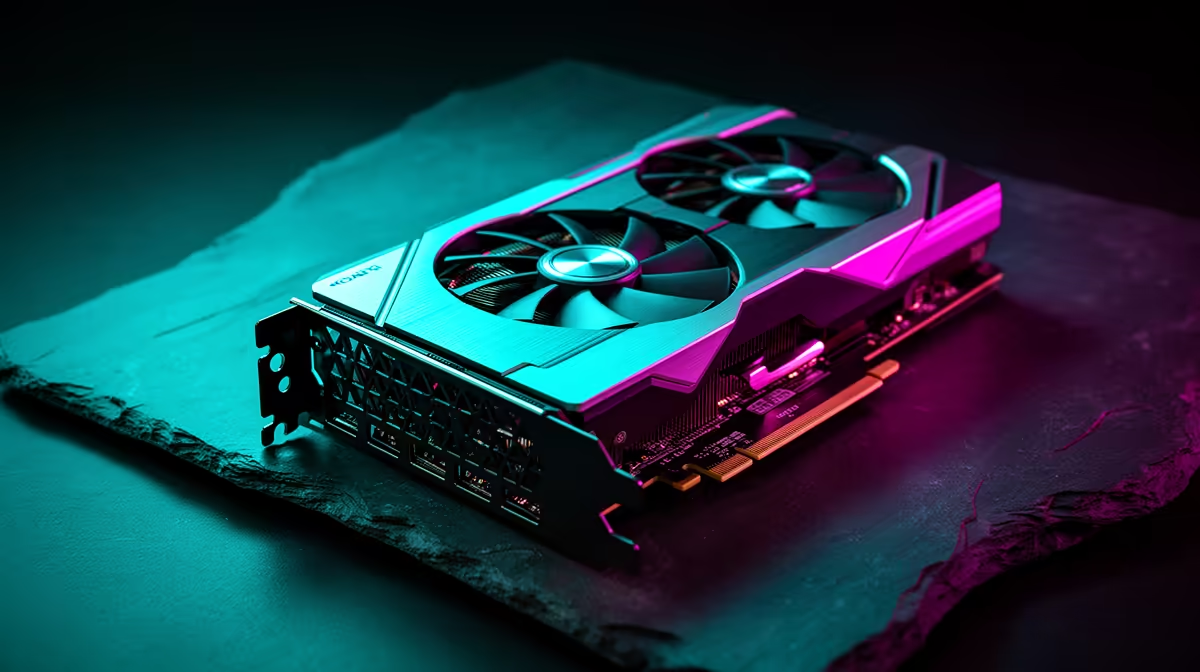
Large flagship cards in the RTX 5090 class measure over 340mm in length and occupy three expansion slots in width. Both dimensions must fit your specific case. Your case's product page or manual will list maximum GPU length under specifications; do not assume compatibility based on case size category alone, as some mid-towers support 360mm while others cap at 300mm. The three-slot width means the top three rear IO panel slots must be unoccupied. If you currently have a PCIe add-in card such as a capture card in the second slot, you must relocate or remove it. In many cases bought locally, drive cage positioning directly limits GPU length; removing a front drive cage is sometimes the only way to accommodate cards above 330mm.
PSU Requirements and Connector Checks 🔌
A card with a 575W TDP like the RTX 5090 requires a PSU providing at least 1000W for a complete system. Add your CPU at 125 to 170W, storage, RAM, and fans, and sustained system draw under gaming load can reach 850 to 950W. A 1000W unit runs close to its rating; a 1200W Gold or Platinum-rated PSU provides appropriate headroom for sustained loads and longevity. The RTX 5090 uses a 16-pin 12VHPWR power connector. Modern PSUs include this cable natively; older PSUs require an adapter from two or three 8-pin cables. Using the native cable is preferred over adapters for long-term reliability.
Motherboard Slot Position and BIOS Settings 🖥️
Not all x16 physical slots on a motherboard connect at x16 electrical from the CPU. Many boards have a second x16 slot operating at x4 from the PCH, delivering dramatically less bandwidth. Always install a flagship GPU in the primary CPU-direct slot, typically the topmost x16 slot on most ATX boards. Some Z790 and older motherboards switch the primary slot to x8 when an M.2 drive is populated in a specific slot due to lane sharing. Check your motherboard manual for lane sharing notes before finalising your installation plan. After installation, verify the link width and speed in your GPU utility to confirm the card runs at its expected PCIe interface speed.
Route the 16-Pin Cable Before Installing the GPU ⚡
Thread the 16-pin 12VHPWR cable from your PSU through the cable management routing before seating the GPU in its slot. This cable is stiff and difficult to route once the GPU blocks access to cable channels. An improperly routed cable under mechanical stress at its connector is the most common cause of connector heat issues on high-wattage cards. Route cleanly and seat the connector fully until it clicks.
FAQ
Does a heavier GPU require additional support in South African cases?
Yes. A three-slot GPU weighing 1.4 to 1.7kg puts significant leverage stress on the PCIe slot over time. GPU support brackets that rest on the case floor are widely stocked and cost R150 to R400, a practical addition for any large triple-slot card.
Will a large GPU block CPU cooler fan access for maintenance?
In most mid-tower and full-tower cases, a long GPU does not physically obstruct the CPU cooler fan. In compact cases where the GPU extends past the RAM slots, the GPU may need removal before the CPU cooler can be taken out for maintenance.
Is it safe to use a PCIe x16 riser to relocate a large GPU vertically?
For a high-performance flagship GPU, use only PCIe 5.0 certified x16 riser cables designed for vertical GPU mounting. Keep cable length under 200mm for best signal integrity and source from reputable brands to ensure reliable PCIe 5.0 operation.
Installing a flagship GPU in your South African gaming PC?
Evetech stocks the full range of RTX 5090 cards alongside compatible cases, PSUs, and GPU support brackets with local warranty.