Quick Answer
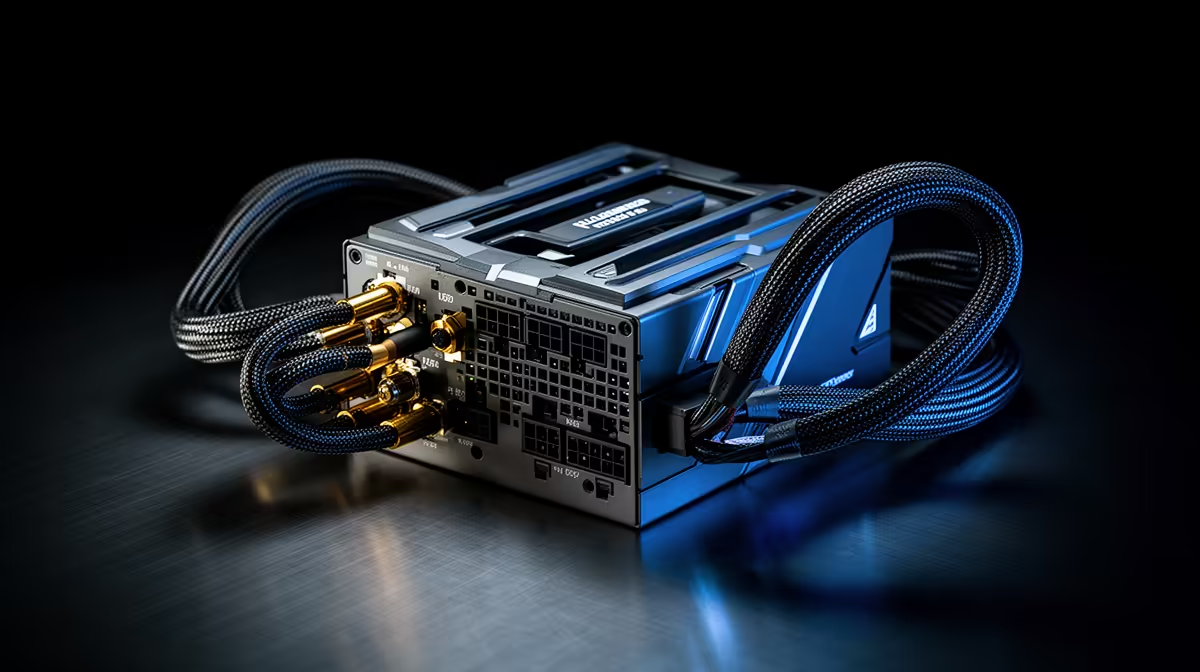
For gaming, ATX 3.1 compliance and a native 12V-2x6 connector are non-negotiable with current-gen GPUs. For streaming and creator workloads, wattage headroom increases because CPU and GPU run simultaneously at high sustained load. All three use cases benefit from full modularity, 80 Plus Gold or better, and a ten-year warranted brand.
Gaming-Specific PSU Priorities 🎮
Pure gaming loads are bursty: the GPU spikes hard during dense scenes, then backs off. ATX 3.1's transient handling was built precisely for this pattern. For single-GPU gaming builds, the RTX 5080 at 300W TDP is well served by an 850W to 1000W ATX 3.1 fully modular Gold unit. The RTX 5090 at 575W TDP needs 1000W minimum, with 1200W recommended when paired with a high-TDP CPU. For gaming, prioritise correct wattage plus ATX 3.1 compliance first; efficiency and warranty tier are secondary but still relevant for a build expected to run 2,000 to 3,000 hours per year.
Streaming and Dual-Workload Demands 📡
A streaming setup differs from pure gaming because the CPU runs at high load simultaneously with the GPU. Software-based streaming encoders like OBS with x264 can push a 16-core CPU to 80% utilisation while the GPU handles rendering at full tilt. A Ryzen 9 9950X at 170W with an RTX 5080 at 300W plus system overhead reaches 550W to 600W sustained. For streaming rigs, add 150W to 200W beyond what a gaming-only calculation suggests. A 1000W Gold ATX 3.1 unit is the floor for enthusiast streaming setups; 1200W provides real headroom for long multi-hour sessions.
Creator Workloads: Long-Duration Sustained Load 🎨
Video editing and 3D rendering push both CPU and GPU to sustained maximum load for hours. A Core Ultra 9 285K at 250W and an RTX 5090 at 575W pull nearly 900W plus overhead, demanding a minimum 1200W unit. At these sustained loads, Platinum efficiency becomes meaningful: the 3% difference between Gold and Platinum translates to roughly 25W to 30W less heat the PSU manages over an eight-hour render session. In South Africa's warmer climate, this thermal relief matters. For creators, spending R5,000 to R7,500 on a 1200W or 1600W Platinum ATX 3.1 fully modular unit is a sound investment in component longevity.
Measure Total System Draw Under Real Workloads ⚡
Use an inline power meter to measure your system's actual wall draw during your heaviest task. The reading at the wall, divided by your PSU's efficiency factor, gives actual DC load. Size your PSU to keep that number below 75% of rated capacity for optimal efficiency and longevity.
FAQ
Does a gaming PSU need any special features beyond correct wattage and ATX 3.1?
For a standard gaming-only build, ATX 3.1 with correct wattage covers the primary requirements. A hybrid fan mode that stays silent at idle and light gaming load is a worthwhile extra. Premium additions like full modular cabling improve noise and build quality but are not electrically essential.
Can one PSU suit both a gaming and content creation workload?
Yes, provided it is sized for the heavier workload. A 1200W Platinum ATX 3.1 unit handles a creator workstation and runs a gaming rig at low load very efficiently. Oversizing for the use case never causes problems; only undersizing causes instability.
Do streaming or creator workloads need specific connector configurations?
Not beyond the standard requirements. A native 12V-2x6 for the GPU, EPS 4+4 or 8+8 for the CPU, and adequate SATA leads for storage covers all current streaming and creator setups.
Building a gaming, streaming, or creator rig and need the right PSU?
Evetech stocks power supplies from 650W to 1600W with ATX 3.1 compliance and full modular options, matched to every workload type and locally stocked for fast delivery.