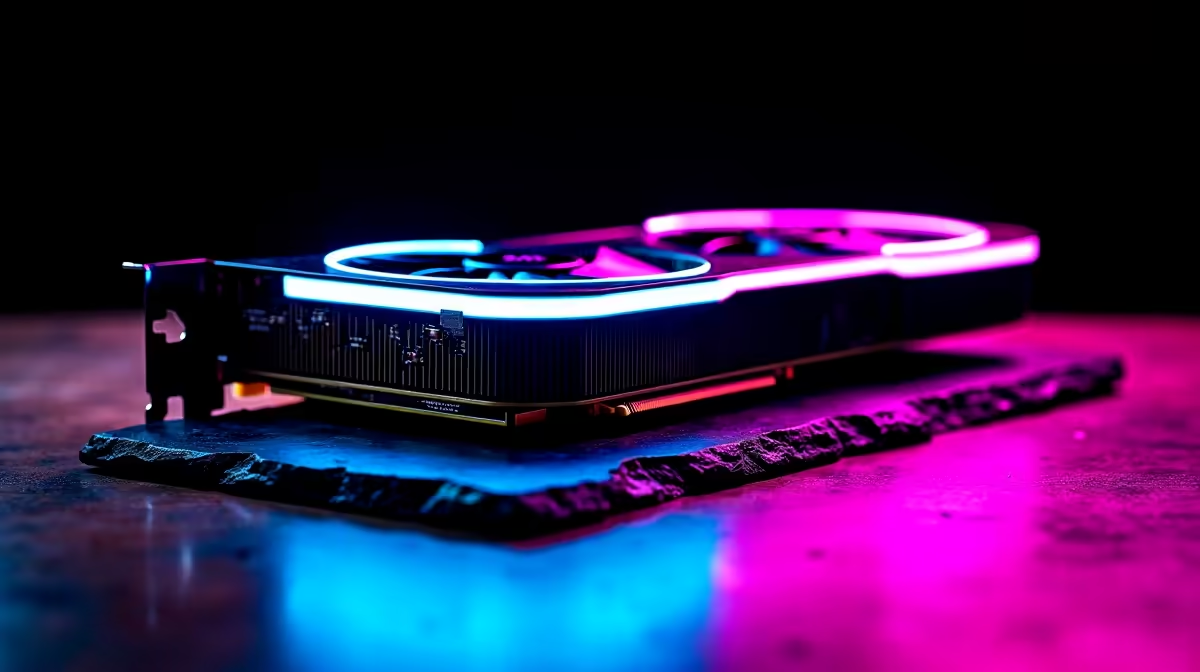
Staring at those jaw-dropping Cyberpunk 2077 path tracing videos? Or maybe the hyper-realistic lighting in Alan Wake 2? That’s the magic of ray tracing, and it’s the future of gaming. But let's be real, running it smoothly in South Africa requires some serious silicon. If you’re planning your next big rig, you’re probably wondering: what will be the best GPU for ray tracing in 2026? Let's look ahead. 🇿🇦
What Really Powers Next-Gen Ray Tracing?
Before we speculate on future champions, it’s crucial to understand what makes a graphics card excel at ray tracing. It's not just about raw power; it's about smart, specialised hardware.
Modern GPUs have dedicated cores—NVIDIA calls them RT Cores, and AMD has Ray Accelerators—built specifically to calculate the complex physics of light. The more powerful and efficient these cores are, the better your performance.
But the hardware is only half the story. AI-powered upscaling technologies like NVIDIA's DLSS, AMD's FSR, and Intel's XeSS are essential. They render your game at a lower resolution and then intelligently upscale it, giving you a massive frame rate boost. Without them, even the most powerful cards would struggle to deliver smooth, high-resolution ray-traced visuals. The ongoing innovation in this space is just as important as the silicon itself.
Predicting the 2026 Ray Tracing Heavyweights
While we don't have a crystal ball, we can make some educated predictions based on current technology and industry trends. The battle for the best GPU for ray tracing 2026 will likely be fought between the usual titans, with a potential dark horse in the race.
Team Green: NVIDIA's Throne to Lose?
NVIDIA has historically been the leader in ray tracing performance, and it's easy to see why. Their RT Cores are mature, and their DLSS technology, especially with recent additions like Ray Reconstruction, is phenomenal. For the future, expect their next-gen architectures (beyond the current Ada Lovelace series) to push efficiency and AI performance even further. We anticipate smarter RT Cores that handle more complex light bounces with less of a performance hit, solidifying their position for those seeking the ultimate visual fidelity from their NVIDIA GeForce graphics cards. For gamers who refuse to compromise, their future top-tier cards will likely continue to be the benchmark.
Team Red: Can AMD's RDNA Architecture Catch Up?
AMD has made incredible strides. Their recent AMD Radeon graphics cards offer fantastic rasterisation performance for the price, making them a popular choice in South Africa. While their ray tracing is good, it has typically lagged slightly behind NVIDIA's top offerings. For 2026, we expect AMD to double down on their Ray Accelerators and FSR technology. If they can close the hardware gap and enhance their AI upscaling, they could offer some of the best value options for a top-tier ray tracing experience.
Team Blue: The Intel Arc Wildcard?
Don't count Intel out. While they are the newcomer, their Alchemist and Battlemage architectures have shown promise. The strength of Intel Arc graphics cards lies in their forward-looking feature set and aggressive pricing. Their XeSS upscaling is impressive, and if they can scale up their hardware-accelerated ray tracing capabilities, they could become the go-to choice for budget-conscious builders looking for a great ray tracing GPU by 2026. ✨
PSU Check! ⚡
Before you even think about upgrading to a power-hungry, next-gen GPU, check your Power Supply Unit (PSU). Future high-end cards will likely be demanding. A good rule of thumb is to aim for a high-quality, 80+ Gold rated PSU with at least 850W-1000W to give yourself enough headroom. It's the foundation of a stable gaming rig!
Beyond Gaming: Ray Tracing for SA Creatives
Ray tracing isn't just for making games look pretty. For South African 3D artists, architects, and video editors, it's a productivity powerhouse. Technologies like NVIDIA's CUDA and OptiX accelerate rendering in applications like Blender, V-Ray, and DaVinci Resolve, cutting down project times dramatically. If your PC is for both work and play, investing in professional workstation GPUs with robust driver support and massive VRAM pools can be a wise decision. These cards are optimised for stability and performance in creative workloads.
Budgeting for Your 2026 Upgrade 🚀
So, what does this mean for your wallet? Predicting exact prices is tricky, but we can expect the trend of high-end GPUs being a significant investment to continue. The best graphics card for ray tracing will likely carry a premium price tag. For those looking at the absolute best performance, exploring premium graphics cards will be the starting point.
However, the most exciting developments often happen in the mid-range. By 2026, the performance of today's high-end cards (like the RTX 4080 or 4090) could become available at a much more accessible price point. When you're ready to make a move, be sure to search for your next GPU to compare the latest models and find the perfect balance of price and performance for your needs. Keep an eye on VRAM—16GB should be considered a healthy minimum for high-resolution, ray-traced gaming in the near future. For those with a bigger budget, the very best high-end NVIDIA options will always be available for peak performance.
Ready for a Visual Upgrade?
The world of ray tracing is moving fast, but getting the right hardware is key to enjoying it. Whether you're planning for 2026 or upgrading today, Evetech has the perfect GPU for your rig. Explore our massive range of graphics cards and light up your gaming world.