Quick Answer
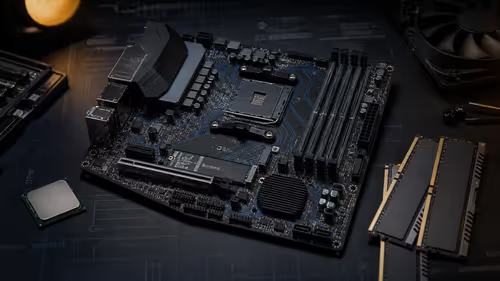
The Ryzen 7 7800X3D paired with 16GB DDR4 at 3600MHz is a capable gaming setup, but DDR4 on this platform introduces a compatibility nuance: the 7800X3D sits on AM5 which natively uses DDR5. Running DDR4 is not possible on AM5 boards, meaning this configuration likely refers to a DDR5-6000 kit being compared or a prior DDR4 platform being evaluated. For AM5, DDR5-6000 CL30 is the optimal pairing for the 7800X3D in 2026.
Ryzen 7 7800X3D and Memory: The Real Performance Picture
The Ryzen 7 7800X3D is AMD's most gaming-optimized CPU, using 3D V-Cache technology to stack 96MB of L3 cache directly onto the processor die. This massive on-chip cache reduces the frequency at which the CPU needs to reach out to system RAM, which changes the memory sensitivity equation compared to standard Ryzen 7000 chips. Because the 7800X3D's 3D V-Cache serves as a large buffer between the CPU cores and main memory, it is less sensitive to raw memory speed increases than the standard 7700X. Gaming tests consistently show that the 7800X3D achieves near-peak performance at DDR5-6000, with diminishing returns above that threshold. This is good news for budget-conscious SA builders who do not need to chase expensive high-frequency DDR5 kits to unlock the chip's gaming potential. For a 2026 build around the 7800X3D, DDR5-6000 CL30 32GB is the recommended memory configuration. It sits in the 1:1 FCLK sweet spot, delivers excellent latency characteristics, and costs less than DDR5-7200 or DDR5-8000 kits that add almost nothing to gaming frame rates on this particular CPU. ## Optimal Memory Configuration for the 7800X3D
To get the best performance from a 7800X3D memory pairing, enable your kit's EXPO profile in BIOS immediately after building. Most DDR5 boards ship with memory running at JEDEC base speeds until you manually enable the XMP or EXPO profile. With a DDR5-6000 kit and EXPO enabled, the CPU's FCLK runs at 2000 MHz in a 1:1 ratio with the memory controller. This is the optimal operating point. Going above DDR5-6000 typically pushes FCLK into a 2:1 divider at DDR5-6400 or higher, which increases latency and can actually reduce gaming performance on the 7800X3D relative to a well-configured DDR5-6000 setup. Timings matter alongside frequency. A DDR5-6000 CL30 kit outperforms DDR5-6400 CL36 in latency-sensitive gaming scenarios. When choosing between kits in South Africa, compare the CAS latency alongside the speed rating. Tighter timings at the same frequency generally win. ## Gaming Performance Impact in 2026
With a DDR5-6000 CL30 kit, the 7800X3D delivers near-maximum gaming performance in virtually every tested title. The 3D V-Cache architecture means that games hitting the cache regularly, which includes open-world titles, RPGs, and strategy games with complex AI, see massive performance benefits from this chip regardless of whether memory is running at 6000 or 7200 MT/s. FPS-focused titles like CS2, Valorant, and Rainbow Six Siege benefit enormously from the 7800X3D's low-latency cache architecture. In these titles, the CPU can output extremely high frame rates that stress fast monitors, and the memory configuration has a measurable but modest impact compared to the V-Cache's fundamental contribution. For SA gamers running a 1440p setup with a GPU in the RTX 4070 to RTX 4080 tier, the 7800X3D with DDR5-6000 is a complete gaming platform that will not require CPU or memory upgrades for several years. ## Frequently Asked Questions
Does the Ryzen 7 7800X3D benefit more from faster RAM than other CPUs?
Actually the opposite. The 7800X3D is less dependent on memory bandwidth due to its 3D V-Cache buffer. It performs near its peak at DDR5-6000, meaning you do not need to invest in premium DDR5-7200 or above kits to maximize it. Standard EXPO DDR5-6000 CL30 is the value-optimal choice. Is 16GB enough RAM for the Ryzen 7 7800X3D in 2026?
16GB is the functional minimum, but 32GB is the recommended configuration. Several modern games approach 16GB of system RAM usage at high settings, and the 7800X3D is often paired with powerful GPUs that drive you toward higher-fidelity game settings where RAM use increases. What is the best DDR5 kit for the Ryzen 7 7800X3D?
A quality DDR5-6000 CL30 32GB dual-rank kit is the benchmark recommendation. Dual-rank kits provide slightly better memory interleaving performance than single-rank alternatives at the same speed, which benefits the 7800X3D's memory subsystem. Can the 7800X3D run DDR5-7200 stably?
Some 7800X3D chips and AM5 boards support DDR5-7200 with manual tuning, but at that speed the FCLK runs in a 2:1 divider, which increases latency and partially offsets the bandwidth gain. Benchmark results consistently show DDR5-6000 1:1 outperforming DDR5-7200 2:1 in gaming on the 7800X3D.