Motherboard pricing is moving again in overseas channels. ASUS has already adjusted parts of its current AMD and Intel ranges, while wider industry reporting points to more pressure from printed circuit board materials during the third quarter of 2026. That matters to South African PC builders, but it is not proof that every local board is about to jump by the same percentage.
Quick Answer
Do not panic-buy a motherboard from an overseas price headline. A live Evetech snapshot on 6 August found current AMD and Intel boards from R3,149, including AM5 options from R3,499 and several B850 models below R4,000. Buy now when the processor, memory type and build date are fixed. Wait when you are still choosing the platform, because the wrong socket or RAM generation can waste more than a possible price increase.
What changed in the motherboard market
The latest movement is broader than a single flagship model. Current reporting describes price adjustments across AMD and Intel motherboard lineups, with ASUS already moving some channel prices and other large board makers expected to review pricing during Q3.
The pressure begins further up the manufacturing chain. A motherboard uses a multilayer printed circuit board, power-delivery components, networking controllers, audio hardware and a long list of smaller parts. When those inputs cost more, manufacturers and distributors may pass some of the increase down the chain.
One number needs careful handling: reports of PCB input costs rising by at least 50% do not mean a R4,000 motherboard automatically becomes R6,000. The board itself is only one part of the final retail cost, and actual product increases remain model- and market-dependent. Shipping, exchange rates, old inventory and local promotions can all change what reaches a South African shelf.
What the South African shelf looks like now
The 6 August catalogue read covered 20 active products in the direct Intel and AMD motherboard categories. The lowest checked board was an ASUS Prime B860M-K at R3,149. On the AMD side, an ASRock B850M Pro RS WiFi and an ASUS B650E Max Gaming WiFi both sat at R3,499.
The next band contained several useful AM5 choices between R3,699 and R3,999, followed by stronger networking, storage and power-delivery configurations from roughly R4,099 upward. An MSI X870 Gaming Plus WiFi appeared at R5,999 in the same snapshot.
These are current catalogue prices, not a forecast. Their value is that they give builders a real Rand baseline before an overseas movement is turned into a local assumption. Start with all motherboards, then narrow the list by the processor platform rather than brand alone.
Platform cost matters more than board price
A motherboard is not an isolated purchase. The socket decides which processors fit, while the memory standard can determine whether existing RAM carries over. Form factor affects the case, expansion slots and sometimes cooling clearance. A cheap board becomes an expensive mistake when any of those parts do not match.
For an AMD build, compare the full AMD motherboard range with the CPU and DDR5 kit you intend to use. AM4 can still make sense for a value-focused upgrade using compatible parts. AM5 is the more natural starting point for a new build when a longer platform path matters.
For Intel, use the Intel motherboard range to separate LGA 1851 boards from older sockets. A B860 board and a Z890 board can support the same processor family while serving very different needs. Pay for extra expansion, storage, networking or tuning features only when the build will use them.
A sensible buy-now or wait rule
Buy now when the PC is being assembled within the next one to three months, the exact processor is selected, and the current board meets the required ports and expansion needs at an acceptable total build cost. In that situation, delaying a compatible in-stock board for an assumed price drop adds risk without improving the specification.
Wait when the processor is still undecided, when you may move between AMD and Intel, or when the build is many months away. New firmware, refreshed products and changing bundle prices can matter more than today's board-only number. There is also no reason to replace a stable motherboard simply because a new pricing report exists.
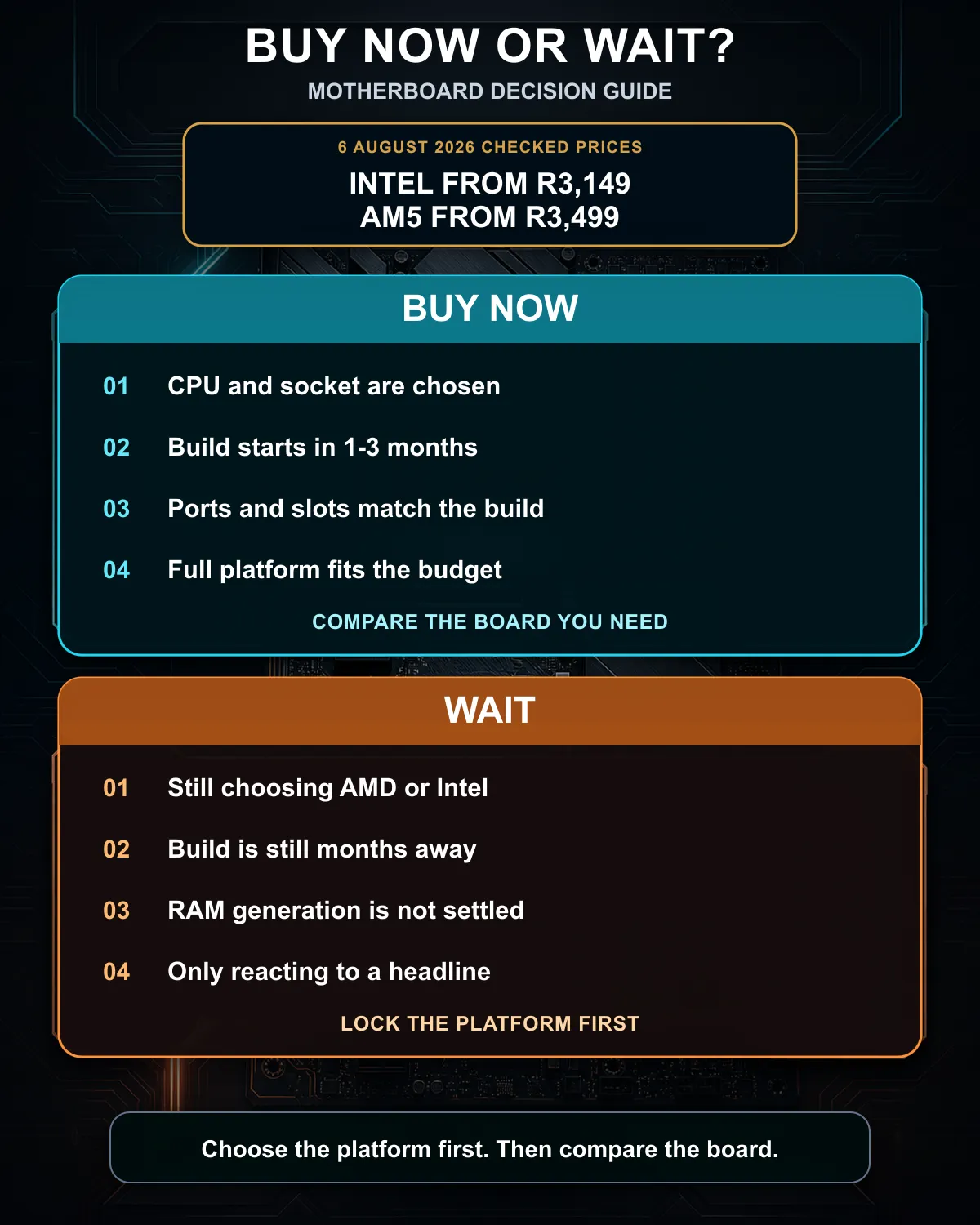
Before checkout, check four things: CPU socket, DDR4 or DDR5 support, case form factor and the number of storage slots you actually need. Then look at Wi-Fi, Ethernet speed, rear USB and front-panel headers. This order keeps a headline from pushing the build toward features that do not improve it.
Frequently Asked Questions
Have South African motherboard prices already increased?
No matching local increase is established. The live snapshot records current prices so buyers have a baseline if the market changes.
What was the cheapest motherboard checked?
An ASUS Prime B860M-K was active at R3,149 on 6 August 2026.
What did an entry AM5 board cost?
The checked AMD range included B850 and B650E motherboards from R3,499.
Does a 50% PCB increase mean a 50% motherboard increase?
No. PCB input cost is not the full retail price, and the final board adjustments remain dependent on model and market.
Should I buy a motherboard before choosing the CPU?
No. Choose the processor platform first, then match the socket, memory type and required features.
Planning a new PC build?
Compare current AMD and Intel motherboards at Evetech, lock the correct socket and memory type, and judge the board by the full platform cost.