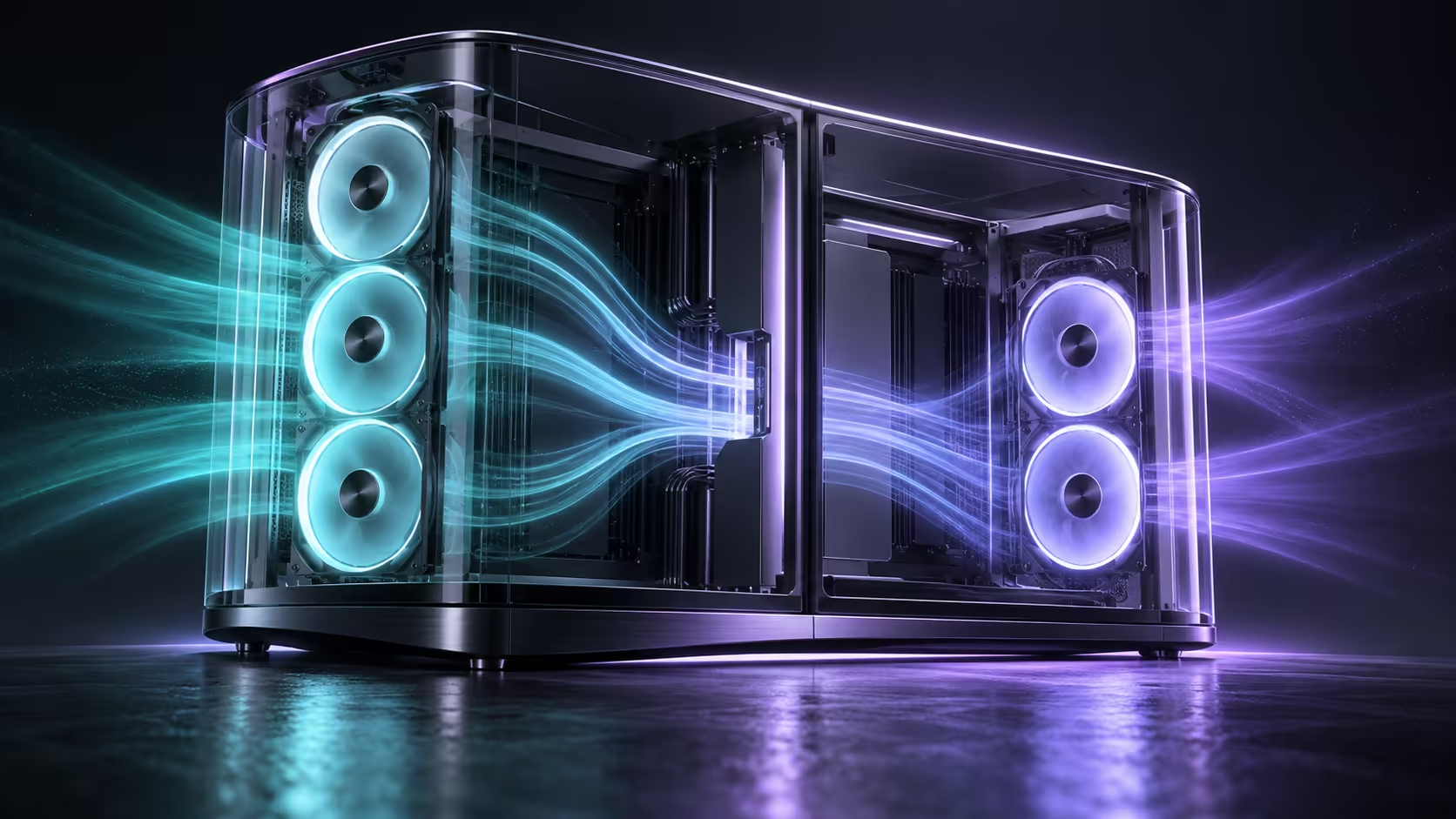
Curved glass changes what you see through a case; it does not decide whether your parts fit inside it. Thermaltake Arcus 380 puts the hardware on display, so it rewards planning the cooler, graphics card and cable route before choosing the final lighting arrangement.
Quick Answer
The current release describes a dual-chamber chassis with five supplied 120 mm fans, a 430 mm graphics-card allowance and 160 mm CPU-cooler height. Check those limits against the assembled components. On 28 October, a separate GAMDIAS Aura GC2 Elite White case was R499 in the catalogue; that is a different chassis, not an Arcus price.
🪟 Make the glass view work for your build
The one-piece curved panel wraps the front and side, while the second chamber gives cables a separate area. That can produce a clean display of the main hardware, but it is still a practical enclosure. Think about the desk position, access to the connections and whether you can reach the machine comfortably for routine cleaning.
Black and Snow versions appear in the manufacturer's catalogue. Choose the finish after deciding where the case will sit and which hardware you already own. A colour change does not solve a cooler that is too tall or a cable route that presses against a panel. Browse all cases with a short component list instead of comparing exterior photos alone.
🌬️ Start with the supplied airflow layout
Thermaltake's distributed release identifies three reverse-blade side intake fans and two rear exhaust fans. They are part of a supplied layout, not five unassigned fans you must position from scratch. Check the airflow directions before adding more hardware, particularly when the visible face of a reverse-blade fan differs from what you expect.
The release also lists additional fan positions and top radiator support. A maximum fan count does not mean every build needs to fill every mount. Plan cooling around the processor and graphics card you use, then consider noise and access. Adding hardware for appearance can make a compact working space more complicated without answering the original thermal requirement.
📐 Compare usable clearances
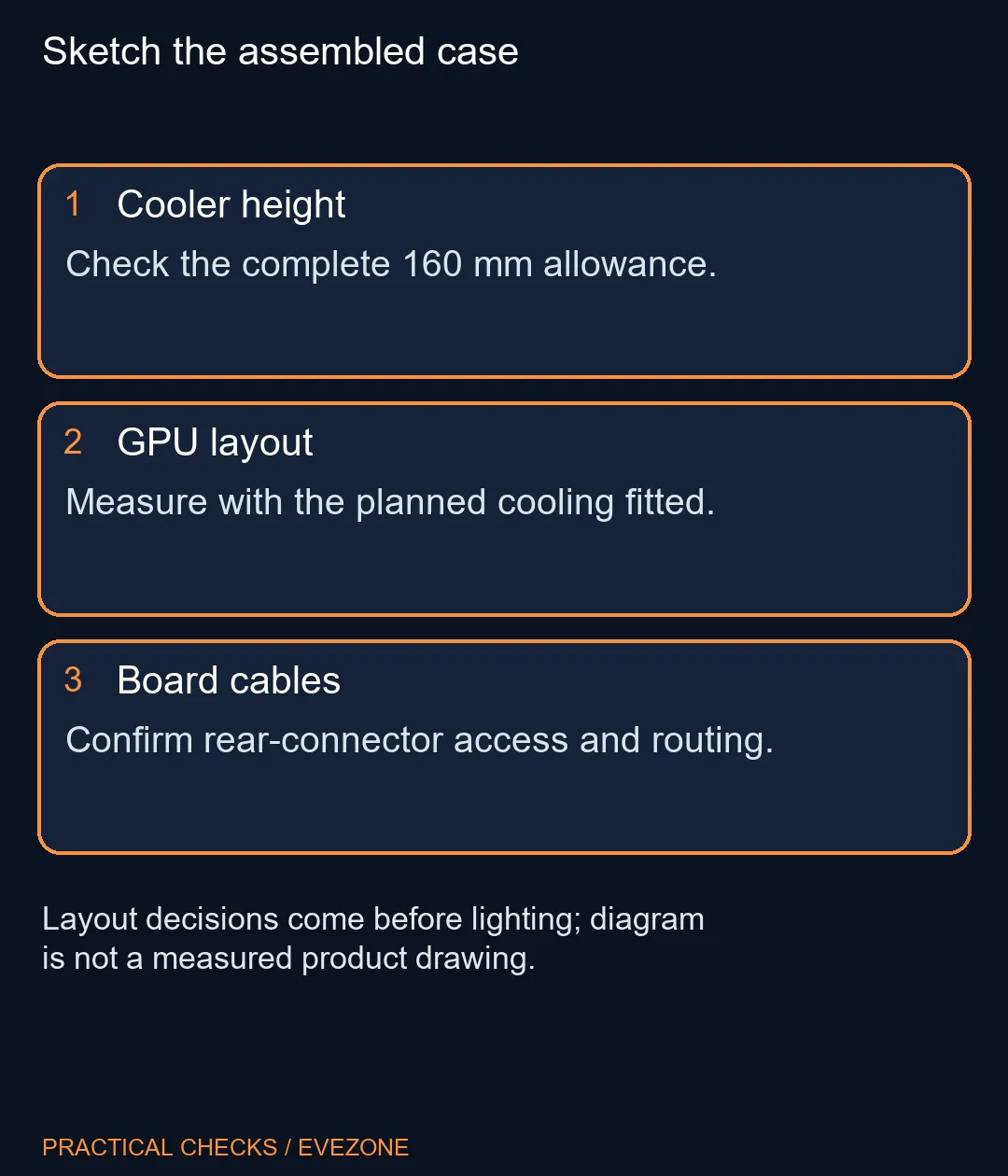
A160 mm CPU-cooler limit deserves careful attention. Check the full height of the cooler as installed, including the position of its fan. If memory clearance forces that fan upwards, the assembled height can differ from the cooler's most favourable diagram. Measure the complete arrangement before committing to a glass-sided layout.
Likewise, the 430 mm graphics-card allowance is a planning limit, not permission to ignore other installed parts. Consider the card support, power leads and any cooling hardware that shares the space. The included support bracket can help support a large card, but its presence does not prove every possible graphics card and cable combination fits without adjustment.
🧷 Match the board and the budget
The chassis supports conventional motherboard layouts as well as specified back-connect formats. Back-connect compatibility matters only when the exact board's rear sockets can be reached through the tray openings. Compare all motherboards by the complete model and connector layout, not just theATX label. Keep the assembly instructions available while planning the wiring order.
This 27 October release follows earlier public show appearances, so the buying information is the current layout detail rather than a claim of first-ever disclosure. There is no confirmed Rand price here. TheR499 local example shows why a budget comparison must separate a basic chassis from the specific curved-glass design. Include cooling and power requirements in the total build cost before deciding how much of the budget belongs to presentation.
Frequently Asked Questions
How many fans are supplied?
The release specifies five 120 mm Infinity ARGB PWM fans: three side intakes and two rear exhausts.
Is this only for back-connect boards?
No. The release lists conventional Mini-ITX,microATX and ATX support alongside back-connect microATX and ATX boards.
What CPU cooler height is listed?
The stated limit is 160 mm. Check the complete installed cooler, including any raised fan.
What is the GPU length allowance?
The release lists up to 430 mm. Check the actual layout and installed cooling before relying on that maximum.
Does it include a power supply?
The cited release describes a chassis and supplied fans. It does not establish an included PSU bundle.
Is the R499 case the Arcus 380?
No. That is a separate GAMDIAS Aura GC2 Elite White catalogue reference, not the new Thermaltake case.
Building around a showcase chassis?
Compare Evetech cases using the cooler, graphics-card and motherboard layout you intend to install.