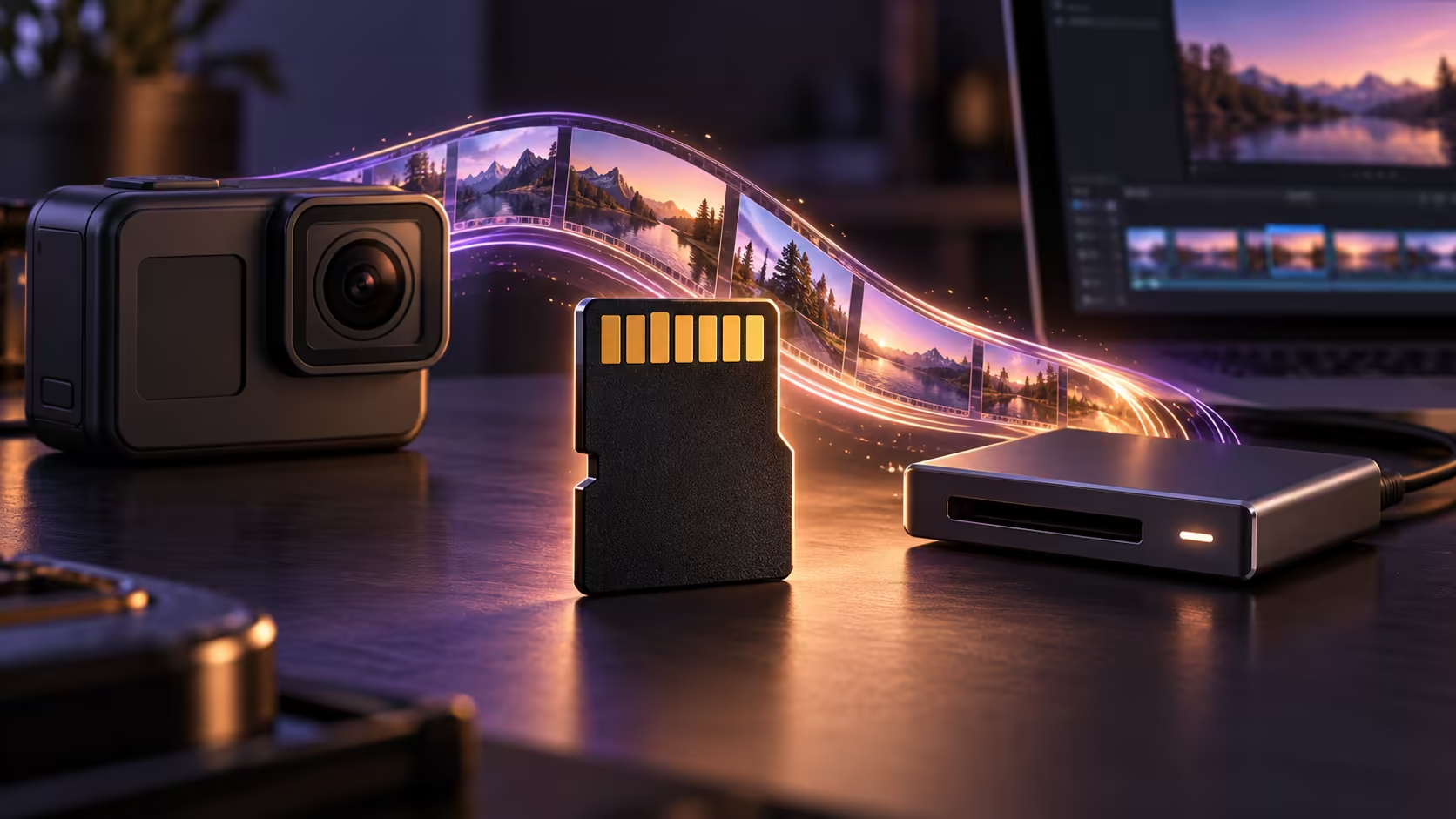
A recording stopping halfway through a clip is a poor moment to discover that two speed labels describe different things. TEAMGROUP ACE 8K has a new 27 October recording update, and the useful part is the qualification attached to its highest-resolution claim.
Quick Answer
Match the camera's exact recording mode to the card's sustained-write requirement. TEAMGROUP states V30, a 30MB/s minimum rating, and conditional 8K compatibility. For local storage context, a Dahua V800256GB SATA SSD was R1,199 on 27 October; that drive is not a camera-slot substitute or a price for this memory card.
🎥 Begin with the codec, not the product name
The new update discusses 4K120fps and 8K applications, but it says the 8K claim applies where write-speed requirements are compatible. That matters because a resolution label does not describe every recording format a camera offers. Open the device's card guidance and identify the mode you actually intend to use, including its frame rate and compression setting.
If your device requires a different speed class or card interface for that mode, an 8K name on the packaging cannot override the requirement. Keep that question separate from whether the card physically fits. A successful short recording in a less demanding mode is useful, but it does not prove that a longer session in a higher-bitrate mode will behave identically.
💾 Read minimum and maximum speeds differently
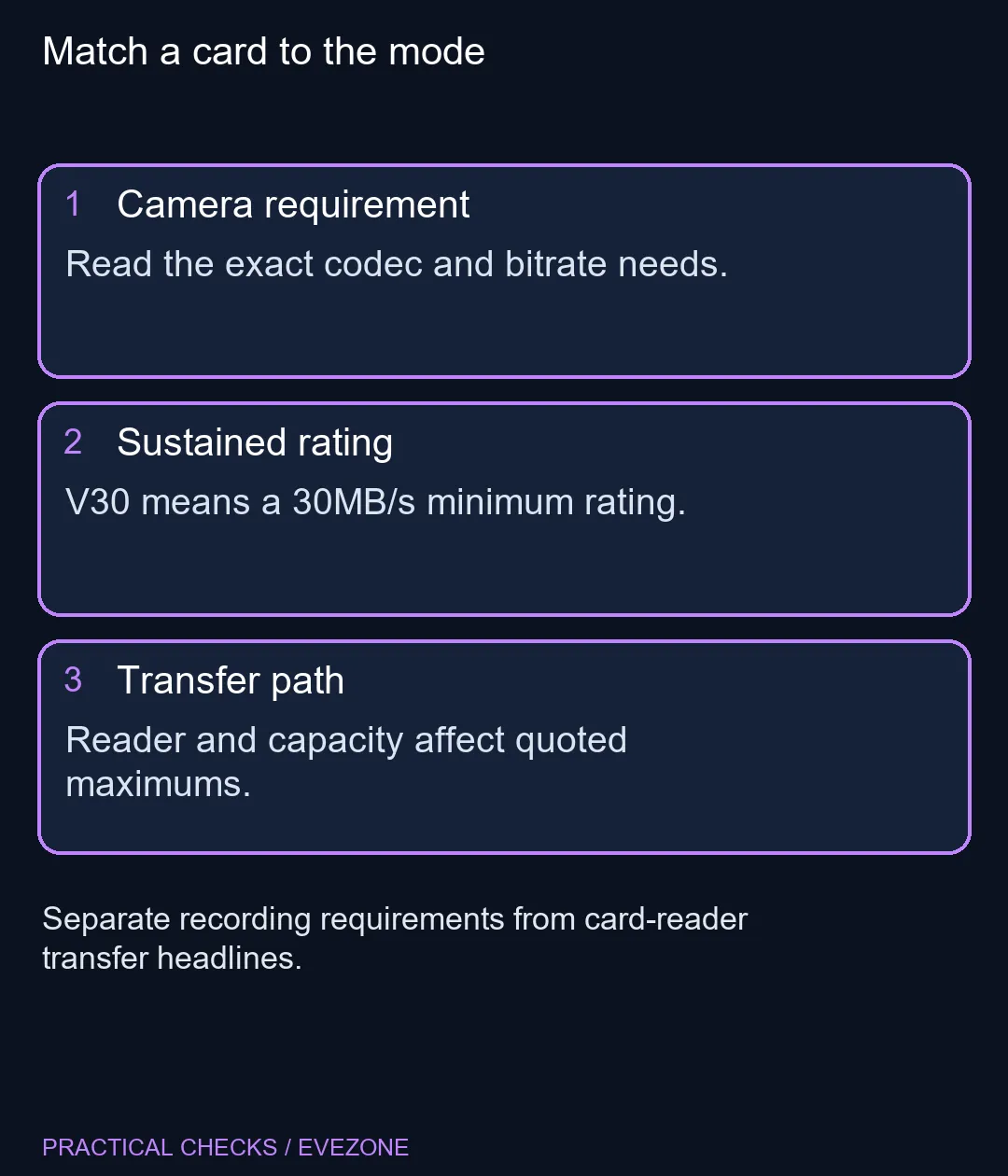
V30 is the minimum sustained-write rating stated in the update. The up-to 160MB/s read and 110MB/s write figures are maximum transfer claims under the manufacturer's conditions. They are not interchangeable with the minimum rating, and the read maximum does not establish how quickly the camera can keep writing new frames.
There is also a capacity distinction. The product specification lists up-to 90MB/s writes for 128GB, while 256GB through 1TB reach up-to 110MB/s with a professional reader. Ordinary UHS-I figures are lower. Match the row for the actual capacity and the actual reader instead of assigning the headline number to every combination. A suitable desktop transfer path helps after the shoot, but it does not change the camera's own slot requirements.
🗂️ Budget for the footage after capture
Our dated R1,199 example is an internal SATA SSD. It illustrates that the cost of storing copied footage is a different decision from choosing a tiny recording card. You cannot insert that drive into a microSD slot. Browse internal ssds for internal storage planning and external ssds when portable storage is the better fit for the files you will move between machines.
Think through how the footage will be copied and checked before reusing the card. One working copy is an uncomfortable place to be when a clip matters. Keep the original until the transferred files have been checked and the backup arrangement is in place. Buying a larger card can reduce how often you change media; it does not make that checking process unnecessary.
🔎 Treat compatibility tests as scoped evidence
TEAMGROUP says it tested the card with named imaging devices, and its footnote says results can vary with device model, firmware and settings. That is a manufacturer test claim, not a universal certification from every camera maker. Check the precise camera and firmware you own, and run a representative recording before relying on a new card for an important session.
The card has earlier July and September announcements. Today's milestone is the 27 October recording update and its early-November overseas rollout wording, rather than a first disclosure of the name. No verified South African card price is supplied here. Use the recording requirement to narrow the choice first, then compare an actual local offer without converting a regional headline into a promised SA launch.
Frequently Asked Questions
Does the 8K name guarantee every 8K camera mode?
No. The manufacturer explicitly limits the claim to recording applications with compatible write-speed requirements.
What does V30 mean here?
The update states a minimum sustained write speed of 30MB/s for the V30 rating.
Does every capacity reach 110MB/s write?
No. The 128GB table lists up to 90MB/s;256GB through 1TB list up to 110MB/s with a professional reader.
Will any reader deliver 160MB/s?
The quoted read maximum uses a professional reader. The product page lists lower figures for ordinary UHS-I operation.
Can a SATA SSD replace the card in a camera slot?
No. An internal SATA SSD is a different device and interface, even if its capacity or price looks attractive.
Is early November an SA availability promise?
No. The announcement names initial overseas markets, without confirming a South African offer.
Planning a recording and backup setup?
Choose compatible capture media first, then compare Evetech storage options for the copied footage.