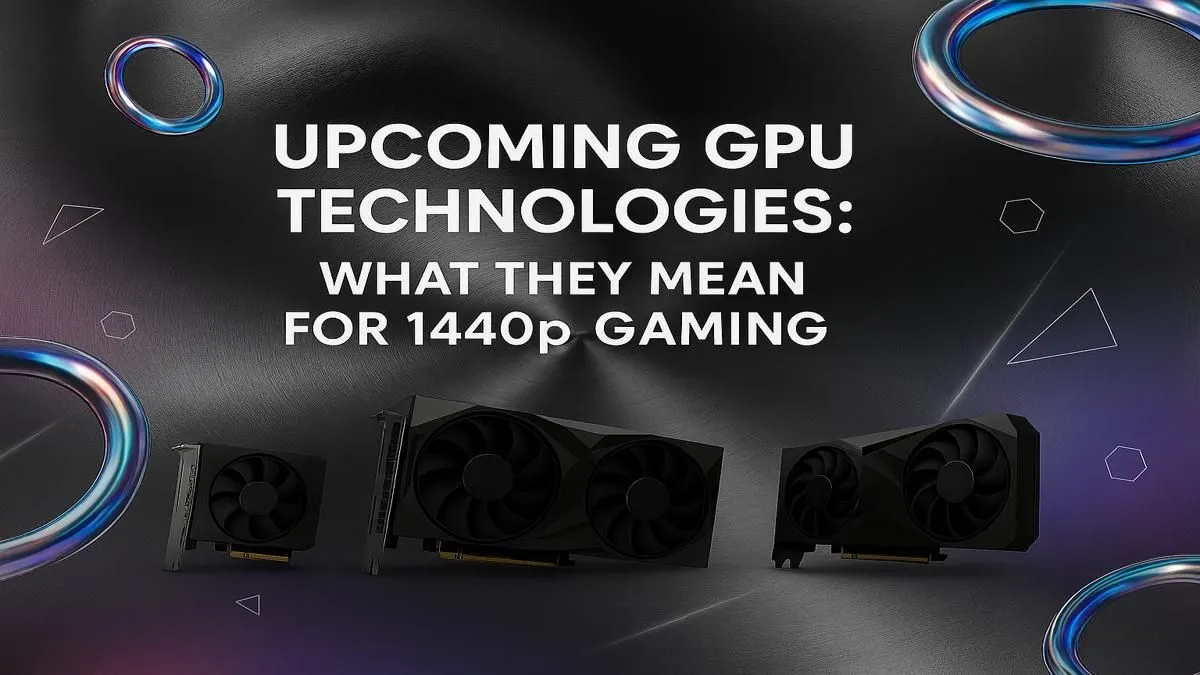
Staring at your screen, you know 1080p just doesn’t cut it anymore. For South African gamers, 1440p is the new sweet spot—that perfect blend of sharp visuals and buttery-smooth frame rates. But the goalposts are always moving. The next wave of GPUs is on the horizon, promising to redefine what’s possible. Understanding these upcoming GPU technologies isn’t just for enthusiasts; it’s about future-proofing your rig and ensuring your ZAR goes further.
AI Upscaling: The Key to High-FPS Gaming 🚀
The single biggest factor shaping the future of 1440p gaming is Artificial Intelligence. Technologies like NVIDIA’s DLSS, AMD’s FSR, and Intel’s XeSS are no longer just optional extras; they're essential. These smart upscaling tools render your game at a lower resolution and then use AI to intelligently reconstruct the image to a pristine 1440p.
The result? You get a massive performance boost, allowing you to crank up settings like ray tracing without turning your game into a slideshow. It's the magic that lets a mid-range card punch well above its weight, a trend we're seeing across the board, including with Intel's own Arc graphics cards and their impressive XeSS technology.
Beyond Ray Tracing: The Dawn of Path Tracing
If ray tracing simulates how a few important light rays bounce around a scene, path tracing simulates… well, all of them. It's the next leap towards photorealism, creating incredibly lifelike lighting, shadows, and reflections that are indistinguishable from reality. We saw a glimpse of this in titles like Cyberpunk 2077's Overdrive Mode.
This level of simulation is immensely demanding and will require a significant jump in processing power. Even today's powerful graphics cards are pushed to their limits by it. The upcoming GPU technologies are being built with path tracing in mind, combining raw power with even smarter AI denoising and upscaling to make it playable at 1440p.
Check Your VRAM! 🔧
For 1440p gaming, 8GB of VRAM is the absolute minimum today. But with next-gen textures and technologies, 12GB or even 16GB is becoming the safer bet for future-proofing. When you're browsing for a new card, keep a close eye on the VRAM—it's your GPU's short-term memory for loading all those beautiful, high-resolution assets.
Smarter Architectures and Memory Systems
It’s not all about fancy lighting. The core architecture of GPUs is evolving rapidly. We're seeing bigger and faster on-chip caches, like the Infinity Cache found on the latest AMD Radeon GPUs, which drastically speeds up access to frequently used data.
This reduces the reliance on slower video memory (VRAM), cutting down latency and boosting frame rates. Expect future GPUs from all major players to feature more sophisticated memory subsystems, ensuring the processing cores are never left waiting for data. This is how the future of 1440p gaming will deliver consistent, stutter-free performance.
What This Means for Your Next PC Build ✨
So, how do you prepare for this new era?
- Prioritise AI: Your next GPU absolutely must have strong AI upscaling capabilities. It’s the most important feature for maximising performance at 1440p.
- Don't Skimp on VRAM: As mentioned, 12GB+ is the smart play for longevity.
- Look at the Whole Package: Don't just focus on raw power. Architectural improvements and smart features are what truly define a next-gen experience. While legendary older generations like the GeForce GTX series were fantastic for their time, the new AI-driven approach is a massive leap.
Many of these consumer-level advancements are born from innovations first tested in hugely powerful professional workstation graphics cards, where performance and accuracy are paramount. The future is bright, and it's coming faster than you think.
Ready to Build for the Future?
The next wave of gaming is almost here. To truly harness these upcoming GPU technologies, you need a balanced rig built for performance. Use our Custom PC Builder to configure the perfect 1440p machine and stay ahead of the curve.