Stuttering frames in the middle of a clutch play in Apex? Your brand-new graphics card struggling to deliver smooth performance in Helldivers 2? It’s a classic Mzansi gamer frustration. Before you blame lag or your GPU, the real culprit might be a sneaky performance thief: the CPU bottleneck. This guide will help you diagnose and fix the CPU bottleneck holding your rig back, getting you back to buttery-smooth frame rates. Let's get your PC sorted. 🚀
What a CPU Bottleneck Feels Like
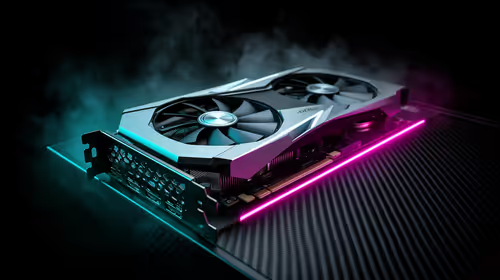
Imagine your powerful graphics card is a Formula 1 car, ready to tear up the track. Your CPU is the pit crew. If the crew is slow, it doesn't matter how fast the car is... it’s going to be stuck waiting for instructions. That’s a CPU bottleneck in a nutshell. Your GPU can render frames faster than your CPU can prepare them, leading to stuttering, inconsistent frame rates, and a gaming experience that feels... off.
This issue is especially common when you pair a new, high-end GPU with an older processor, or when playing CPU-intensive games like strategy titles or competitive shooters at lower resolutions where frame rates are sky-high.
Pinpointing the Problem 🔧
Guessing isn't good enough. You need data to confirm a CPU bottleneck is your issue. Luckily, it's easy to check.
The simplest way is using Windows Task Manager. While your game is running, press Ctrl+Shift+Esc and go to the "Performance" tab. If you see your CPU usage consistently hitting 95-100% while your GPU usage is sitting much lower (say, below 90%), you've likely found your bottleneck.
For a more detailed view, tools like MSI Afterburner with RivaTuner Statistics Server can show you these stats as an in-game overlay. This gives you a real-time look at how your components are performing during intense gameplay, making it easier to spot the performance gap.
Your Guide to Fixing a CPU Bottleneck
Once you've confirmed a CPU bottleneck, it's time for action. You can either try to work around it with software tweaks or solve it for good with a hardware upgrade.
First, Try the Free Fixes
Before spending any ZAR, try these software-level adjustments:
- Close Background Apps: Shut down Discord, browser tabs, and other non-essential programs while gaming.
- Increase Resolution: This sounds counterintuitive, but running your game at a higher resolution (e.g., 1440p instead of 1080p) puts more load on the GPU, which can help balance the system and reduce the bottleneck.
- Tweak In-Game Settings: Lower CPU-heavy settings like "object detail," "physics quality," or "view distance."
The Ultimate Fix: A Processor Upgrade
While software tweaks can help, the most effective, long-term solution for a severe CPU bottleneck is upgrading your processor. A new CPU will provide the headroom your GPU needs to perform at its peak.
Choosing the right one is crucial. You'll want a processor that complements your graphics card and gaming goals. For most South African gamers, a modern 6-core or 8-core CPU is the sweet spot for performance and value. When you're ready to explore your options, browsing the wide range of available CPUs is the best place to start. Whether you're looking at the latest Intel Core processors known for their raw gaming speed, or considering AMD's powerful Ryzen lineup which offers incredible multi-core performance, the right chip will completely revitalise your gaming experience.
Upgrade Pro Tip ⚡
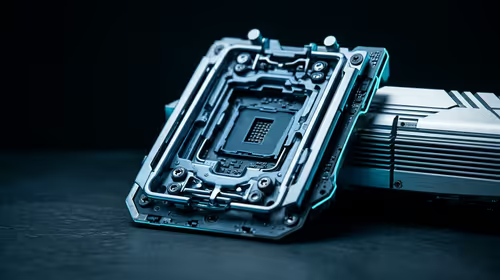
Before you buy a new CPU, always double-check your motherboard's compatibility! Look up your motherboard model online and find its "CPU Support List." This ensures the new processor will physically fit the socket (e.g., LGA 1700 for Intel, AM5 for AMD) and be supported by the motherboard's chipset and BIOS. It's a quick check that can save you a massive headache.
A balanced PC is a happy PC. By fixing your CPU bottleneck, you unlock the full potential of the components you already paid for, ensuring every rand spent on your rig translates into pure performance. ✨
Ready to Build a Balanced Rig? A CPU bottleneck can cripple even the most expensive GPU. Don't let your processor hold you back. A balanced system is key to smooth, high-frame-rate gaming. Explore our massive range of PC components and find the perfect parts to build a rig that's ready for anything.