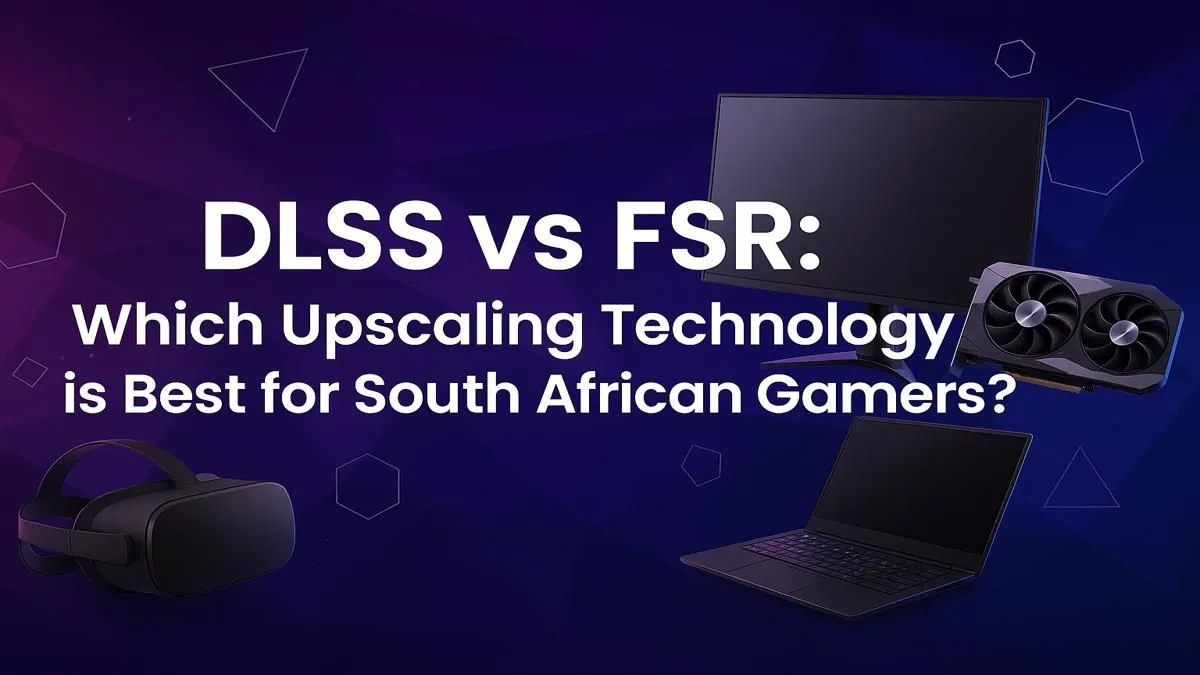
Staring at a stuttering frame rate in the middle of a tense firefight? We've all been there. In South Africa, getting smooth, high-FPS gaming without selling a kidney for a new GPU is the dream. That's where upscaling tech comes in, and the biggest battle is DLSS vs FSR. This isn't just a technical debate; it's about getting the most bang for your buck right here in SA. So, which one should you back? 🚀
Understanding Upscaling: DLSS vs FSR Explained
Before we declare a winner in the DLSS vs FSR South Africa showdown, let's quickly break down what these acronyms actually mean. Think of them as clever tricks your graphics card uses to give you more frames per second (FPS) without a massive drop in visual quality.
- NVIDIA DLSS (Deep Learning Super Sampling): This is Team Green's secret sauce. It uses Artificial Intelligence and dedicated Tensor Core hardware inside RTX GPUs to render your game at a lower resolution and then intelligently upscale it to your monitor's native resolution. It reconstructs the image to look as good as, and sometimes even better than, the original.
- AMD FSR (FidelityFX Super Resolution): This is Team Red's answer, and its biggest strength is that it's open-source. It doesn't rely on special AI hardware. Instead, it uses an advanced spatial upscaling algorithm to boost performance. The best part? It works on a huge range of GPUs, not just AMD's.
The core idea for both is simple: less work for your GPU means more FPS for you.
The Showdown: Image Quality and Performance
When you're deciding between FSR and DLSS, it often comes down to two things: how good does it look, and how fast does it run?
Visual Fidelity: Who Renders it Best?
Generally speaking, DLSS takes the crown for a sharper, more detailed image. Because it's powered by a trained AI model, it's exceptionally good at reconstructing fine details, like text on a sign or the texture of a distant wall. The latest versions, like DLSS 3 with Frame Generation, push this even further.
FSR, especially the newer FSR 2.0 and beyond, has closed the gap significantly. It produces a fantastic image that is often hard to distinguish from native resolution in the heat of the moment. However, in a side-by-side comparison, it can sometimes appear slightly softer than its DLSS counterpart. For gamers looking for the absolute pinnacle of visual quality from upscaling, the technology packed into the latest NVIDIA GeForce graphics cards often has the edge. ✨
The FPS Boost: Raw Power Gains
Here, the competition is fierce. Both DLSS and FSR can provide massive performance uplifts, sometimes doubling your frame rate or more. This allows you to enable demanding features like ray tracing or play at higher resolutions (like 1440p or 4K) on a mid-range card. The exact FPS gain depends heavily on the game, your settings, and the performance mode you choose (e.g., Quality, Balanced, Performance).
The winner here is... you! Both technologies deliver on their promise of more frames, making high-refresh-rate gaming more accessible than ever.
Hardware Compatibility: The Deal-Breaker 🔧
This is arguably the most important factor in the DLSS vs FSR South Africa debate, especially when budgets are tight.
- DLSS is exclusive: You need an NVIDIA GeForce RTX 20-series card or newer to use it. If you don't have one, DLSS isn't an option.
- FSR is for everyone: This is AMD's trump card. FSR works on a massive range of GPUs, including older NVIDIA (GTX 10-series and up) and Intel cards. This makes it an incredible tool for breathing new life into an older gaming rig. If you're building a new PC and value flexibility, checking out the latest AMD Radeon graphics cards is a smart move.
Check Game Support First! ⚡
Before you buy a GPU for a specific feature, always check the official support list for your favourite games. A game must be developed to support DLSS or FSR for the feature to be available in the graphics settings. Sites like PCGamingWiki are a great resource for checking compatibility.
The Verdict: Which Upscaler Wins in SA?
So, who wins the DLSS vs FSR battle for South African gamers? The answer isn't about which tech is "better" in a vacuum, but which is better for you.
Choose DLSS if:
- You are buying a new NVIDIA RTX card anyway.
- You demand the absolute best image quality possible from upscaling.
- Your favourite games have excellent DLSS support.
Choose FSR if:
- You're on a tighter budget or upgrading an older PC.
- You value flexibility and want a feature that works on almost any modern GPU.
- You own an AMD GPU and want to maximise its potential.
Ultimately, both technologies are fantastic wins for gamers. They allow us to push our hardware further and enjoy smoother gameplay, which is what it's all about. The key is to find the right balance of price and performance that fits your needs and budget, and there are always great graphics card deals to help you get there.
Ready to Boost Your FPS?
The DLSS vs FSR debate is about finding the right tool for your rig. Whether you're Team Green or Team Red, the perfect GPU is waiting. Explore our best graphics card deals and find the power to conquer your favourite games.