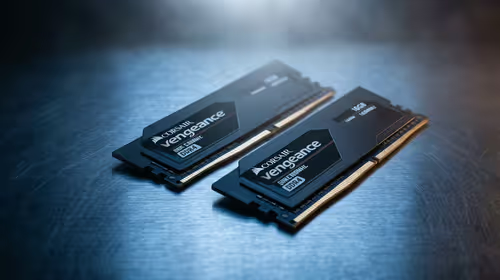
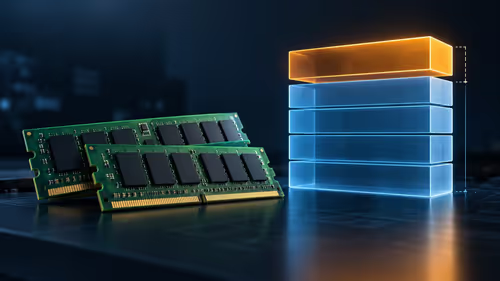
So, you’ve just dropped some hard-earned ZAR on a shiny new kit of Kingston Fury Renegade RAM. You slotted it into your motherboard, booted up, and admired the RGB glow. But here’s the catch... you’re probably not getting the speed you paid for. Don’t worry, this is a common oversight. That advertised performance isn't automatic; you need to tell your PC to use it. Let's unlock that power in just a few clicks. 🚀
What is Intel XMP 3.0 and Why Should You Care?
Think of Intel's Extreme Memory Profile (XMP) as a turbo button for your RAM. Your Kingston Fury Renegade memory comes with built-in, factory-tested overclocking settings. By default, your motherboard plays it safe and runs the RAM at a standard, slower speed. To get the blistering performance needed for high-refresh-rate gaming and demanding creative work, you need to enable Intel XMP 3.0.
Activating it tells your system to use the RAM's full potential, boosting data transfer rates significantly. This often translates to smoother frame rates in titles like Apex Legends or Warzone, and faster rendering times in apps like Adobe Premiere Pro. For modern systems, this is the key to getting the most from your cutting-edge DDR5 memory.
A Step-by-Step Guide to Enable Intel XMP 3.0 on Kingston Fury Renegade RAM
Ready to unleash the beast? The whole process happens in your PC's BIOS (or UEFI, the modern version) and takes less than two minutes. While the exact menu names can vary slightly between motherboard brands like ASUS, Gigabyte, and MSI, the steps are fundamentally the same.
- Restart Your PC and Enter the BIOS/UEFI: As your computer boots up, repeatedly press the
Delete or F2 key. This key can vary, so watch the screen for a prompt like "Press DEL to enter setup." - Find the XMP Setting: Once inside the BIOS, you might need to switch to "Advanced Mode" (often by pressing
F7). Look for a section related to overclocking, often labelled "Ai Tweaker," "OC Tweaker," "M.I.T.," or simply "Overclocking." Inside this menu, you should find the setting for XMP. - Activate the XMP Profile: The setting will likely be disabled by default. Click on it and you should see an option like "XMP Profile 1" or "EXPO 1" for AMD systems. Select it. This action is the core of how you enable Intel XMP 3.0 on your Kingston Fury Renegade RAM.
- Save and Exit: Press the
F10 key to save your changes and exit the BIOS. Your computer will restart, now with its memory running at full speed. It’s a testament to the reliable performance that Kingston's legacy of performance RAM is known for.
Verify Your Speed ⚡
After restarting, you can easily confirm the new speed. In Windows, press Ctrl+Shift+Esc to open Task Manager. Go to the "Performance" tab, click on "Memory," and check the "Speed" listed on the right. It should now match the advertised speed of your Kingston Fury Renegade kit!
What if My System Seems Unstable?
In rare cases, enabling XMP can cause instability if other components aren't up to the task. If your PC fails to boot or crashes, simply re-enter the BIOS and disable XMP. The most common culprit is an outdated BIOS, so check your motherboard manufacturer's website for an update. Ensuring you have a solid motherboard and power supply is key, especially when building a rig with a popular configuration like 16GB of DDR4 memory or more.
Is XMP Still Relevant for Older Systems?
Absolutely! While our focus here is on the latest XMP 3.0 for DDR5, the principle is identical for older standards. If you're running a system with DDR4 memory, enabling its XMP 2.0 profile is just as crucial for unlocking performance. Even much older builds using DDR3 gaming RAM modules benefit from this simple tweak. It’s one of the easiest and most effective "free" performance upgrades you can make to any gaming PC. ✨
Ready to Unleash Your PC's Full Potential?
Whether you're building a new rig or upgrading an old friend, running your RAM at its rated speed is non-negotiable. Explore our massive range of high-performance memory and find the perfect kit to power your next victory.
Shop All DDR5 Gaming RAM Deals