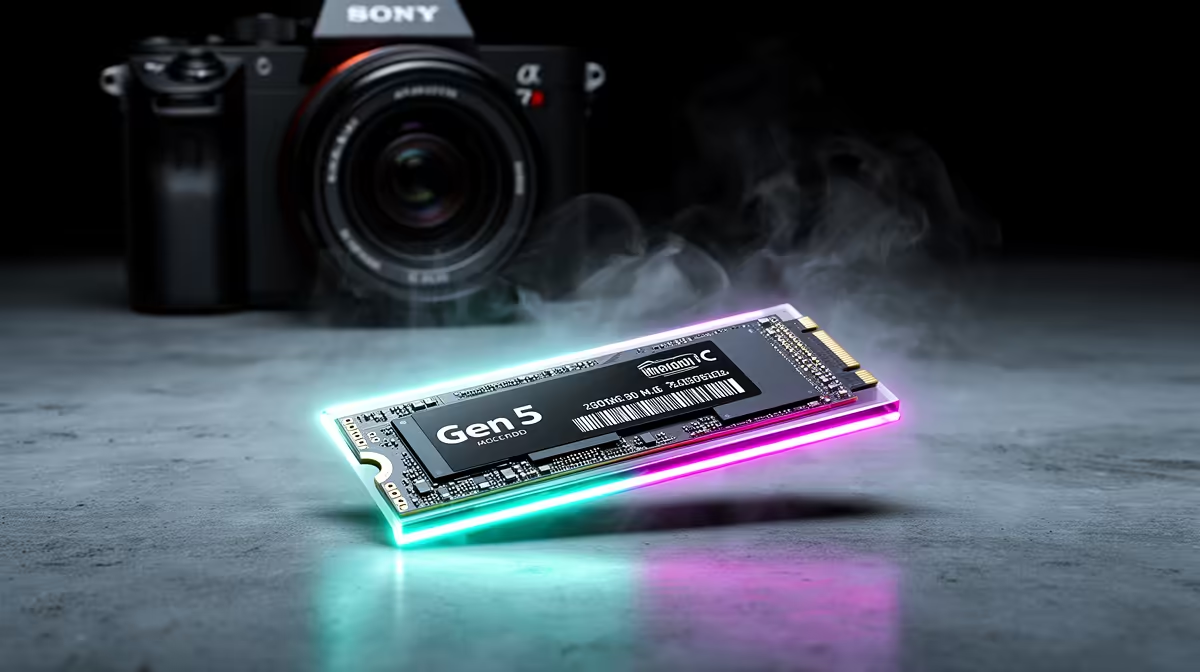
Staring at a loading screen feels like a special kind of torture, right? Especially when you’ve just dropped into a hot zone in Apex or you’re trying to stream without a single stutter. The big debate right now is Gen 5 vs Gen 4 SSDs. One promises blistering, next-level speed, while the other offers incredible performance that’s already mainstream. But for a South African gamer, is the new tech worth the extra Randelas? Let's find out.
The Gen 5 vs Gen 4 SSD Showdown: What's the Real Difference?
At its core, the battle between a Gen 5 and Gen 4 SSD is about bandwidth… think of it as the number of lanes on a highway. A PCIe 4.0 (Gen 4) SSD is like a super-fast four-lane highway, capable of read speeds up to around 7,500 MB/s. It’s incredibly quick and has been the gold standard for a few years.
A PCIe 5.0 (Gen 5) SSD effectively doubles the highway to eight lanes. With theoretical speeds soaring past 12,000 MB/s, it's built for the most demanding tasks imaginable. But does your gaming PC actually need all that extra road?
The Ultimate Speed Test: Gaming & Real-World Performance
Numbers on a box are one thing; real-world performance is another. We're breaking down where you'll actually feel the difference in this Gen 5 vs Gen 4 SSD comparison.
Game Loading Times: A Matter of Seconds ⚡
Here’s the honest truth: for most games right now, the difference is surprisingly small. A top-tier Gen 4 SSD might load a massive open world in Starfield or Baldur's Gate 3 in 10 seconds, while a Gen 5 drive might do it in 8. It's faster, yes, but not the night-and-day leap you might expect.
Why? Most games aren't yet fully optimised to take advantage of Gen 5 speeds. Technologies like Microsoft's DirectStorage will change this, allowing games to pull assets directly from the SSD to the graphics card, but we're still in the early days.
Streaming and Content Creation: The True Battleground 🚀
This is where a Gen 5 SSD starts to pull away. If you’re a streamer or content creator, you live and die by your workflow speed.
- Video Editing: Scrubbing through 4K or 8K timelines becomes buttery smooth.
- File Transfers: Moving hundreds of gigabytes of raw footage or project files takes a fraction of the time.
- Complex Applications: Loading massive sample libraries for music production or complex 3D models happens almost instantly.
For these professional use cases, the time saved directly translates into more productivity, making the Gen 5 vs Gen 4 SSD debate much more one-sided.
Check Your Specs! 🔧
Before you even think about buying a Gen 5 SSD, check your motherboard's manual or product page. You need a dedicated M.2 slot that explicitly supports 'PCIe 5.0'. Plugging a Gen 5 drive into a Gen 4 slot will work, but it will be limited to Gen 4 speeds, and you'll have paid a premium for performance you can't use.
Is a Gen 5 SSD Worth It for Your Rig in South Africa?
Okay, let's talk brass tacks. Speed is great, but value is king. The decision to go with a Gen 5 SSD hinges on two things: your budget and your hardware.
A blazing-fast SSD is pointless if the rest of your system can't keep up. To unlock the full potential of a Gen 5 drive, you need a compatible motherboard and a modern CPU. This is a crucial factor, as it means the upgrade isn't just about the drive itself. You need to ensure the very foundation of your PC, whether you're looking at great value Intel and AMD motherboards, is ready for the new standard.
The latest platforms are where you'll find this cutting-edge support. For instance, many new-generation Intel motherboards were among the first to offer dedicated PCIe 5.0 M.2 slots for these new drives. Of course, Team Red isn't far behind, with a wide range of AMD motherboards also providing the necessary bandwidth for gamers and creators who demand the best.
The Verdict: Who Should Upgrade?
So, who wins the Gen 5 vs Gen 4 SSD battle? It depends entirely on you.
- For The Hardcore Creator & Future-Proofer: If your work involves massive files, or you simply want the absolute fastest, most future-proof rig possible and have the budget for a compatible motherboard, a Gen 5 SSD is a phenomenal investment. ✨
- For The Smart Gamer & Value Hunter: A high-quality Gen 4 NVMe SSD is the undisputed champion of value right now. It delivers lightning-fast gaming performance that is more than enough for today's titles, at a price that makes far more sense for the vast majority of South African PC builders.
The gap will surely widen as games evolve, but for now, you can get 95% of the noticeable gaming benefit for a fraction of the cost with a solid Gen 4 drive.
Ready to Slash Your Loading Times? Whether you're team Gen 4 for value or Gen 5 for pure power, the perfect drive is waiting for you. A faster SSD is one of the best upgrades you can make to your PC. Explore our massive range of SSDs and find the perfect match for your rig.