Staring at spec sheets trying to find the perfect graphics card for 1440p gaming? You're not alone. This resolution is the new sweet spot for South African gamers, offering a stunning visual upgrade from 1080p without demanding a monster rig. But navigating the endless options can be tough. This guide cuts through the noise, breaking down GPU performance at 1440p so you can find the right card for your budget and your favourite games. 🚀
Why 1440p is the New Gaming Gold Standard
For years, 1080p was king. It was easy to run and monitors were affordable. But today, 1440p (2560x1440 pixels) offers a significantly sharper, more immersive experience. Details in games like Alan Wake 2 or the sprawling landscapes of Elden Ring truly pop with colour and clarity.
The best part? You no longer need to spend R30,000+ to get great 1440p GPU performance. Modern graphics cards from all the major players offer fantastic frame rates at this resolution, making it the perfect balance of visual fidelity and value for your next PC build or upgrade.
Decoding 1440p Performance: More Than Just FPS
When you look at benchmarks, the big number everyone talks about is the average FPS (Frames Per Second). While a high FPS is great, it doesn't tell the whole story. To truly understand GPU performance at 1440p, you need to look a little deeper.
- Average FPS: This is your main performance metric. For smooth gameplay in fast-paced shooters, aim for 100+ FPS. For story-driven single-player games, 60 FPS is a fantastic target.
- 1% Lows: This number is crucial. It represents the performance during the most demanding moments of gameplay. High 1% lows mean a stable, stutter-free experience, which is just as important as a high average FPS.
- VRAM (Video RAM): Think of this as your GPU's short-term memory. At 1440p, high-resolution textures eat up VRAM quickly. We'd recommend a minimum of 8GB, but cards with 12GB or even 16GB will give you more headroom for future titles.
Ready to see what's out there? You can browse a huge variety of current-gen graphics cards to get a feel for the specs and pricing available in SA.
Free Performance Boost! ⚡
Before you start gaming, dive into your PC's BIOS and make sure Resizable BAR (for NVIDIA Intel) or Smart Access Memory (for AMD) is enabled. This feature allows your CPU to access the GPU's entire VRAM at once, often providing a noticeable performance uplift in many modern games... for free!
The Main Contenders for 1440p Dominance
The battle for your graphics card slot is fiercer than ever. Each team brings something unique to the table, and the best choice often depends on your budget and the types of games you play.
### Team Green: NVIDIA's GeForce Line-up
NVIDIA is often praised for its mature feature set, including DLSS (Deep Learning Super Sampling), which uses AI to boost frame rates with incredible image quality. If you're keen on pushing ray tracing to its limits for ultra-realistic lighting, NVIDIA's RT cores give them a strong edge. Their cards are excellent all-rounders, from competitive esports to cinematic single-player experiences. Check out the latest NVIDIA GeForce graphics cards to see the current range. ✨
### Team Red: AMD's Radeon Powerhouses
AMD often delivers incredible rasterization performance (gaming without ray tracing) for your money. Their FSR (FidelityFX™ Super Resolution) technology is an open-source alternative to DLSS that works on a wider range of cards and also provides a significant performance boost. For gamers focused on raw power and value, the line-up of AMD Radeon graphics cards is always a top contender.
### The New Challenger: Intel's Arc Series
Don't count out the newcomer! Intel has entered the dedicated GPU market with its Arc series, offering competitive performance at compelling price points. While their driver support is still maturing, they've made massive improvements and present a fantastic value proposition for gamers looking to build a powerful 1440p rig on a tighter budget. It's worth keeping an eye on the latest Intel Arc graphics cards as a serious alternative.
A Quick Note: Gaming vs. Workstation Cards
While browsing, you might come across cards that seem incredibly powerful but are priced differently. These are often workstation graphics cards, like NVIDIA's Quadro line. 🔧 While they excel at tasks like 3D modelling, video rendering, and scientific calculations thanks to their specialised drivers, they are not optimised for gaming. Stick to GeForce, Radeon, or Arc for the best gaming experience.
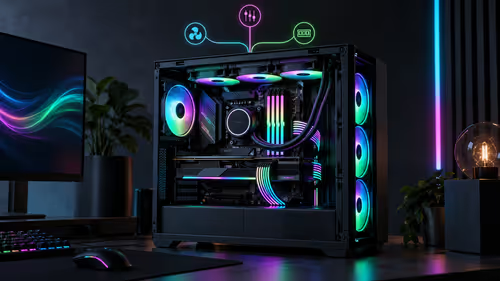
Ready to Build Your 1440p Dream Machine? Choosing the right GPU is the most exciting part of any PC build. Now that you know what to look for, the perfect card is waiting. Use our PC builder to pair your chosen GPU with the perfect components and create a rig that will conquer 1440p gaming for years to come.