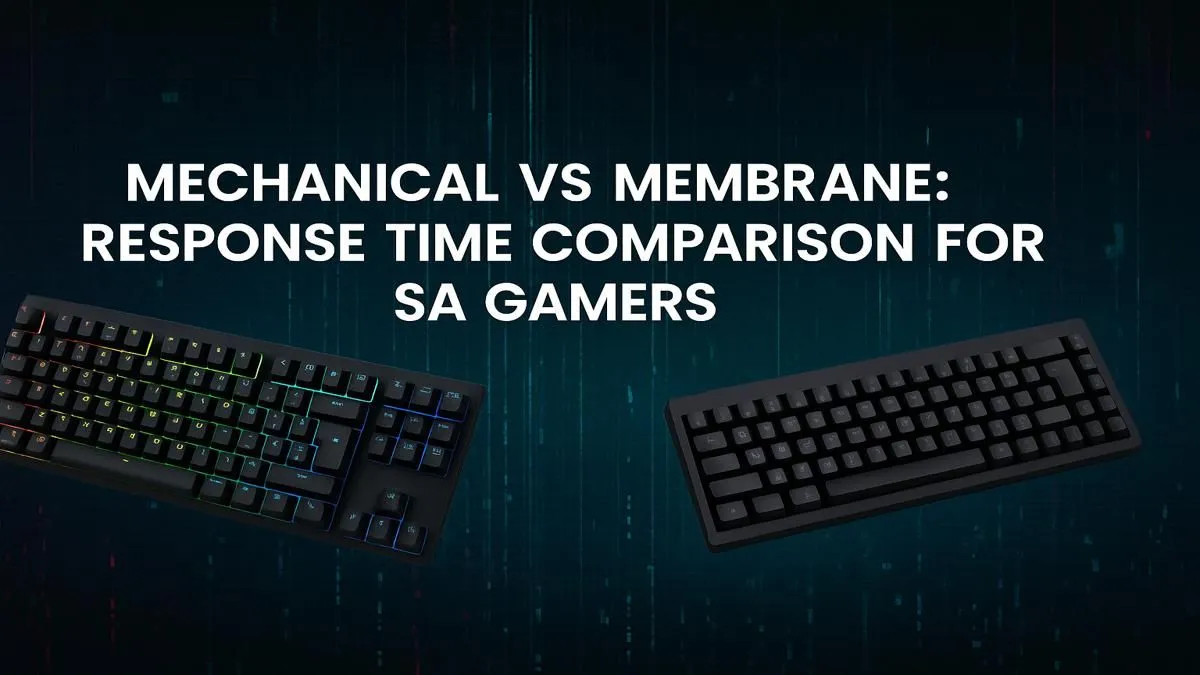
That split-second difference between a clutch win and a frustrating loss… ever wondered if it's your keyboard? In the heat of a competitive match, every millisecond counts. That's why the mechanical vs membrane response time debate is so critical for South African gamers. Is your gear giving you the edge, or is it secretly holding you back? Let's dive in and find out which keyboard type is truly faster for gaming. 🚀
Understanding Keyboard Response Time
Before we pit mechanical vs membrane keyboards against each other, let's quickly break down what "response time" actually means. It’s not just one thing; it's a combination of factors:
- Actuation Point: The distance a key must travel down before it registers a keystroke.
- Polling Rate: How often the keyboard reports its status to your PC, measured in Hertz (Hz). A 1000Hz polling rate means it reports 1000 times per second.
- Debounce Delay: A tiny, built-in delay to prevent a single keypress from accidentally registering multiple times.
For gamers, lower is always better. A faster response time means less input lag, ensuring your in-game actions happen the instant you press a key.
The Mechanical Advantage: Built for Speed ⚡
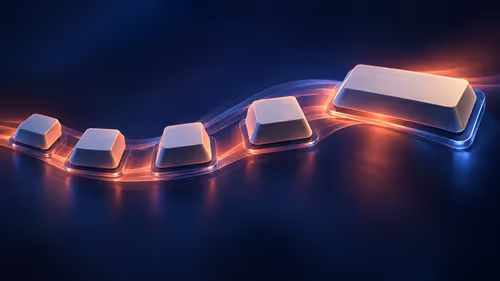
When it comes to raw speed, mechanical keyboards generally take the crown. The magic lies in their individual physical switches beneath each keycap.
Unlike membrane keyboards that require you to press the key all the way down, mechanical switches actuate part-way through the press. This means your command is sent to the PC sooner, shaving off crucial milliseconds. This difference in mechanical vs membrane response time is most noticeable in fast-paced games where rapid, repeated keystrokes are common.
Furthermore, the variety is immense. You can choose from linear switches (smooth and fast), tactile switches (a small bump for feedback), or clicky switches (loud and satisfying). Finding the right feel is easy when you can select from a huge variety of keyboard switches to perfectly match your playstyle.
Find Your Feel 🔧
Can't decide between Red, Brown, or Blue switches? Many brands offer switch tester kits. It's a small investment that lets you physically feel the difference in actuation and feedback before committing to a full keyboard. This simple step can save you from buyer's remorse and ensure your new board feels perfect for your playstyle.
The Membrane Reality: Good, But Is It Fast Enough?
Membrane keyboards use a single rubber dome sheet under the keys. To register a keystroke, you have to push the key all the way down to press the dome against the circuit board. This "bottoming out" action inherently makes them a bit slower than their mechanical counterparts.
So, is a membrane keyboard’s speed a problem? For everyday typing and casual gaming, absolutely not. They are quiet, often spill-resistant, and generally more budget-friendly. You can find many excellent and affordable gaming keyboards that use membrane technology. However, if you're serious about competitive gaming, the slight delay could be a disadvantage.
The Verdict: Which Keyboard Is Faster for Gaming?
Let's be clear: on paper and in practice, mechanical keyboards have a faster response time. The physical switch design allows for quicker actuation, which translates to a tangible advantage in competitive scenarios.
However, the human element is the biggest factor. A seasoned pro on a membrane board will still outperform a beginner on the most expensive mechanical one. The key is to find what works for you. If you're chasing every possible competitive edge, the superior mechanical keyboard response time makes it the logical choice. Check out some of our latest gaming keyboard deals to see the performance you can get for your budget.
Beyond the Switch: Other Factors to Consider ✨
The mechanical vs membrane debate is central, but other features impact your overall experience and performance.
- N-Key Rollover (NKRO): This ensures every single keypress is registered, no matter how many keys you press at once. It's a must-have for complex combos.
- Build Quality: A solid frame prevents flex and ensures durability for years of intense gaming sessions.
- Customisation: Make your setup your own with custom keycaps to add some personal flair.
- Ergonomics: Long gaming sessions are tough on your hands. Pairing your board with ergonomic wrist rests can make a world of difference in comfort and endurance.
Often, the best value comes from upgrading to a full keyboard and mouse combo, ensuring your peripherals are perfectly matched for performance.
Ready to Find Your Perfect Match?
The mechanical vs membrane response time debate is clear: for pure speed, mechanical wins. But the best keyboard is the one that feels right for you. Explore our massive range of gaming keyboards and find the perfect weapon to conquer your game.