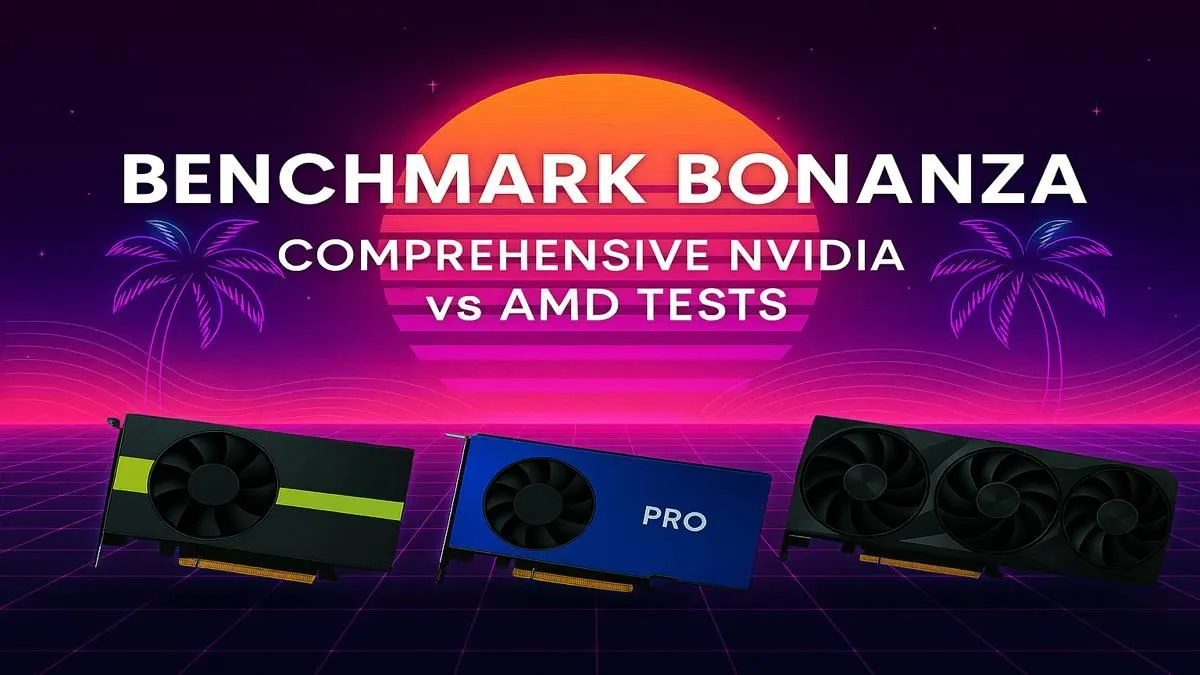
Choosing a new graphics card in South Africa feels like picking a side in a Soweto Derby... Team Green or Team Red? The NVIDIA vs AMD benchmark debate rages on, with both camps claiming victory. But when your hard-earned Rands are on the line, marketing hype means nothing. You need cold, hard data. So, which GPU truly delivers the max performance for your gaming rig right now? Let's dive into the numbers and find out.
Understanding the NVIDIA vs AMD Benchmark Battle
Before we jump into the graphs and framerates, what are we actually comparing? Benchmarks are standardised tests that push a graphics card to its limits, measuring its performance in specific games or synthetic loads. This gives us a clear, unbiased look at how different cards stack up. The outcome of any NVIDIA vs AMD benchmark isn't just about bragging rights; it directly impacts your gaming experience, from silky-smooth frame rates in Helldivers 2 to breathtaking visuals in Alan Wake 2.
It's about more than just raw power. We also need to consider crucial technologies like NVIDIA's DLSS and AMD's FSR (FidelityFX Super Resolution), which use AI to boost performance, and how each brand handles demanding features like ray tracing.
Raw Performance: Gaming Benchmarks Across Resolutions 📊
The heart of the AMD vs NVIDIA performance comparison lies in gaming. A card might excel at 1080p but struggle at 4K, so your monitor's resolution is a key factor in your decision.
The Entry Point: 1080p Gaming
At 1080p, the competition is incredibly fierce. This is where most gamers play, and both teams offer fantastic value. In many traditional (non-ray-traced) games, AMD's Radeon cards often provide incredible price-to-performance, making them a popular choice for budget-conscious builders. This is where the latest NVIDIA vs AMD benchmarks show the tightest race.
The Sweet Spot: 1440p Gaming
For many PC gamers, 1440p is the new standard, offering a significant visual upgrade without needing a top-of-the-line card that costs a fortune. In this segment, NVIDIA's GeForce series truly shines, with cards like the RTX 40-series delivering excellent frame rates and feature support. If you're looking for a card that balances price, performance, and future-proof features for high-refresh-rate gaming, browsing the latest NVIDIA GeForce graphics cards is a fantastic starting point.
The Enthusiast Tier: 4K Gaming 🚀
At 4K, the performance demands are immense. This is where flagship GPUs from both companies battle for the crown. Historically, NVIDIA's top-tier cards have held an edge, especially when you enable demanding features like ray tracing. However, AMD's high-end offerings have become incredibly competitive, often trading blows in pure rasterization performance. A detailed NVIDIA vs AMD benchmark at this level shows that the choice often comes down to the specific games you play and the features you value most.
Beyond the Frames: Ray Tracing and Upscaling Tech
Max performance isn't just about the highest number on a chart. It's also about the technology that enhances your experience.
Ray Tracing: This technology simulates real-world lighting for incredibly realistic shadows and reflections. While both brands support it, NVIDIA's RT Cores have traditionally given them a significant performance advantage in ray-traced titles.
Upscaling: This is the real magic. ✨
- NVIDIA DLSS (Deep Learning Super Sampling): Uses AI and dedicated Tensor Cores on RTX cards to boost frame rates while maintaining, and sometimes even improving, image quality.
- AMD FSR (FidelityFX Super Resolution): An open-standard upscaling tech that works on a wide range of GPUs, including AMD's own and even older NVIDIA cards. While FSR is more accessible, many gamers and critics agree that DLSS currently produces a slightly cleaner image.
For gamers who want to experience the latest visual tech without sacrificing performance, the upscaling debate is a critical part of the NVIDIA vs AMD benchmark discussion. Exploring the features available on modern AMD Radeon graphics cards reveals just how far their FSR technology has come.
Monitor Your Performance ⚡
To see your own real-time benchmarks, use a tool like MSI Afterburner with the RivaTuner Statistics Server. It's free and lets you display your FPS, GPU temperature, and usage right on your screen while you game. This is the best way to confirm you're getting the max performance you paid for!
Price-to-Performance: Getting the Best Bang for Your Rand 💰
Here in South Africa, value is everything. While one GPU might top the NVIDIA vs AMD benchmark charts, it might not be the smartest buy for your budget.
This is where the battle gets interesting. AMD has built a strong reputation for offering competitive performance at lower price points, particularly in the mid-range. You can often get more raw rasterization power for your Rand with Team Red.
On the other hand, NVIDIA's ecosystem, mature driver support, and superior ray tracing performance can be worth the premium for many users. For streamers, the NVENC encoder is a huge plus, and for professionals, CUDA core support in creative apps is essential. The final decision depends on what you value most. The best approach is to check the latest prices and see which card fits your specific needs and budget by looking through the best graphics card deals available now.
So, who wins the NVIDIA vs AMD benchmark war? The truth is... you do. The intense competition means better products and more choice at every price point. The "best" GPU is the one that aligns with your budget, your favourite games, and the features you can't live without.
Ready to Choose Your Champion? The NVIDIA vs AMD benchmark battle is fierce, but the real winner is you... the South African gamer with more choice than ever. Whether you need bleeding-edge ray tracing or the best bang-for-your-buck, the perfect GPU is waiting. Explore our full range of PC Components and find the power your rig deserves.