Quick Answer
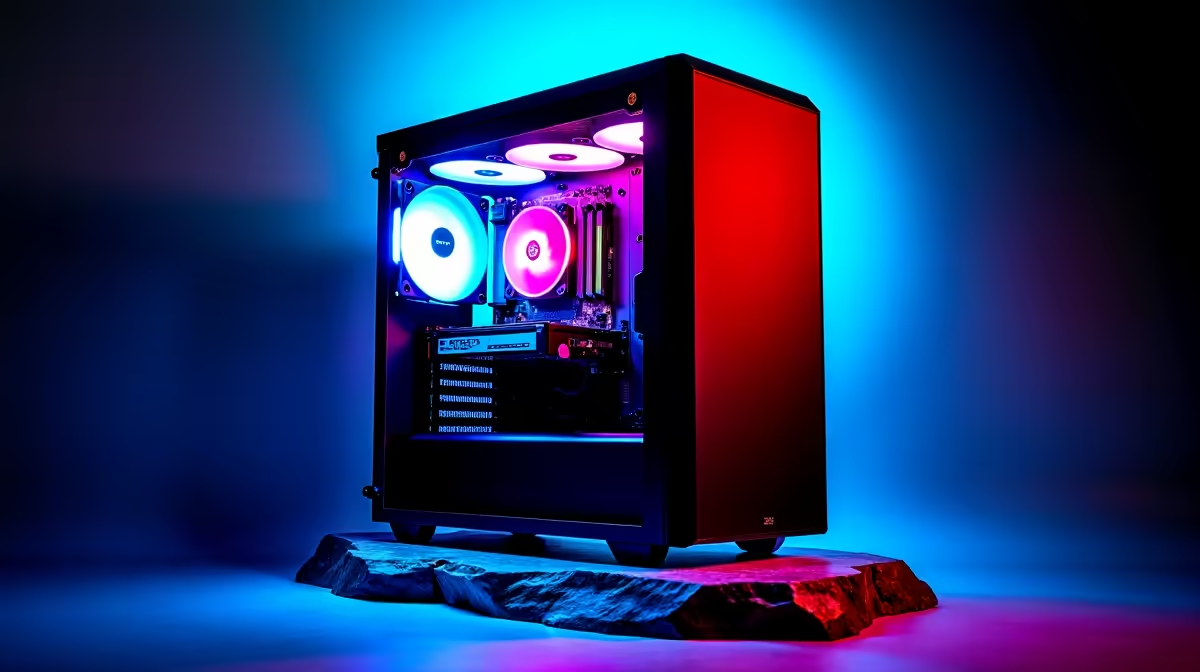
PC insurance in South Africa is worth considering for gaming setups valued above R15,000 - R20,000, particularly given local risks including loadshedding-related power surges, load-shedding-induced lightning strikes during storm season, and the high replacement cost of GPUs and monitors in the SA market. Standard home contents insurance typically covers desktops as part of household contents, but dedicated electronics cover or all-risk insurance provides more comprehensive protection and is often the better fit for high-value gaming rigs.
Building a serious gaming PC in South Africa is a significant financial investment. With a mid-range gaming GPU alone costing R8,000 to R15,000 and a full rig with monitor potentially exceeding R40,000 to R60,000, the question of whether to insure that setup is genuinely worth thinking through. Unlike a car or smartphone, most South Africans don't automatically insure their desktop PC - but there are very specific local factors that change the risk calculation significantly.
Risks Specific to SA Gaming Setups
South Africa has a few risk factors that make PC insurance more relevant locally than in many other markets. Loadshedding creates repeated power cycling that stresses PSUs, capacitors, and storage drives over time. More critically, the switching transients when Eskom's grid returns power after an outage can cause voltage spikes that damage sensitive components - a reality well-known to SA PC builders. Lightning-related surges during summer storm season in Gauteng and other inland areas are another significant risk; a nearby strike can travel through electrical wiring and fry an unprotected system even without a direct hit.
Theft is also a factor, particularly in areas without secure storage. A full gaming rig including monitors, peripherals, and a high-end GPU represents a high-value target. Standard home contents insurance covers theft of desktop equipment as part of household contents up to the insured limit, but many policies have per-item limits that cap a single electronics item at R10,000 to R15,000 - insufficient for a premium gaming setup.
Types of Cover Available in South Africa
For gaming PCs, there are three main insurance options in South Africa. The first is home contents insurance, which most homeowners and renters have, covering desktops for theft and certain types of accidental damage. The limitation is that claim values are often capped per item, and cover may not extend to power surge damage from load-shedding unless specifically included.
The second option is all-risk or specified items cover, offered by insurers like Discovery Insure, OUTsurance, Santam, and King Price among others. This allows you to list your gaming PC and its components individually with accurate replacement values and extends cover to accidental damage, power surges, and in some cases mechanical breakdown. This is the most comprehensive option for a high-value setup.
The third option is electronics or portable possessions cover, typically more relevant for laptops and portable devices but sometimes extendable to desktops. It often includes accidental damage and theft outside the home, though a desktop is rarely taken out of the house.
Cost of PC Insurance vs Risk in SA
The cost of insuring a R40,000 gaming setup in South Africa under an all-risk specified items policy typically runs between R150 and R300 per month depending on the insurer, location, security features, and excess structure. That's R1,800 to R3,600 annually. Weighed against the cost of replacing a single GPU (R8,000 to R20,000) or a monitor (R4,000 to R15,000) after a surge event, the maths can work in your favour fairly quickly - especially in loadshedding-heavy periods.
A quality surge protector (R400 to R1,500) and UPS (R1,500 to R5,000) reduce but do not eliminate risk, and insurance companies may require evidence of surge protection before paying out surge-related claims. Installing a good UPS is strongly recommended alongside insurance, not instead of it.
What to Check Before Taking Out a Policy
Before committing to any PC insurance policy in South Africa, check the following: per-item limits under your existing contents cover, whether power surge damage is specifically included or excluded, the excess amount (what you pay per claim), the reinstatement basis (new-for-old or depreciated value), and whether peripherals and monitors are included or need to be listed separately. It's also worth checking the claims process - some SA insurers require police case numbers for theft claims, and getting valuations for custom-built PCs can complicate the process compared to insuring a branded off-the-shelf system.
Frequently Asked Questions
Q: Does home contents insurance automatically cover my gaming PC in South Africa?
A: In most cases, yes - your desktop PC is covered as part of household contents for theft and certain damage events. However, per-item limits and exclusions for power surge damage mean a high-value gaming setup may not be fully covered without adding all-risk or specified items cover.
Q: Does a UPS protect my gaming PC from loadshedding-related surges?
A: A quality UPS with surge protection significantly reduces the risk of voltage damage during load-shedding switching events. It is not a 100% guarantee against all surge events, particularly from nearby lightning strikes, but it materially lowers risk and is a prerequisite that many insurers will ask about.
Q: Can I insure a custom-built gaming PC in South Africa?
A: Yes, custom-built PCs can be insured under all-risk policies. You will typically need to provide a component list with purchase receipts or invoices to establish the insured value. Keep your build documentation organised to simplify the claims process if you ever need it.
Q: Is it worth getting separate insurance for gaming peripherals?
A: High-value peripherals - premium gaming monitors, mechanical keyboards, headsets - are worth listing on a specified items policy if their combined value exceeds R5,000 to R10,000. Many policies allow you to bundle the full setup including peripherals into a single listed item with one combined insured value.