Is your gaming PC truly ready for a South African summer? Between searing heatwaves, an unexpected outage surprises, and the fine dust that gets everywhere, your rig faces a unique endurance test. Pushing your hardware to its limits before a critical mission in Helldivers 2 or a deadline is essential. A proper PC stress test is your best defence, acting as a health check-up to uncover hidden weaknesses before they cause a catastrophic failure. Let's get your machine battle-ready. 🚀
Why a PC Stress Test is Crucial in South Africa
Think of a stress test as a controlled, high-intensity workout for your computer. By pushing your CPU, GPU, and RAM to 100% load in a safe environment, you simulate the most demanding conditions possible. For us in SA, this isn't just about bragging rights; it's about survival.
An effective PC stress test helps you:
- Verify Stability: Is your new build or recent upgrade truly stable? A 30-minute test can reveal issues that might only appear after hours of gaming.
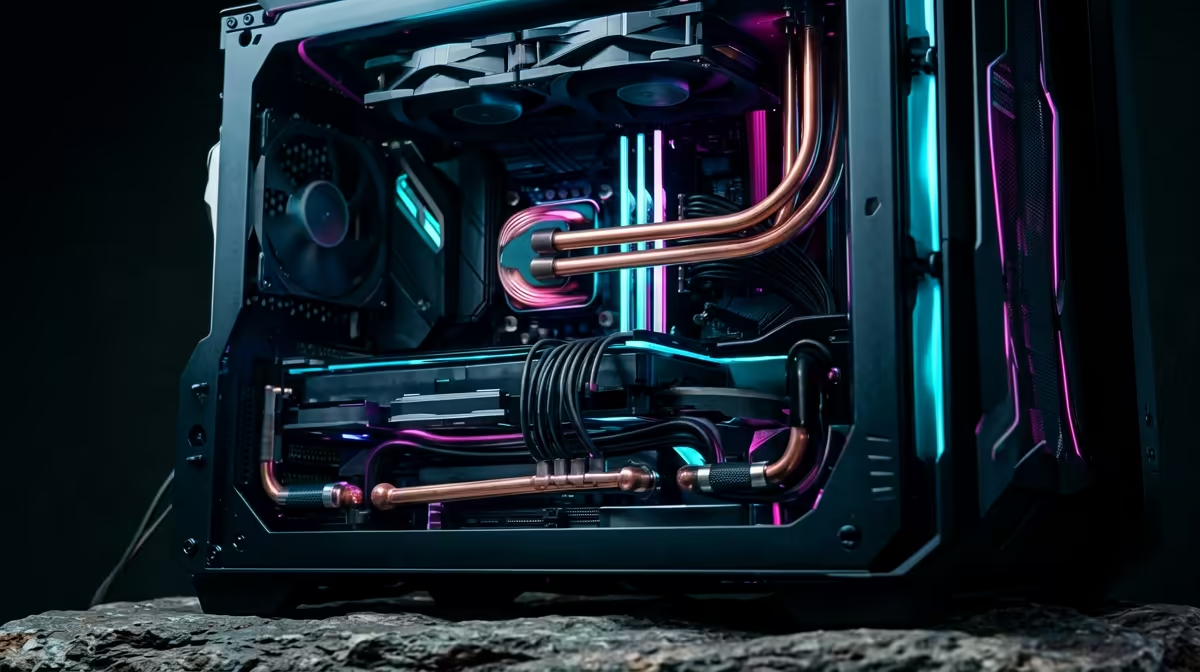
- Check Cooling Performance: Our climate is unforgiving. A stress test will quickly show if your fans and heatsinks are up to the task of a 35°C summer day, or if your CPU is thermal throttling (slowing down to prevent damage).
- Diagnose Problems: If you're experiencing random crashes or blue screens, stress testing individual components can help you pinpoint the culprit, saving you time and money. This is especially critical for those running demanding creative or professional workloads on workstation PCs where stability is non-negotiable.
Gearing Up: The Best Tools for the Job
You don't need to spend a cent to conduct a thorough PC stress test. A few trusted, free applications are all you need to push your components to their absolute limit.
Key Software to Download:
- For your CPU:
Cinebench is fantastic for a quick but intense test that also gives you a performance score. For a longer, more brutal thermal test, Prime95 is the classic choice. - For your GPU:
Unigine Heaven or Superposition provide a real-world gaming scenario that heavily loads your graphics card. FurMark is another popular option, often called the "GPU killer" for how hard it pushes the hardware. - For Monitoring: This is non-negotiable!
HWMonitor or MSI Afterburner are essential for watching your component temperatures, clock speeds, and usage in real-time.
Cooling Check 🌡️
Before you start any stress test, install a monitoring tool like HWMonitor. Keep a close eye on your CPU and GPU temperatures. For most modern components, anything consistently over 90-95°C under load is a red flag indicating poor cooling or old thermal paste. Catching this early can save your hardware!
Running the Gauntlet: A Step-by-Step Guide
Ready to see what your machine is made of? Follow these simple steps for a comprehensive PC stability test.
- Prep Your PC: Start by closing all unnecessary background applications. For the best thermal reading, ensure your PC's dust filters are clean and the side panel is on, simulating normal use.
- Establish a Baseline: With your monitoring software open, note your PC's idle temperatures. This gives you a reference point.
- Test the CPU: Run Cinebench for 10-20 minutes. Watch your CPU temperatures. Do they skyrocket instantly, or do they rise steadily and stabilise at a safe level (ideally below 90°C)?
- Test the GPU: Now, it's the graphics card's turn. Run Unigine Heaven on a loop for at least 30 minutes. Whether you have one of the latest powerful NVIDIA GeForce gaming PCs or a rig from the red team, this will tax it heavily. High-end AMD Radeon gaming PCs are built for this kind of pressure, but it's always best to verify.
- Analyse the Results: Did your PC complete the tests without crashing, freezing, or showing visual glitches? Did temperatures remain within safe limits? If so, congratulations! Your rig is stable. ✨
Interpreting the Results: Pass, Fail, or Upgrade?
So, what happens if things don't go smoothly? A "fail" during a PC stress test in South Africa is valuable information.
- Immediate High Temps: If your CPU or GPU hits 95°C+ within seconds, you likely have a cooling problem. This could be due to poorly applied thermal paste, insufficient case airflow, or a failing AIO cooler.
- Crashes or Blue Screens: This often points to instability. It could be an unstable overclock, a faulty power supply that can't handle the load, or even a bad memory module.
- Throttling: If you see your component's clock speeds dropping significantly during the test while temps are high, your PC is thermal throttling to protect itself. You're leaving performance on the table!
If your machine is struggling, it might be a sign that its components are getting old. A modern, well-built system can make all the difference. If you're considering a new core for your setup, you can find some incredible value in the latest Intel PC deals available right now. Alternatively, if you favour multi-core performance for streaming or content creation, be sure to check out our AMD Ryzen PC deals for some serious power.
Is Your Rig Ready for the SA Gauntlet?
If your stress test revealed more heat than performance, it might be time for an upgrade. A well-cooled, professionally built PC is your best defence against throttling and crashes. Explore our legendary PC deals and build a machine that won't let you down when the action heats up.