Stuttering in the middle of a tense firefight in Warzone? You’ve tweaked every graphic setting, but your FPS still dips. While your GPU gets all the glory, the unsung hero of smooth gameplay is often your RAM. The relationship between RAM speed and FPS is more direct than many South African gamers realise. Faster memory can be the key to unlocking a more stable, higher framerate experience. Let's dive in. 🚀
The Link Between RAM Speed and FPS
Think of your CPU as a master craftsman and your RAM as its workbench, holding all the tools and data it needs for the current job. RAM speed, measured in Megahertz (MHz), determines how quickly that data can be passed to the CPU. The faster the RAM, the less time your powerful processor spends waiting around.
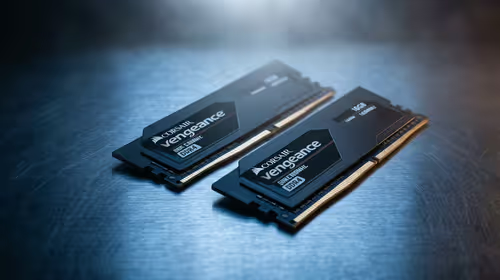
This is crucial for gaming. When your CPU can access game assets, character locations, and physics calculations faster, it can prepare frames for the GPU more quickly. This direct correlation is how memory speed impacts gaming, especially in CPU-intensive titles. While massive capacity is great for multitasking, for pure gaming smoothness, the speed of your modern DDR4 memory often matters more.
How Much Does RAM Speed Impact Gaming?
So, will upgrading from 3200MHz to 3600MHz double your framerate? Not quite. The impact of RAM speed on FPS is most noticeable in two key areas:
- CPU-Bound Scenarios: In games like Valorant or CS:GO, where you're pushing for hundreds of frames per second at 1080p, your CPU is the bottleneck. Faster RAM feeds the CPU quicker, directly translating to higher average and maximum FPS.
- 1% Lows: This is arguably more important. Faster RAM significantly improves your "1% lows"—the framerate of the worst-performing moments. This means fewer jarring stutters and a much smoother, more consistent experience, even if the average FPS only climbs by 5-10%.
For those on the bleeding edge, the jump to next-generation DDR5 RAM can provide even more bandwidth for next-gen processors, further enhancing this effect. ✨
Choosing the Right RAM for Your Rig
Before you rush to buy the fastest kit you can find, compatibility is key. Your motherboard dictates which generation of RAM you can use—you can't put DDR4 sticks in a DDR5 board, and vice-versa.
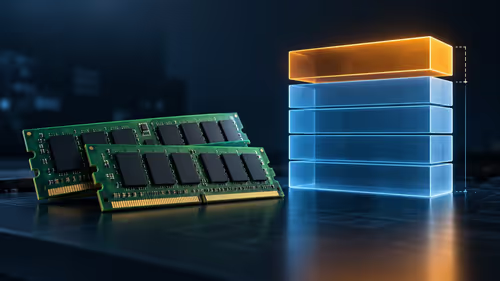
For gamers running slightly older but still capable systems, a memory upgrade can be a cost-effective way to breathe new life into your rig. Many classic builds still get fantastic performance from quality DDR3 gaming RAM modules. In fact, maxing out an older Z97 or X99 motherboard with a kit of 32GB of DDR3 RAM can make a world of difference in modern titles that love memory.
When choosing, it's always wise to stick with reputable manufacturers known for reliability and performance. Investing in trusted Teamgroup memory kits, for example, ensures you're getting quality components that will hit their advertised speeds.
Don't Forget to Enable XMP/EXPO! 🔧
Simply installing fast RAM isn't enough. You need to enter your motherboard's BIOS UEFI and enable the Extreme Memory Profile (XMP for Intel) or Extended Profiles for Overclocking (EXPO for AMD). This one-click setting tells your system to run the RAM at its advertised speed, not the slower default. It's the easiest performance boost you'll ever get!
Ultimately, while the GPU remains the king of gaming performance, ignoring your RAM speed means leaving free performance on the table. A balanced system is a happy system.
Ready to Unlock Smoother Gameplay?
The link between RAM speed and FPS is clear. Upgrading your memory can eliminate stutters and give you the competitive edge. Explore our massive range of high-speed RAM and find the perfect kit to unleash your PC's true potential.