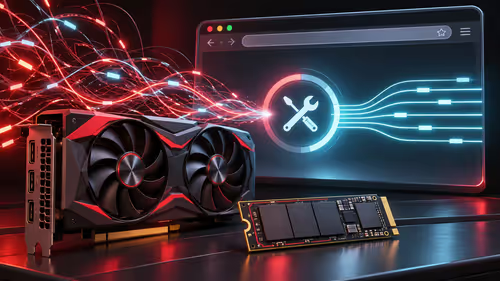
Pick your graphics card's hardware encoder and you have found the best encoder for OBS recording on most gaming PCs: NVENC on GeForce, AMF on Radeon, QuickSync on Intel graphics. It records at a fraction of the CPU cost of software encoding, so your game keeps its frame rate while the file is written. x264 only wins when you own a processor with cores to spare.
Quick Answer
Use NVENC, AMF or QuickSync for recording while you play, and save the file as MKV. Switch to x264 only if your CPU is an 8-core or larger chip and the game is light. Expect roughly 40 to 60 Mbps for a clean 1080p60 capture, or 12 000 to 20 000 kbps if disk space matters more.
🎮 Hardware Encoders: The Everyday Pick
A hardware encoder is a dedicated block on the graphics chip. It does nothing but compress video, so it barely touches the cores your game depends on.
- NVENC (GeForce GTX 16 series and RTX cards) is the most refined, with a quality gap to x264 that is small at high bitrates.
- AMF (Radeon) has improved with each generation, though older cards look softer.
- QuickSync (Intel integrated graphics) is a handy second option, and it can run alongside a discrete card.
In OBS, open Settings, then Output, switch Output Mode to Advanced, and pick the encoder on the Recording tab. If the list shows only x264, update your graphics driver first.
Pair the encoder with the right streaming essentials such as a decent microphone, because bad audio ruins a clean capture faster than a soft picture does.
🧠 When x264 Earns Its Place
Software encoding runs on the CPU. With plenty of spare cores it squeezes a little more quality out of every megabyte, which suits gameplay you plan to edit and compress again. On a busy gaming rig it fights the game for the same cores and you see skipped frames.
If you choose x264, start at the veryfast preset and move to faster only when OBS reports dropped frames. A slower preset sounds tempting, but a stuttering recording is worse than a slightly larger file.
📁 Format, Rate Control and Safety
Record to MKV. If OBS or the PC crashes mid-session, an MKV stays playable, whereas an MP4 may not open at all. Afterwards use File, then Remux Recordings to produce an MP4 for editors and phones without re-encoding.
For rate control, recording is the one place CQP or CRF suits better than CBR. Try CQP 18 to 23 for a steady look, and accept that file size moves with the action.
Webcam footage shares the same encoder budget, so a good webcam that outputs a clean signal saves you from heavy filtering later.
Frequently Asked Questions
What is the best OBS encoder for recording gameplay?
The encoder built into your graphics card: NVENC, AMF or QuickSync. Compression happens on the GPU, so the game keeps its frame rate during a long take.
When should I use x264 for recording?
Use it when the CPU has spare cores, such as a multi-core chip running a lighter title. Expect slightly better quality per megabyte, but dropped frames on a busy system.
Why record in MKV rather than MP4?
A crash or power blip can wreck an MP4 but leaves an MKV readable. After a session, remux to MP4 from the File menu in a few seconds.
Which rate control suits saved recordings?
CQP or CRF is better for files kept on your disk because quality stays even. Save CBR for live streaming, where the platform wants a fixed bitrate.
Does the encoder change how much disk space I use?
Mostly the quality setting does. Long takes can reach tens of gigabytes, which matters if you upload big files over a shared South African fibre line.
Can I record with a different encoder than I stream with?
Yes, by choosing Advanced mode, where the recording encoder is a separate setting from the stream encoder.
Ready to record cleaner gameplay?
See the Evetech streaming range for microphones, cameras and extras that keep your recordings sounding as good as they look.