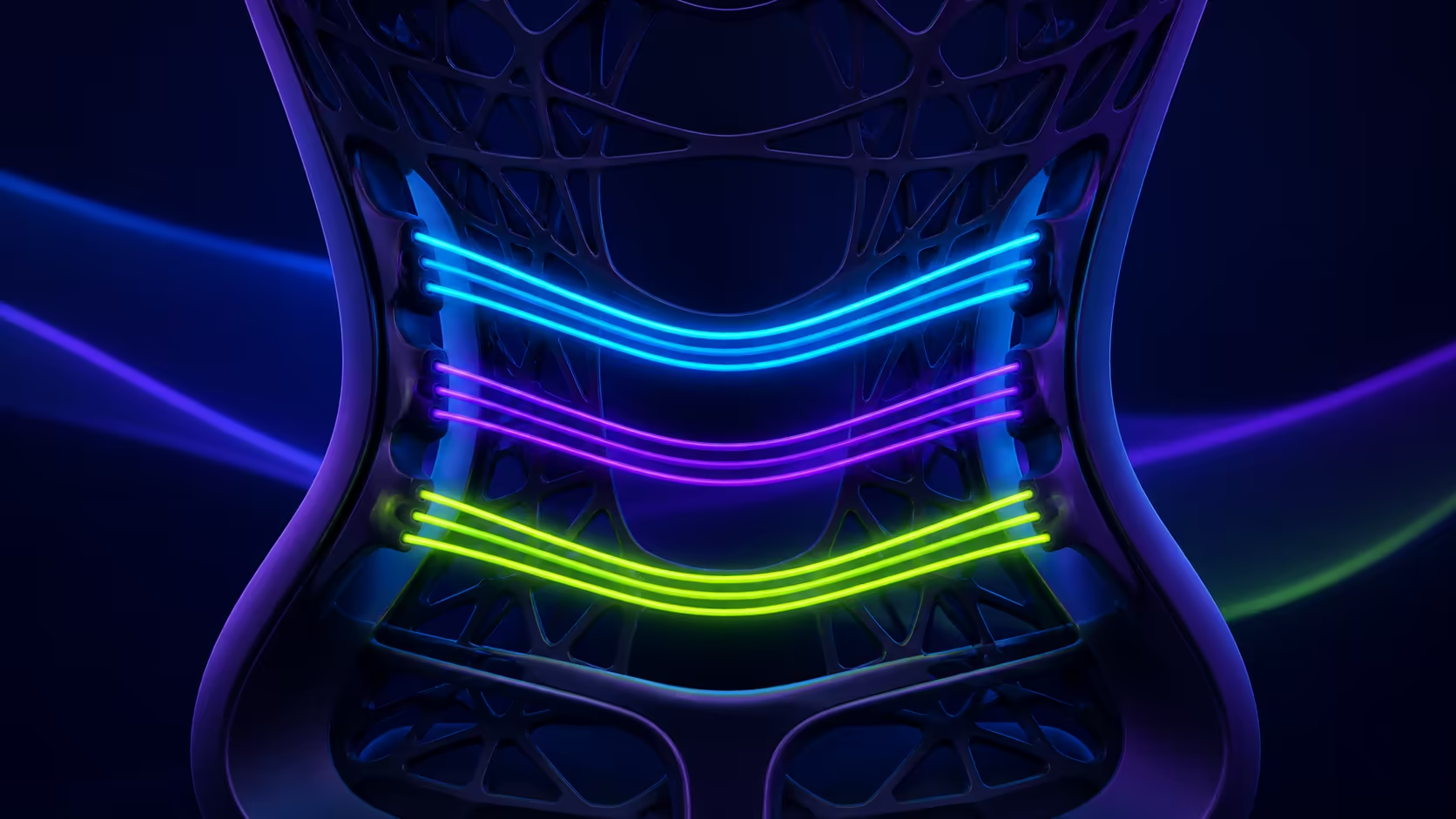
A three-zone elastic lumbar support system may divide lower-back contact into several areas, but the zone count cannot promise all-day comfort. Useful support still depends on the individual, exact mechanics, desk relationship and opportunities to move.
Quick Answer
Yes. The E3 Ultra's three-zone elastic lumbar can improve perceived all-day comfort when its 40-degree wings, adjustable depth and height match the user's waist.
Three-zone support can offer localised contact when each region reaches the user appropriately. The R9,599 E3 Ultra provides three elastic zones within its 8D system, with rotating floating wings and adjustable height, depth and dynamic angle.
🧩 Understand the intended zones
Manufacturers may use zones to describe separated areas or differentiated response. The label does not standardise location, control or pressure. Learn what each region does on the exact candidate before adjusting it.
Start from a neutral posture and ask whether contact feels balanced. Stronger pressure is not automatically better support.
🧪 Run a controlled comfort trial
Change one zone or setting at a time, then type, read and reach normally. Observe whether the torso stays with the backrest or escapes one contact area. Give subtle changes enough time to become clear.
Compare systems through Evetech's HBADA chair category, but preserve their distinct names. The E3 Ultra combines the 8D and three-zone elastic descriptions in one lumbar mechanism.
🖥️ Remove competing workstation problems
A distant keyboard makes the torso leave the backrest, while a misplaced display can bend the upper body. Correct these relationships before deciding whether a zone provides enough contact.
Arm support also matters. The E3 Ultra offers 720 degrees of omni adjustment at the armrests; place them so the shoulders settle and the chair can approach the desk.
⚕️ Separate comfort from treatment
All-day comfort is influenced by tasks, duration, movement, personal factors and the entire chair. Multi-zone contact does not guarantee a pain-free session or prevent injury.
Use Evetech's broader office seating selection for a fit comparison. Seek qualified advice when pain persists, worsens or includes concerning symptoms instead of extending the chair-tuning experiment.
Record the user's response by region rather than writing one overall comfort score. A design may meet one intended zone well and miss another. The map shows where further adjustment is useful and where chair geometry may simply not suit the person.
Keep the chair-to-desk distance marked during retests. If the user sits farther away on the second trial, the torso may leave support for reasons unrelated to the zones.
Repeat the test after a normal movement break instead of extending one uninterrupted sit. This separates the chair's contact pattern from fatigue created by remaining in any posture too long. It also keeps the evaluation focused on fit rather than an unrealistic all-day stillness claim.
Add control clarity to the zone map. If the user cannot identify which region changed, the resulting comfort judgement is difficult to repeat or compare across candidates.
At R9,599, the E3 Ultra should retain both its 8D and three-zone elastic descriptions throughout the value review. Keep each movement range in its own comparison row and label every test chair accurately.
Fourteen-degree dynamic support helps the contact adapt as posture changes. The design is real, but comfort remains individual and extended sitting still needs movement. Reduce intensity or wrap when a floating wing creates a pressure point.
Revisit the wrap after changing recline because body contact can shift considerably with the backrest angle.
Retest the centre zone after wing changes.
On the E3 Ultra, the two floating wings rotate 40 degrees while 14-degree dynamic movement, one-inch depth and 1.6-inch height travel broaden the lower-back contact zone.
Frequently Asked Questions
Why might a chair divide lumbar contact into zones?
The approach aims to manage contact across three intended lower-back regions. How those regions move or respond is specific to the product.
Can three zones guarantee all-day comfort?
No. Zone count cannot guarantee fit, and desk setup, task duration, movement and individual preference continue to influence comfort.
Does the E3 Ultra use three-zone elastic support?
Three-zone elasticity is part of the E3 Ultra's 8D adjustable lumbar system.
What lumbar system does HBADA provide?
The E3 Ultra includes 8D adjustable lower-back support. Its detailed mechanics should be learned directly from the chair before use.
How should multi-zone contact be tested?
Start neutrally, adjust one region or control, and complete representative work. Judge balanced contact and the ability to remain naturally against the backrest.
When should medical advice replace chair tuning?
Seek appropriate professional care when symptoms are severe, persistent, worsening or worrying. A chair adjustment is not a diagnostic or treatment tool.
Ready to compare lumbar zones through a fair, controlled trial?
Explore Evetech office chairs while keeping exact support design, desk fit and personal response as separate decision points.