Quick Answer
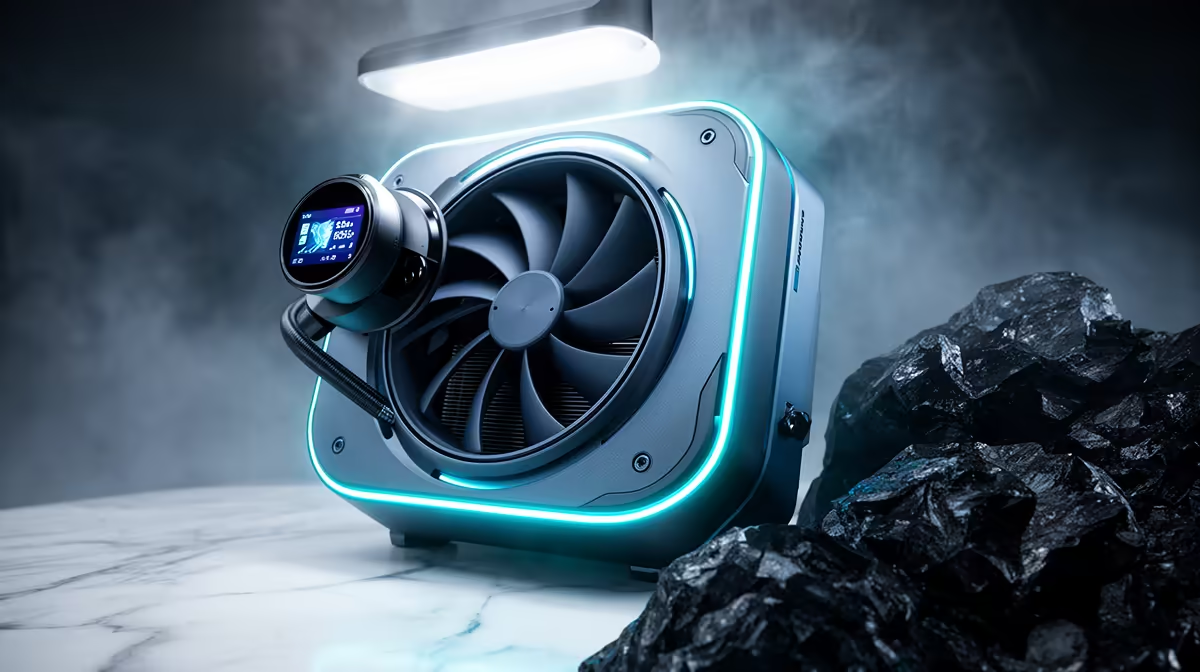
AIO (all-in-one) liquid coolers combine a pump block on the CPU, a sealed tube loop, and a radiator with attached fans into a single install. The key variables are radiator size (120mm, 240mm, 280mm, or 360mm), pump design (impeller speed and noise floor), fan type (static pressure vs airflow optimised), and whether an LCD panel is included for temperature or custom display output.
Radiator Size: The Most Important Variable 🌡️
Radiator size directly determines how much heat surface area the AIO can dissipate. A 120mm single-fan unit barely improves on a premium air cooler and suits only low-TDP CPUs below 65W. A 240mm dual-fan radiator handles Ryzen 7 9700X class CPUs at 105W comfortably. The 360mm triple-fan radiator is the mainstream choice for Ryzen 9 9950X builds at 170W, keeping cores under 85 degrees Celsius under Cinebench R24 sustained load. For Intel Core Ultra 9 285K at 253W PL2, 360mm is the minimum for sustained all-core workloads; 420mm units exist but require full-tower cases.
Pump Design: Noise, Speed, and Longevity 🔧
The pump block sits on the CPU and circulates coolant through the loop. Pump speed is measured in RPM and directly affects both noise and flow rate. Fixed-speed pumps run at a constant 2,400 to 3,600 RPM and are often audible in quiet environments. Variable-speed PWM pumps reduce to 1,200 to 1,800 RPM during light loads, becoming near-inaudible. High-end units include ceramic bearing pumps rated for 50,000 to 70,000 hours, compared to 20,000 to 30,000 hours for budget sleeve-bearing designs. Pump noise often manifests as a higher-pitched hum distinct from fan noise.
LCD Displays and Fan Options 💡
LCD-equipped AIOs like the Corsair iCUE Elite and NZXT Kraken Elite feature panels on the pump head displaying CPU temperature, fan RPM, custom animations, or GPU stats. The display does not affect cooling performance, so treat it as a cosmetic and monitoring feature priced into the R2,800 to R5,000 bracket for 360mm units with LCD. Fans included with premium 360mm AIO kits in 2025 to 2026 include at least 2,000 RPM addressable RGB fans with static pressure fins suited to radiator-mounted airflow.
Match AIO Fan Orientation to Your Case Airflow ⚡
Whether you mount the radiator at the front or top, ensure fans pull cool air through the radiator from outside the case rather than pushing pre-heated internal air through it. Front-mounted intake with fans pulling from outside is the most consistent setup for low CPU temperatures across mid-tower cases in South Africa's warm climate.
FAQ
How long do AIO coolers last before they need replacement in SA?
Quality AIOs with ceramic bearing pumps typically operate for five to seven years without issues. The sealed loop does not need refilling. In South Africa's warmer coastal cities, ambient temperatures slightly accelerate coolant evaporation over many years, but this is negligible within a standard GPU lifespan.
Do AIO coolers require any maintenance?
Minimal maintenance: dust filters on radiator fans should be cleaned every three to six months. The coolant loop is sealed and requires no servicing. Check that fan and pump headers remain securely connected during annual cable management checks.
Is a 240mm AIO enough for a Ryzen 9 9900X in South Africa?
For stock operation, a quality 240mm AIO keeps a Ryzen 9 9900X under 85 degrees Celsius during gaming. For sustained all-core workloads like video rendering, 360mm provides noticeably better thermal headroom and quieter fan operation.
Shopping for the right AIO cooler for your build?
Evetech stocks a full range of 240mm and 360mm all-in-one coolers with local warranty support across South Africa.