Quick Answer
Stylus pressure levels measure how finely a pen divides the spectrum from the lightest possible touch to maximum press force. Common tiers are 512, 1,024, 2,048, and 4,096 levels. For shading and digital art, 4,096 is the current professional standard; for basic note-taking, 2,048 is adequate.
How Pressure Level Counts Work 🔬
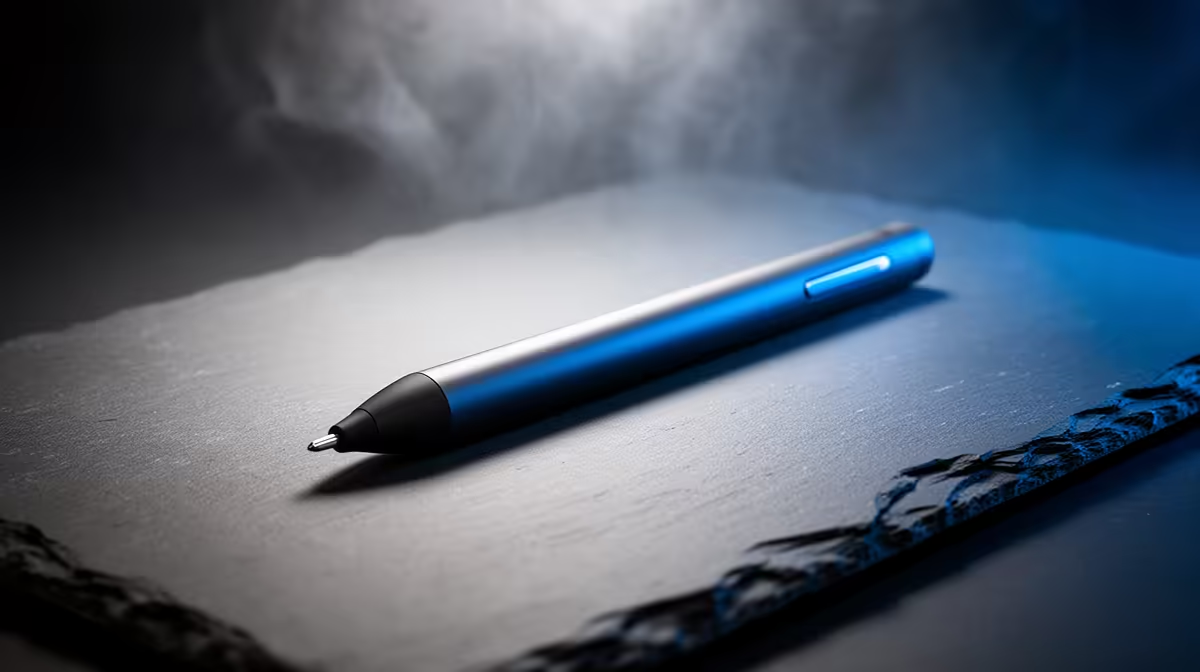
Every stylus pen contains a pressure sensor in its tip that outputs a number from zero to its maximum value whenever the nib contacts the screen. A 512-level pen maps the full range of physical pressure onto just 512 steps; a 4,096-level pen uses eight times as many. The drawing or notes app reads that number and translates it into brush opacity, stroke width, flow rate, or a combination of all three depending on your brush settings. The perceptible difference between 512 and 1,024 levels is significant: shaded gradients show visible banding at 512 that smooths out at 1,024. The jump from 1,024 to 2,048 is meaningful for professional drawing but less obvious in handwritten notes.
Practical Impact on Shading and Digital Art 🎨
Shading is where pressure levels matter most. When you hatch across a surface to build up shadow, each individual stroke varies in pressure as your hand moves. At 4,096 levels, that natural pressure variation is captured with enough granularity that strokes blend smoothly in post-processing. At 512 levels, the same strokes clip to visible pressure bands, giving the drawing a mechanical, stepped look. Specific workflows affected include pencil-sketch linework, ink brush lettering, digital watercolour glazing, and fine-art portraiture.
How Pressure Levels Affect Note-Taking 📓
For handwritten academic notes, pressure-level differences are less dramatic but still present. Writing at 4,096 levels produces natural-looking variation in stroke thickness that mirrors actual pen-on-paper handwriting, giving your notes a more readable, organic appearance. At 1,024 levels, handwriting looks slightly more uniform and mechanical. In OneNote, which renders ink thickness from pressure data, the difference is visible when zooming into notes. For students at design or architecture programmes where diagram quality matters, the extra fidelity is worthwhile. For STEM students taking text-heavy equation notes, 2,048 levels is a practical threshold that keeps costs lower without noticeable quality loss.
Adjust Your Pressure Curve for Lighter Hands ⚡
If you write or draw with a naturally light touch, the default pressure curve in most drawing apps will make your strokes appear too thin. Open the brush or pen pressure settings and shift the curve so that medium pressure triggers a fuller stroke. This small calibration change extracts far more usable range from your 4,096 levels and prevents wrist fatigue from pressing too hard.
FAQ
Is there a noticeable difference between 4,096 and 8,192 pressure levels?
For nearly all users, no. 8,192-level pens exist in the highest-end Wacom line, but drawing apps do not currently expose brush behaviour that takes meaningful advantage of the doubled resolution. 4,096 remains the practical ceiling that software is built around.
Do pressure levels affect latency?
No directly. Latency depends on the digitiser refresh rate and pen protocol implementation. A 4,096-level pen can have higher or lower latency than a 1,024-level pen depending on the hardware design. Check both specs independently.
At what pressure level should a student buy for cost efficiency?
For pure note-taking, 2,048 is the cost-efficient threshold and typically available in pens priced at R600 to R1,000 locally. For any creative or design work, stretch to 4,096 at the R1,000 to R1,800 range for noticeably better results.
Choosing between pressure-level tiers for your workflow?
Evetech stocks active stylus pens from entry-level to professional grade. Browse current stock to find the right pressure sensitivity for your studies or creative projects.