Quick Answer
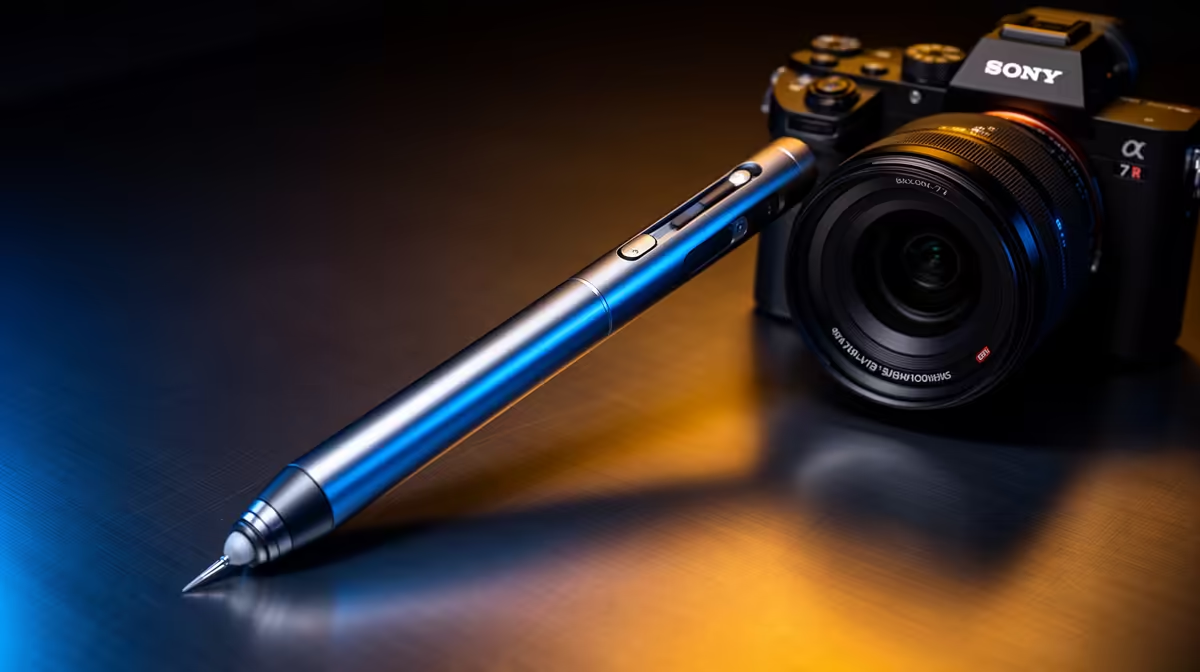
Tilt support lets a stylus detect the angle at which you hold it relative to the screen, typically up to 60 degrees in all directions. Software reads this angle data and rotates or widens the brush stroke to mimic how a real pencil, marker, or charcoal stick behaves when held at a slant.
The Mechanics of Tilt Detection 🔧
Inside a tilt-enabled active pen, additional sensors track the pen's lean away from vertical. This lean value is sent alongside pressure data to the host device. In drawing apps the two streams are combined: pressure sets line weight while tilt changes the stroke shape. Hold the pen nearly upright and you get a fine, circular tip; tilt it to 45 degrees and the stroke widens on the leaning side, exactly like shading with the side of a pencil. Most modern pens support tilt at 60 degrees of range across a full 360-degree azimuth, meaning the software knows not just how far you are tilting but in which direction. Wacom AES 2.0, MPP 2.0, and USI 2.0 all carry tilt data as part of their protocol, so compatible 2-in-1 laptops like the Microsoft Surface Pro or Lenovo Yoga receive the full information stream.
How Tilt Improves Shading and Sketching 🎨
For digital artists the most immediate benefit is shading speed. Without tilt, replicating a wide pencil-side stroke means switching to a flat brush and adjusting settings. With tilt, you hold the pen naturally at an angle and the software responds the same way a physical medium would. Hatching, cross-hatching, and soft graphite-style blending all feel intuitive. Calligraphers benefit too: the stroke width difference between a straight hold and a tilted hold mirrors a broad-nib fountain pen. Students producing handwritten diagrams or architectural sketches at institutions like the University of Pretoria or CPUT find tilt makes freehand geometry far more natural, because you can shade across surfaces in a single fluid motion.
When Tilt Support Matters Less 📋
For pure note-taking with typed annotation or basic handwritten text, tilt adds negligible value. Most people hold a pen upright when writing, so the tilt angle stays near zero and the software never calls on that data. If your primary use case is marking up PDF lecture notes or filling in digital forms, a standard 4,096-pressure pen without tilt saves R300 to R600 and performs identically for that workflow. The investment in tilt pays off specifically when you are drawing, illustrating, or producing anything where brush shape variety matters.
Calibrate Tilt in Your Drawing App First ⚡
Open the pen settings in Krita or Clip Studio Paint and run the tilt calibration tool before starting a project. Skipping this step often produces asymmetric strokes because the app assumes your screen is perfectly flat, which most laps and desks are not. The process takes under two minutes and immediately improves shading accuracy.
FAQ
Does tilt work in Microsoft OneNote?
OneNote on Windows reads basic pressure but does not interpret tilt data for stroke shaping as of current builds. You need a dedicated drawing app like Krita, Clip Studio Paint, or Adobe Fresco to see the tilt effect on brush shape.
Can I use a tilt-capable pen on any touchscreen laptop?
Only if the laptop has a compatible digitiser. Check for MPP 2.0 or Wacom AES 2.0 support in the spec sheet. A standard capacitive touchscreen does not read pen tilt, pressure, or hover data regardless of what the pen itself supports.
Is tilt support worth it for a student buying their first stylus in SA?
If you are studying design, architecture, or illustration, yes. For pure academic note-taking, prioritise pressure sensitivity and battery life first. A good 4,096-pressure pen without tilt in the R700 to R1,200 range serves most student needs perfectly.
Looking for an active pen that supports full tilt detection?
Evetech stocks active stylus pens with advanced tilt and pressure sensing, compatible with popular 2-in-1 laptops. Check what is currently available to match your device and creative workflow.