Quick Answer
Triple-shielding in a DisplayPort cable layers three distinct barriers: an inner foil around each twisted signal pair, a braided copper mesh around the full cable core, and a protective outer jacket. Together they reject electromagnetic interference (EMI) that would otherwise corrupt the 21.6Gbps signal, preventing the bit errors and link resets that appear as signal dropouts or brief black screens.
The Three Shield Layers and What Each Does 🔧
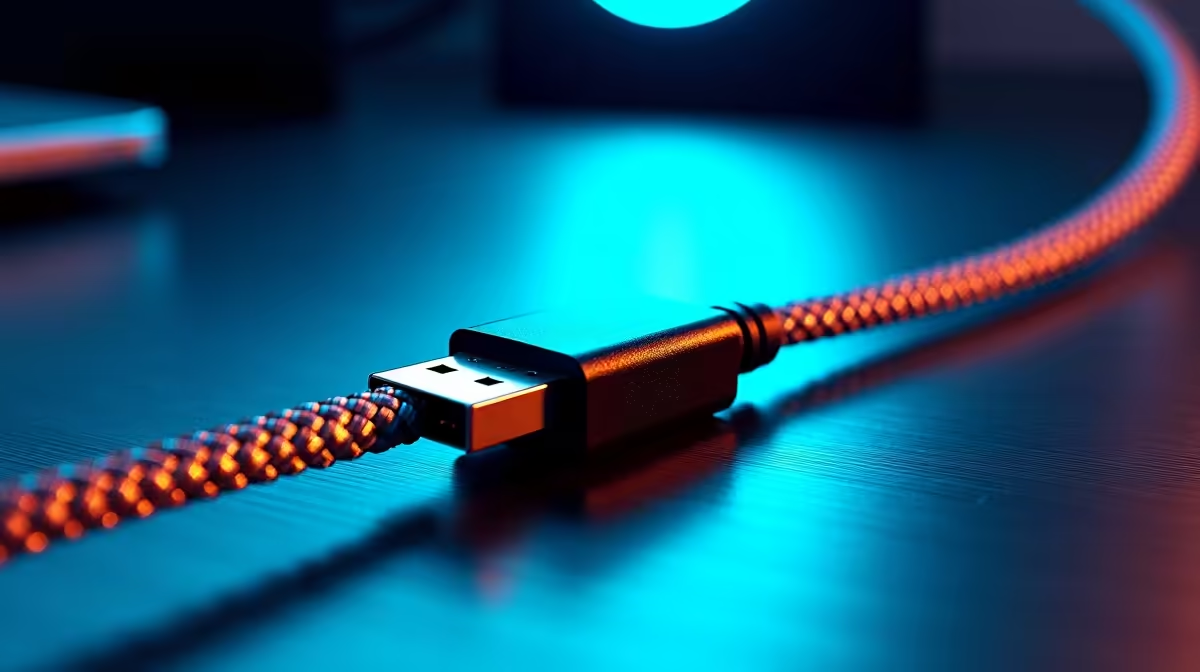
The inner aluminium or polyester foil wraps tightly around each individual twisted pair, providing high-frequency EMI rejection from nearby digital circuitry. This layer also prevents crosstalk between adjacent pairs inside the cable. The second layer is a copper or tinned-copper braid woven around the entire bundle, handling mid-frequency interference (1MHz to 100MHz) from switching PSUs, electric motors, and the 50Hz mains frequency common in South African wiring. The outer PVC or PE jacket provides physical protection against abrasion, moisture ingress, and bend fatigue that would degrade the inner shielding over time.
Why 21.6Gbps Signals Are Especially Vulnerable Without Shielding 🖥️
At DisplayPort 1.2 speeds, signal transitions happen billions of times per second. EMI sources that would be irrelevant at USB 2.0 speeds, such as an RGB fan controller, a wireless mouse dongle, or a PSU running at full load, produce noise that corrupts individual bits at these higher frequencies. DisplayPort uses differential signalling to reject common-mode noise, but without shielding, high-frequency fields from adjacent components overwhelm this rejection capability. Triple-shielded cables maintain bit-error rates below 10^-12, the DisplayPort specification threshold, even in electrically noisy South African gaming setups.
Practical Benefits for SA Gaming and Professional Setups ✨
A South African gamer running an RTX 5080 in a case crowded with RGB fans, a high-RPM liquid cooler, and multiple NVMe drives operates in an intense EMI environment. A triple-shielded DisplayPort cable routed near the PSU cable bundle or near USB hubs on the desk maintains clean signal delivery where a single-shielded cable might fail. Video editors in Johannesburg near broadcast equipment and multi-monitor rigs also benefit significantly. The price premium for triple-shielded over single-shielded cables is typically R50 to R150 for a 1.5m cable.
Route Away From PSU Cables ⚡
Inside your PC and behind your desk, keep the DisplayPort cable at least 5cm from power supply cables and mains extension leads. Power cables radiate 50Hz EMI continuously. Triple shielding resists this but routing away from the source maximises its effectiveness.
FAQ
Does triple shielding affect DisplayPort cable flexibility?
Triple-shielded cables are slightly stiffer than single-shielded options due to the additional braid layer, but quality cables with a flexible PVC outer jacket remain manageable for desk setups. Use cable clips to relieve bend stress at connector entry points.
How do I test whether my cable's shielding is adequate?
Run a sustained 4K signal and watch for pixel errors when nearby interference sources are active. If artefacts disappear when you move specific devices away, shielding is insufficient. A certified triple-shielded cable eliminates this behaviour.
Is triple shielding worth it for 1080p displays?
At 1080p@60Hz, single-shielded cables are adequate in most environments. Triple shielding becomes increasingly important above 1440p at high refresh rates, where the signal density makes the cable more susceptible to ambient interference.
Want to eliminate signal dropouts from your high-resolution display setup?
Evetech stocks triple-shielded DisplayPort cables tested for sustained 21.6Gbps performance in demanding South African setups.