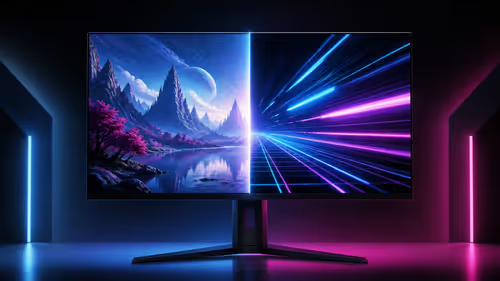
Colour adjustments are most useful when they begin with a repeatable viewing environment. To optimise 100% sRGB on a portable monitor, preserve a neutral baseline, separate coverage from accuracy and judge the exact work that will appear on screen.
Quick Answer
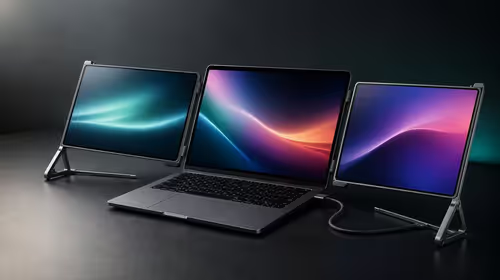
The panel covers 100% sRGB and uses NxtLED architecture to maintain vivid, accurate colour across changing light levels and wide viewing positions.
UPERFECT's R2,499 colour reference covers 100% sRGB on an 18.5-inch 1920x1080 IPS panel. Use neutral display controls, steady room lighting and a suitable calibration method where measured accuracy matters; sRGB coverage alone is not an accuracy result.
🎨 Understand what the percentage means
sRGB is a defined colour space used across common digital content. A 100% sRGB specification describes coverage of that space, while accuracy concerns how closely displayed colours match target values. One does not automatically prove the other.
Begin by identifying the workflow. General browsing, illustration, photo review and final colour approval may need different levels of assurance. A creator delivering colour-sensitive work should use an appropriate measuring instrument and controlled process rather than relying only on a visual impression.
The monitor's IPS technology and 178-degree viewing specification provide useful context for shared viewing. Even so, keep the main viewer centred and the screen angle fixed during adjustments.
Compare other panel choices through Evetech's portable monitor department when the workflow requires a different size or measurement set.
💡 Establish a neutral room and screen
Avoid direct sunlight, strongly coloured wall reflections and rapidly changing lamps during colour work. Let the eyes adapt, then display neutral greys and familiar reference images before altering controls.
Reset unknown picture changes or record them before starting. Keep colour temperature, contrast and any application profile consistent. If several settings move together, there is no clean way to identify which change improved the result.
Reflected light is addressed by the paper-like finish and the separate NxtLED Omni Visible treatment. Neither sets room illumination or establishes panel brightness, so position the display deliberately.
🔍 Check gradients, neutrals and real work
Use a small review set containing skin tones, saturated colours, shadow detail, smooth gradients and neutral greys. Look for clipping, banding and unwanted casts while keeping the same source, application and viewing position.
The 1920x1080 resolution defines the Full HD pixel grid across 18.5 inches. Select the native mode and comfortable scaling before evaluating fine detail; a mismatched output can make interface and image review less reliable.
If a hardware calibrator is part of the workflow, follow its process and save the resulting profile for the correct display. Record the date and conditions so a later check can reproduce the setup.
🧭 Keep colour behaviour consistent
Verify the screen from the main seat first, then move to the side only to assess how a collaborator's view changes. A 178-degree viewing figure is not a promise that every angle presents identical measured colour.
For portable use, note the room conditions each time the setup moves. A profile created under one environment cannot control sunlight, wall colour or source application settings elsewhere.
Choose cables, stands or other items from the Evetech monitor accessory range after their specific job in the colour station is clear. Finish by saving both the neutral baseline and any calibrated profile.
Before sign-off, reopen one completed project whose colour is already understood. A known file provides a practical cross-check for the instrument result and may reveal an application profile or export setting that was overlooked.
Start from an sRGB workflow rather than pushing saturation beyond the panel's intended colour space. Omni Visible keeps brightness and colour more uniform across the 178-degree field, reducing edge darkening that can mislead a visual comparison. Flicker-free performance, DC dimming and low-blue-light protection are comfort features, not reasons to alter the colour target. Use a known reference image and keep the final working brightness appropriate to the room.
For repeatable colour work, keep ambient light and viewing position consistent between editing and approval. Wide-angle stability helps, but it cannot make two differently lit rooms an identical judging environment.
Frequently Asked Questions
Does full sRGB coverage prove accurate colour?
No. Coverage describes gamut reach, while accuracy requires comparison with target values under a controlled method.
Which display mode should be selected first?
Use the native 1920x1080 output with comfortable scaling before judging gradients, text or fine image detail.
Why keep the main viewer centred?
A fixed position removes viewing angle as a changing variable while settings or profiles are being assessed.
What belongs in a colour setup record?
Save room conditions, source, application, display controls, profile and review date so the result can be repeated.
Ready to make colour choices from a stable baseline?
Define the required assurance, then compare portable displays and purpose-matched monitor accessories through Evetech.