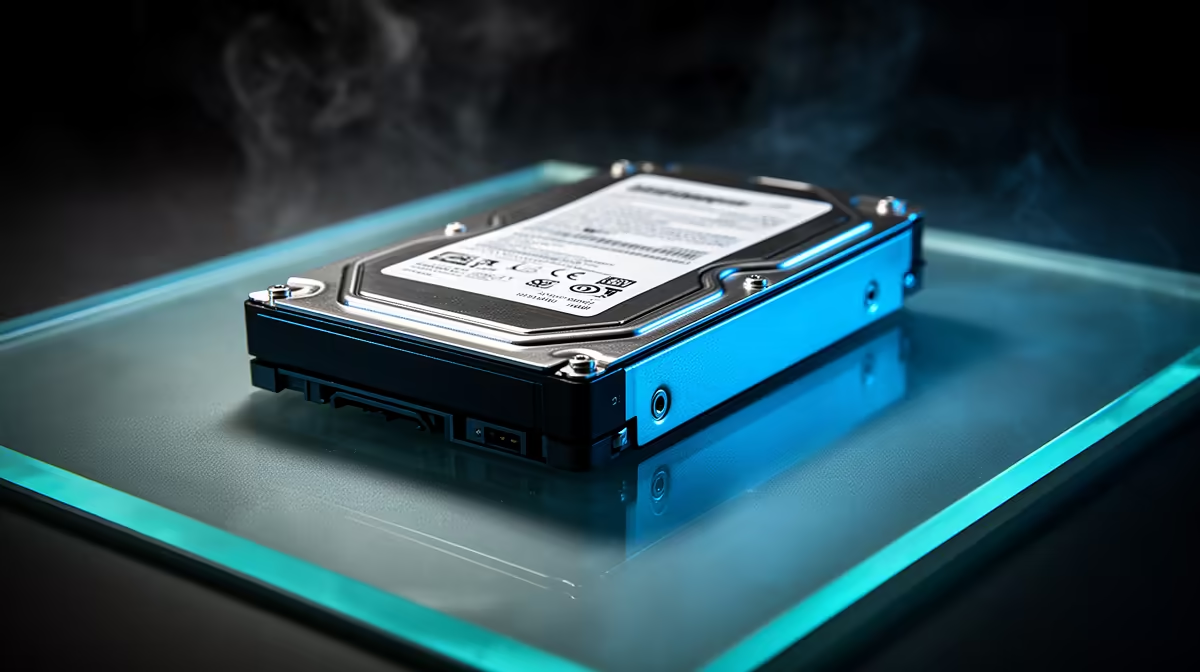
Spec sheets for storage drives all look roughly similar until you actually run one under a full camera load, and by then a wrong purchase is already installed and struggling. Knowing what actually separates a general-purpose drive from a genuine surveillance hard drive before you buy saves that entire headache.
Quick Answer
For an AI NVR, prioritise workload rating, RPM, supported stream count and firmware built for continuous recording rather than general desktop use. The Seagate SkyHawk AI, R19,499 for 24TB, covers all four with a 550TB per year rating, 7200RPM spin speed, support for 64 HD plus 32 AI streams, and ImagePerfect AI firmware.
✅ Four Things to Check Before Buying
Workload rating tells you how much sustained write activity the drive is actually built and warrantied for, which matters far more for continuous recording than for occasional desktop use. RPM affects how quickly the drive can keep pace with multiple simultaneous camera feeds, with 7200RPM generally handling higher channel counts more comfortably than 5400RPM.
Stream count support, meaning how many camera feeds the drive and its firmware are designed to handle concurrently, should match or exceed your actual camera count with some headroom. Firmware built specifically for surveillance and analytics workloads, rather than adapted from general desktop use, rounds out the checklist.
Reading Between the Lines on Spec Sheets
Not every listing states these figures clearly. If a workload rating or stream count is not published, treat that as a sign the drive was not specifically engineered for surveillance duty, even if the capacity figure looks attractive. A genuine surveillance model will almost always list its workload rating, MTBF and supported stream count prominently, since these are the numbers installers actually check before recommending a drive for continuous duty.
🛡 Why Reliability Figures Deserve Attention Too
A 2.5 million hour MTBF and CMR platter technology, both present on the SkyHawk AI, indicate a drive built for years of continuous operation rather than intermittent use. These figures are worth checking against any drive you are considering, since a lower MTBF or shingled recording technology can translate into real reliability differences once the drive is running 24/7.
🔎 Where to Compare Before You Commit
The SkyHawk AI 24TB product page lists the full spec sheet and current price for this specific drive, while Evetech's internal drive stock lets you compare it against other capacities and RPM tiers. For a broader look across the category, the general hard drives range is worth checking too before finalising a purchase.
Frequently Asked Questions
Is capacity the most important factor when buying?
Capacity matters, but workload rating and stream count support are equally important for an AI NVR, since a large drive not built for sustained writes will still struggle under continuous recording.
Should I always choose the drive with the highest RPM?
Not necessarily. Match RPM to your actual channel count; smaller installations do not need the highest spin speed available.
Does firmware really make a measurable difference?
Yes, firmware tuned for surveillance and analytics workloads handles the combined read and write pattern more consistently than general desktop firmware under the same load.
What is a reasonable workload rating for a busy site?
Something in the region of 550TB per year comfortably covers continuous 24/7 recording across a high channel count, which is the figure this drive carries.
Is MTBF a guarantee of how long the drive will last?
No, MTBF is a statistical reliability figure rather than a guarantee for any individual unit, but a higher figure generally reflects a more robust design.
Ready to shop for an NVR drive with real confidence?
Check workload rating and capacity in Evetech's surveillance storage lineup, then add the SkyHawk AI 24TB to your cart.