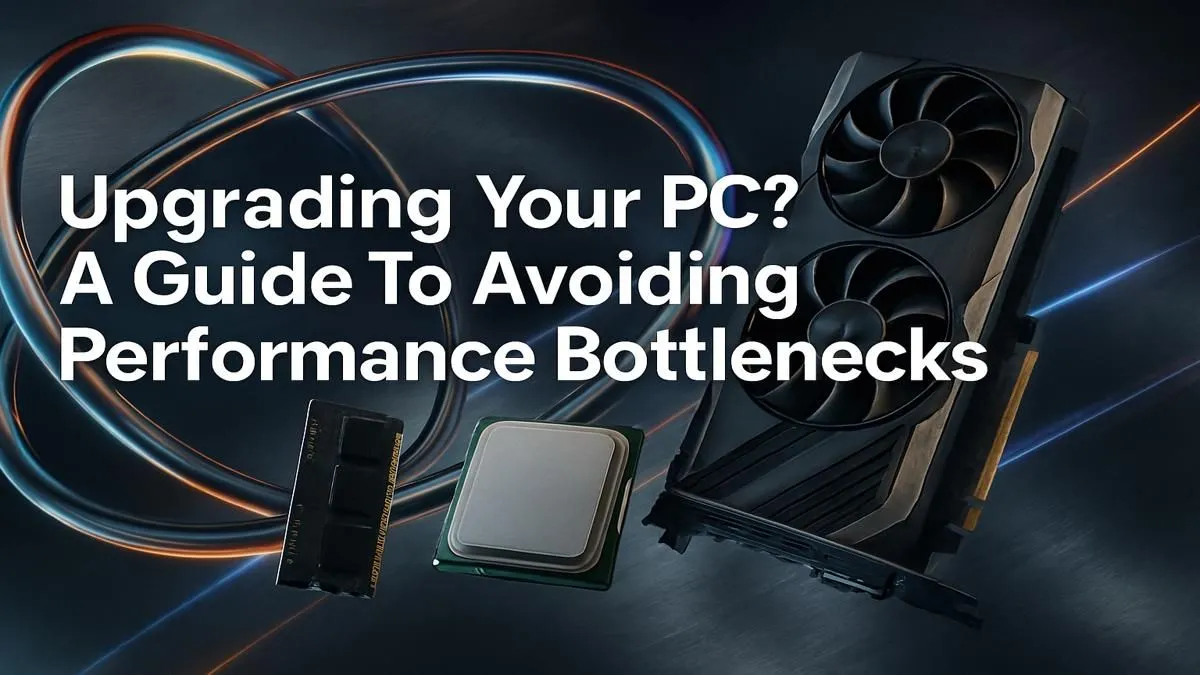
Just dropped a powerful new graphics card into your rig, but your frame rates are still stuttering in the latest titles? That frustrating feeling is likely a PC upgrade bottleneck. It’s when one component holds back the true potential of your entire system, creating a performance ceiling you can't seem to break. Don't worry, we’ve all been there. This guide will help you diagnose the choke point and plan a balanced build for smooth, high-FPS gaming. 🚀
What is a PC Upgrade Bottleneck?
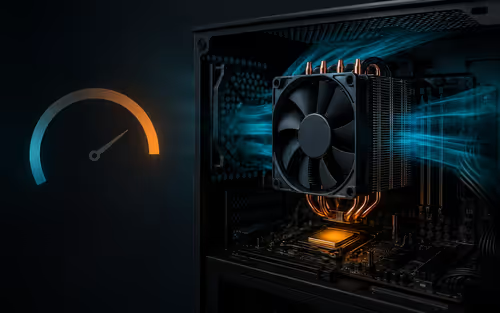
Think of your PC like a factory assembly line. If you have one station that’s much slower than the others, the whole production slows down. A PC upgrade bottleneck works the same way. Your brand-new GPU might be capable of rendering 144 frames per second, but if your older CPU can only process data for 70, you're stuck at 70 FPS.
The most common culprits are the CPU (Central Processing Unit) and GPU (Graphics Processing Unit) being mismatched. However, slow RAM, an old hard drive, or even an underpowered PSU can also create a system bottleneck, limiting your performance in subtle but significant ways. The goal isn't a "perfect" build... it's a balanced one that works for you.
Identifying the Choke Point in Your System
So, how do you find the lazy worker on your PC's assembly line? The easiest way is to monitor your component usage while you're gaming.
- Fire up your favourite game.
- Press
Ctrl+Shift+Escto open the Windows Task Manager and click the "Performance" tab. - Pay close attention to your CPU and GPU usage percentages.
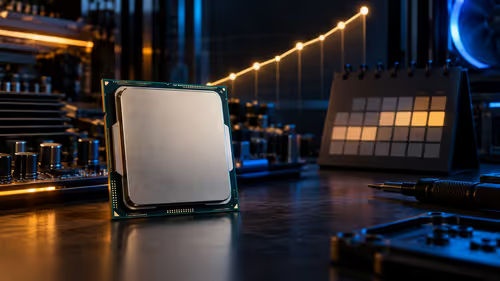
If your CPU is constantly hitting 90-100% usage while your GPU is sitting at 60%, you have a CPU bottleneck. Your processor simply can't keep up with the data your graphics card needs. Conversely, if your GPU is maxed out at 100% and your CPU is barely breaking a sweat, you have a GPU bottleneck—which is often the ideal scenario for gamers, as it means you're getting the most out of your graphics card. If you suspect your processor is the weak link, it might be time to browse the latest CPU processors online.
Upgrade Checklist 🔧
Before you buy a new CPU, always double-check your motherboard's socket type (e.g., AM5 for modern AMD, LGA 1700 for recent Intel) and chipset compatibility. A quick visit to your motherboard manufacturer's website can save you a massive headache. Your motherboard's BIOS may also need an update to support a newer processor!
Creating a Balanced Build for Your Next Upgrade
Avoiding a future PC upgrade bottleneck is all about smart pairing. You wouldn't put a V8 engine in a go-kart, and the same logic applies to PC components. When planning your upgrade, focus on creating a synergistic relationship between your parts.
The Core CPU & GPU Partnership
This is the heart of your gaming rig. A top-tier graphics card like an NVIDIA RTX 4080 needs a capable CPU to feed it information. For Team Red fans, pairing a new Radeon GPU with one of the latest AMD Ryzen CPUs is a fantastic way to build a powerful and efficient system. ⚡
On the other side, Team Blue loyalists will find that a modern Intel Core processor delivers the incredible single-core performance that many competitive esports titles thrive on. The key is to match components from a similar generation and performance tier to ensure neither part is left waiting on the other.
A balanced build ensures every rand you spend on an upgrade translates directly into tangible performance, giving you the smooth, immersive experience you paid for.
Ready to Break the Bottleneck? A balanced PC is a happy PC. Stop letting one slow component ruin your gaming experience in South Africa. Explore our massive range of PC components and find the perfect upgrade to unleash your rig's true power.