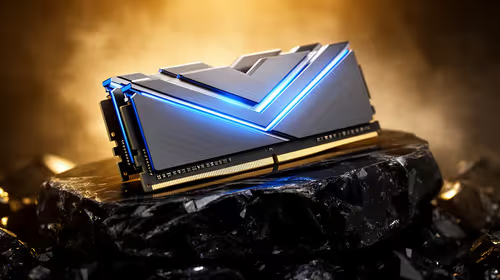
So, you’ve just spent your hard-earned Rands on some shiny new RAM or a super-fast SSD, dreaming of buttery-smooth frame rates... but now your gaming laptop won't even boot? Eish. You’re not alone. Gaming laptop upgrade problems are a real headache for many South African gamers. Before you consider using that expensive machine as a doorstop, let’s walk through some common issues and how to fix them, right here, right now. 🔧
Common Gaming Laptop Upgrade Problems (And How to Fix Them)
Trying to breathe new life into an older machine is a classic move, but it's not always plug-and-play. Here are the most frequent gaming laptop upgrade problems we see and how to troubleshoot them.
Problem 1: The Black Screen of Doom (No Boot)
You press the power button, the lights flicker, but the screen stays stubbornly black. It’s a heart-stopping moment.
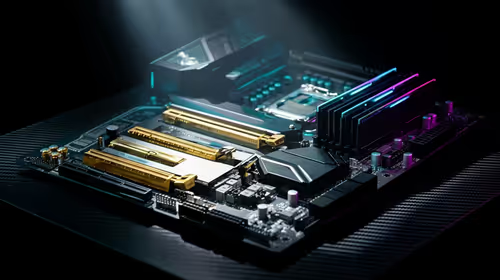
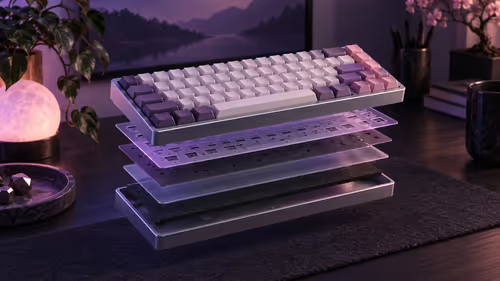
- Reseat the Component: The most common culprit is a component that isn't seated correctly. Power down completely, unplug the battery if you can, and carefully reinstall the RAM or SSD. Make sure it clicks firmly into place.
- Check Compatibility: Did you buy the right part? Laptops are notoriously picky. DDR4 RAM won't work in a DDR5 slot, and some M.2 SSDs (SATA vs. NVMe) have different key notches. Double-check your laptop's specs against what you bought.
- BIOS/UEFI Reset: Sometimes, a hardware change confuses the system's basic input/output system (BIOS). Try booting into the BIOS (usually by pressing F2, F10, or DEL on startup) and loading default settings.
Pro Tip: The Power Cycle Trick ⚡
If you've tried reseating and are still getting a black screen, perform a full power drain. Unplug the AC adapter, disconnect the main battery, and then hold the power button down for 30 seconds. This clears any lingering electrical charge and can often resolve mysterious boot issues after an upgrade.
Problem 2: Performance is Worse, Not Better
You upgraded your RAM, but now games are stuttering? This is a classic sign of a bottleneck. Your upgrade might be highlighting a weakness elsewhere in your system. For example, a powerful CPU like those found in Intel Core i7 gaming laptops can't reach its full potential if it's paired with slow, old storage. Likewise, adding more RAM won't magically boost your FPS if your graphics card is the component struggling to keep up with modern titles.
Sometimes, the real upgrade needed is a more powerful GPU, which is often impossible on a laptop. If you're craving that next-level visual fidelity, exploring current GeForce RTX gaming laptops on special might be the most effective path forward.
Problem 3: The New Component Isn't Detected
You boot into Windows, and your shiny new 2TB SSD is nowhere to be found. Don't panic!
- Initialise the Drive: New drives often need to be initialised and formatted before Windows can see them. Open "Disk Management" in Windows (just search for it in the Start Menu). You should see your new drive as "unallocated." Right-click it, select "Initialise Disk," choose the partition style (GPT is best), and then right-click the unallocated space to create a "New Simple Volume." Follow the wizard, and your drive will appear. ✨
When an Upgrade Isn't the Answer
While adding RAM or an SSD can provide a great boost, there's a ceiling. The core components of a laptop—the CPU and GPU—are almost always soldered to the motherboard. You can't swap out your old GTX 1050 for an RTX 40-series card. If your processor is the bottleneck, no amount of extra RAM will fix it.
This is where you need to weigh the cost vs. the benefit. Spending a few thousand Rand to upgrade an old machine might only give you a minor boost. Sometimes, putting that money towards a new rig is the smarter long-term investment. With fantastic options available, you can find powerful gaming laptops under R20k that offer a balanced experience, or push the boat out for high-end performance with a machine above R20k.
Finding Your Perfect Upgrade Path... Or a New Rig 🚀
Ultimately, troubleshooting gaming laptop upgrade problems comes down to understanding your machine's limits. For some, a simple SSD swap is all that's needed. For others, it's the first sign that it's time for a completely new setup. Whether you're team blue with Intel gaming laptops or team red with the latest from AMD Ryzen, the goal is the same: a smooth, immersive gaming experience.
Before you get the screwdriver out again, take a moment to browse the best gaming laptop deals currently available. You might find that the perfect upgrade comes in a brand-new box.
Tired of Troubleshooting? Maybe It's Time for a Fresh Start.
Upgrading can be rewarding, but sometimes the best upgrade is a whole new machine. If you're hitting the limits of your current rig, explore our massive range of laptop specials and find a rig that's ready to dominate, straight out of the box.