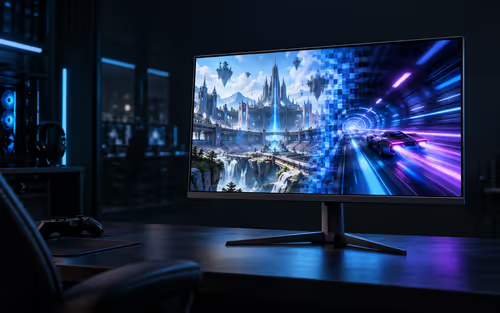
So, you’ve just dropped some serious cash on a powerful gaming rig. The RGBs are glowing, the GPU is purring, and you’re ready to dominate. But wait... you’ve plugged it into that old office monitor from 2012. Big mistake. Pairing a high-performance PC with a basic screen is like putting retreads on a Ferrari. 🤦♂️
This budget gaming monitor guide is for every South African gamer who wants to unlock their PC's true potential without emptying their wallet.
Why Your Monitor is Your Rig's Unsung Hero
It's easy to get fixated on CPUs and GPUs, but your monitor is the final gateway for all that power. It translates your PC's hard work into the smooth, crisp visuals you actually see. A slow, low-refresh-rate screen creates a bottleneck, meaning you won't experience the high frame rates your graphics card is producing. You're literally leaving performance on the table.
Whether you've snagged one of the best gaming PC deals or built your own beast, a proper display is non-negotiable for a premium experience. It’s the difference between seeing the enemy a split-second sooner and seeing the respawn screen.
The "Big Three" Specs for a Budget Gaming Monitor
When you're hunting for value, you need to know where to focus your rands. Forget confusing marketing terms and concentrate on these three core specifications. This is the heart of any good budget gaming monitor guide.
Refresh Rate (Hz): The Smoothness Factor 🚀
Refresh rate, measured in Hertz (Hz), is how many times your screen updates with a new image per second. A standard office monitor is 60Hz. A good gaming monitor starts at 120Hz, but the sweet spot for value is 144Hz or 165Hz.
This higher rate makes motion incredibly smooth, giving you a tangible advantage in fast-paced games like Valorant or Apex Legends. Many modern budget gaming PCs are perfectly capable of pushing the frames needed to take full advantage of a 144Hz screen.
Resolution: The 1080p vs 1440p Question
Resolution is all about clarity. While 4K is the dream, it requires a monster PC to run games smoothly. For an affordable gaming monitor, the real debate is between Full HD (1920x1080) and Quad HD (2560x1440).
- 1080p: This is the undisputed king of budget performance. It’s less demanding on your GPU, allowing even PCs under R20k to achieve high frame rates, making it perfect for competitive gaming.
- 1440p: Offers a significant jump in sharpness and detail, ideal for immersive single-player games. You'll need a bit more graphical horsepower, but prices have become much more accessible.
Response Time (ms): Banishing Motion Blur
Response time measures how quickly a pixel can change colour. A slow response time results in "ghosting" or motion blur, where moving objects leave a faint trail. For gaming, you want a response time of 5ms or less, with 1ms being the gold standard. This ensures your image stays sharp and clear, even in the most chaotic moments.
Pro Tip: Enable Adaptive Sync! ⚡
Your new monitor likely has AMD FreeSync or is G-SYNC Compatible. This amazing tech syncs your monitor's refresh rate with your GPU's frame output to eliminate ugly screen tearing. It's often off by default, so dive into your NVIDIA Control Panel or AMD Radeon Software and make sure it's enabled. It's a free performance boost!
Beyond the Basics: Panel Types and Extra Features
Not all pixels are created equal. The underlying panel technology affects colour, contrast, and viewing angles.
- IPS (In-Plane Switching): Best-in-class colour accuracy and viewing angles. Once slow, modern IPS panels are now fast enough for competitive gaming, making them a fantastic all-round choice.
- VA (Vertical Alignment): The kings of contrast. Blacks look deeper and colours pop more. They're a great middle-ground, though sometimes have slightly slower response times than IPS.
- TN (Twisted Nematic): The original speed demons. While their colours and viewing angles are the weakest, they can offer the absolute fastest response times for a low price, but are becoming less common as IPS tech improves.
Even if you're looking at a powerful machine from our range of pre-built PC deals, matching it with the right panel type will elevate your entire experience.
Your Quick-Fire Buying Checklist ✨
Feeling overwhelmed? Don't be. Here's a simple way to choose the best affordable gaming monitor for you:
- Set Your Budget: Decide how much you can spend. You can find excellent 1080p 144Hz+ monitors for a surprisingly good price.
- Know Your Games: If you mainly play competitive shooters, prioritise refresh rate and response time (1080p @ 144Hz+). For cinematic adventures, a 1440p VA or IPS panel might be a better fit.
- Check Your PC's Power: Your monitor and PC should be a balanced team. There's no point getting a 1440p monitor if your rig struggles to run games at that resolution. This is true whether you have a mid-range machine or one of the top-tier PCs above R20k.
- Confirm Adaptive Sync: Ensure the monitor supports FreeSync or is G-SYNC Compatible. This is a must-have feature.
Ready to See the Difference? A great monitor is the final piece of the puzzle for any gaming rig. Stop letting a slow screen bottleneck your performance. Explore our massive range of gaming monitors and find the perfect display to make your games shine.