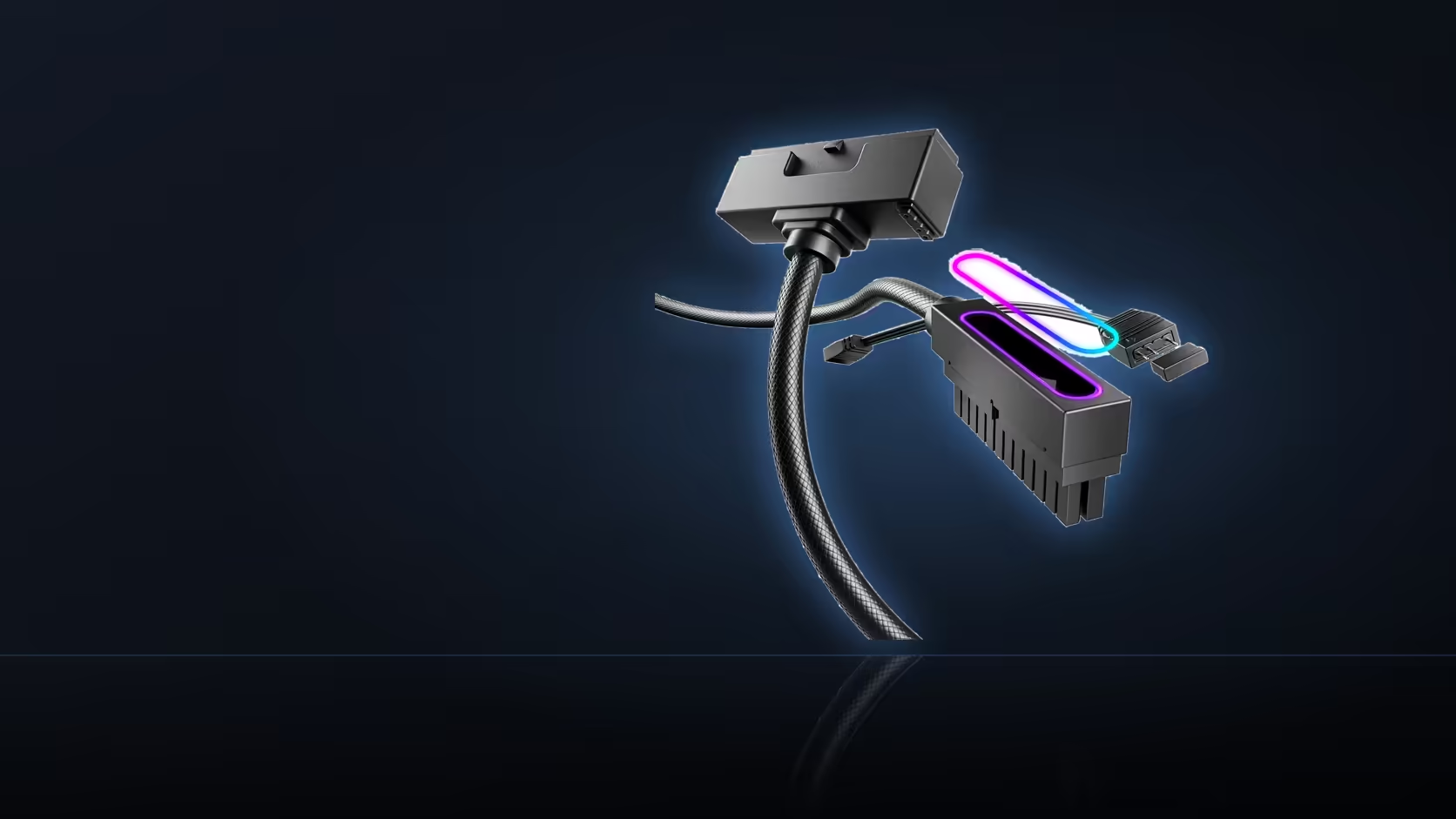
AsiaHorse does not bury the caveat on its side-exit Hydrus cables in fine print somewhere - it states plainly that board compatibility is limited. That is worth taking at face value rather than assuming it applies to someone else's build and not yours.
Quick Answer
AsiaHorse flags board compatibility as limited on the side-exit versions. The clearance around your 24-pin socket has to be checked first. This is not a general-fit product, and measuring beside that socket decides whether it can be used.
📏 What exactly needs measuring
The specific space that matters is the free area immediately beside the 24-pin socket, in whichever direction the particular side-exit head you are considering will actually turn - left for one variant, right for the other. That is the space the connector body physically has to occupy once fitted, and it is a fundamentally different measurement from checking whether the cable has room to run somewhere further along its route.
🚧 What commonly blocks that space
A range of components regularly compete for the exact space a side-exit head needs: board-mounted heatsinks positioned near the socket, drive connectors, various headers crowded into the same general area, and sometimes even the physical edge of the tray cutout itself intruding into the space. Any one of these can block a sideways-turning head from seating properly, even when the straight-down version of the same cable would have fitted without any issue at all.
➡️ Why this warning is specific to side-exit versions
The standard straight-down ATX cable drops directly away from the board toward the tray below, which means it never actually competes for space alongside the socket itself the way a side-exit head necessarily does - it simply is not affected by whatever components happen to be crowding the socket's immediate left or right. This compatibility concern belongs specifically to the two directional variants, not to the Hydrus ATX family as a whole.
🔍 Checking clearance without the part in hand
Before the physical piece arrives, measure the actual free space beside your board's socket directly and compare that measurement against the product's own images, which typically show how far the head extends sideways once fitted - a useful reference even without the cable physically present to test. Where the resulting clearance looks marginal rather than clearly sufficient, choosing the straight-down version instead is the safer call: a head that only just barely fits initially tends to make future access to that corner of the board considerably more difficult later, even if it technically seats on the first attempt. Board size on its own does not reliably predict this either - a genuinely compact board can still have generous clear space directly beside its socket, while a considerably larger board crowds that same area with extra headers and heatsinks, so the actual layout around the socket matters far more than the board's overall form factor. None of this reflects a fault in the product itself; it is simply a consequence of the underlying geometry, since a head that turns sideways inherently needs physical room to make that turn, and AsiaHorse states the limitation openly rather than leaving buyers to discover it the hard way after ordering. cable solutions covers the rest of this piece's shelf, and boards ruling out a side-exit fit entirely still have accent options worth a look at NZXT case lighting.
📸 A practical way to compare space against the product photo
Take a straight-on photo of the socket area from roughly the same angle the product listing uses for its own images, then hold the two side by side on a screen. Comparing like-for-like angles this way makes the head's actual footprint far easier to judge honestly than trying to estimate clearance purely from memory after putting the phone down.
Frequently Asked Questions
What exactly needs measuring?
The space immediately beside the 24-pin socket in the direction the head will exit, since that is where the connector body has to sit.
What commonly sits in that space?
Board heatsinks, drive connectors, headers and sometimes the edge of the tray cutout, any of which can block a sideways head.
Is this warning specific to side-exit versions?
Yes. The straight-down ATX cable drops away from the board, so it does not compete for space alongside the socket.
How do I check without the part in hand?
Measure the free space beside the socket and compare it against the product images, which show how far the head extends sideways.
What if the clearance is marginal?
Choose the straight-down version. A head that only just fits will make future access difficult even if it seats initially.
Does board size decide it?
Not directly. A compact board can have clear space beside the socket while a larger one crowds it, so the layout matters more than the format.
Is the limitation a fault in the product?
It is a consequence of the geometry. A head that turns sideways needs room to turn, and AsiaHorse states that openly rather than leaving it unsaid.
Measuring your board before ordering a side-exit cable?
Have a look at Evetech's power supply range and check the clearance beside your socket first.