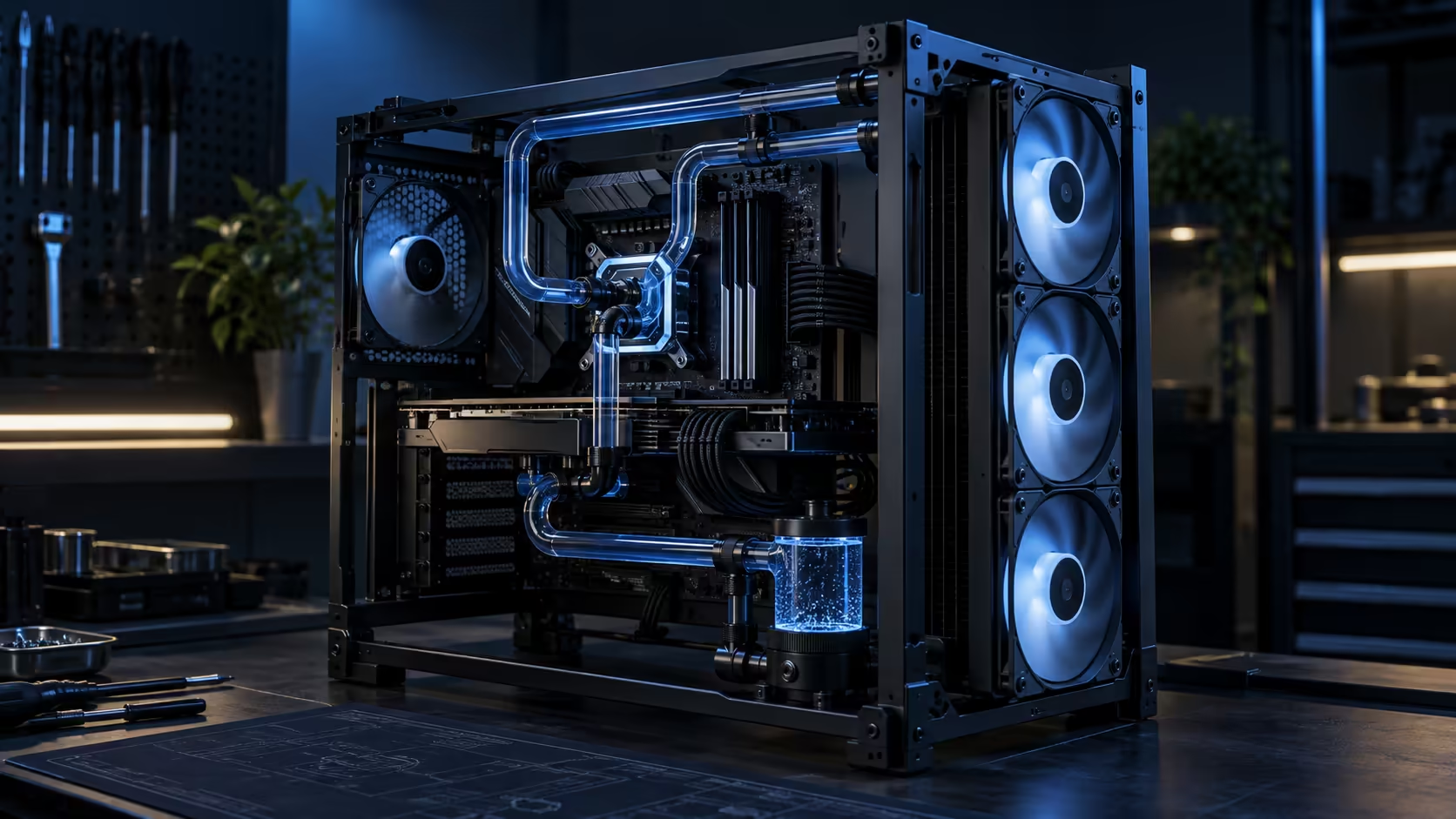
An open frame removes the one thing a normal case spends its engineering budget on: the wall between your components and the room. That changes the build order. In an open-frame gaming PC the radiator no longer competes with a front panel for intake, so the question stops being how many fans you can fit and becomes where the heat leaves from. The ROG GR20 Edition 20 at R15,999 makes that decision easy to get wrong, because it lets you mount almost anything anywhere.
Quick Answer
Put the 360mm radiator in the roof as exhaust, leave the open side as unrestricted intake, and let the bundled crossflow fan sweep air across the board. The GR20 Edition 20 costs R15,999, takes a 360mm radiator or three 120mm fans, and clears graphics cards up to 368mm, so the build order matters more than the fan count.
🔧 Decide the orientation before you fit a single screw
The GR20 stands vertically, at an angle, or flat on its side, and that choice drives everything after it. Pick it first, because moving a filled radiator later means draining nothing but costs you an hour of unscrewing.
Vertical behaves like a conventional tower. Heat rises through the frame, a roof-mounted radiator exhausts into the room, and the footprint on the desk stays small. Angled is the display orientation, and it is the one to choose if the machine sits on a desk you look at rather than under one. Flat is the widest and the most stable, and it is the friendliest to a heavy card, because the PCIe slot carries far less leverage when the card lies horizontally.
On a 368mm card, orientation is not a style question. A card that long sitting vertically puts real sag load on the slot and the bracket, and an open frame gives you no case floor to rest a support arm on. If you are fitting a card near that limit, plan the support at the same time as the orientation.
⚡ Radiator in the roof, pump below the top of the loop
With an all-in-one cooler, the rule that matters is air. Air collects at the highest point of the loop, and you want that to be the radiator, not the pump. A pump running with air trapped in it makes a gravelly rattle and wears out early.
Roof-mounting the 360mm radiator puts it above the CPU block and satisfies that on its own. Pointing the radiator fans outward as exhaust keeps warm air out of the frame and lets the open side do the intake work with no restriction at all.
If the layout forces the radiator to the side instead, keep the tubes at the bottom of the radiator, so the highest point of the loop is still radiator and not pump. That single detail causes more warranty questions on liquid coolers than any other. The liquid cooler range lists radiator sizes against each model, which is the number to check against the 360mm the frame supports.
🌬️ What the crossflow fan is actually for
A crossflow fan is a drum rather than a propeller. Instead of pushing a cone of air forward, it throws a broad, flat sheet sideways across a surface. That is why it appears on an open frame: the parts that suffer most without a case are the ones a round fan never points at, such as M.2 drives lying flat on the board, VRM heatsinks near the socket, and RAM sitting in still air.
Mount it so the sheet travels across the board rather than into it. Aimed straight down at the motherboard you get turbulence; aimed across, you get a moving layer over every surface at once.
Connect it the way its header calls for. Fan headers vary in whether they offer speed control at all, and the wrong header type is why a fan sometimes runs flat out no matter what the BIOS says. Check the header on the fan and the matching header on your board before you route the cable behind the frame, because rerouting it afterwards on an open build means undoing your cable work in full view.
🏠 Living with an open frame in a South African home
This is the part the spec sheet does not cover, and it is the main reason people either love an open build or regret it.
Dust is the obvious one. A closed case filters its intake; an open frame has no intake to filter, so dust lands directly on heatsinks and fan blades. On the Highveld, through a dry, windy August, that is a real rate, not a theoretical one. Plan on a can of compressed air and ten minutes every second month, and put the machine on a desk rather than on the floor where the dust concentration is highest.
Summer ambient temperature matters more too. An open frame is better at rejecting heat into the room, which also means it is more exposed to the room. A closed study at 32 degrees gives the radiator warmer air to work with, so an open build benefits more than a closed one from simply opening a window or moving the desk off a west-facing wall.
Then there is the household. Exposed fans, an exposed graphics card and a visible power cable are not a good mix with a curious toddler or a cat that likes warm surfaces. If either lives with you, the flat orientation on a high desk is the sensible answer, and the power supply cabling is worth routing tight against the frame rather than letting it loop.
🧰 Build order that saves rework
Mount the board and the cooler block first, then the radiator, then the power supply, then the graphics card last. On a closed case the card usually goes in before cable management; on an open frame it goes in last, because every cable you route afterwards is visible and because a 368mm card blocks access to the lower board edge.
Test outside the frame if you can. Post the board with CPU, one stick of RAM and the cooler on a bench before it is bolted in. On a build where everything is visible, finding a dead stick after final cable routing is an hour of work you did for nothing. Compare frames in the case range if you have not committed yet, since board size and radiator support differ far more between open frames than between towers.
Frequently Asked Questions
Does an open-frame case actually run cooler?
Nothing stands between the room and the hardware, so parts draw in air at close to ambient rather than air already warmed by a restricted front panel. You pay for that in dust and in noise, since the panels doing the damping are gone.
Where should the 360mm radiator go?
In the roof as exhaust, with the fans pushing warm air out of the frame. That keeps the radiator above the pump and lets the open side handle intake.
Will a 368mm graphics card sag in an open frame?
Vertically, a card that long puts real load on the slot. Either mount the frame flat or fit a support bracket at the same time as the card.
How often does an open build need cleaning?
Plan on a quick blow-out every second month in a dry, dusty season, and more often if the machine sits on the floor rather than on a desk.
Can I use three 120mm fans instead of a radiator?
Yes. The frame supports a 360mm radiator or three 120mm fans in the same position, so an air-cooled build fits the same mounting points.
Ready to build something you actually want to look at?
Settle the orientation and the radiator position first, then pick the cooler and power supply around them.