A blank screen on a freshly assembled rig almost always traces back to the signal path rather than a dead component, so work outward from the cable before you panic.
Quick Answer
A no-signal screen on a wi-fi 7 router setup is almost always a wrong input, a tired cable, the motherboard port, or a driver state, not a dead card. Trace the physical signal path first, then check Windows and drivers; budget around R3,500 to R9,500 only if a part truly fails. If a part does turn out to be faulty, expect roughly R3,500 to R9,500 for a like-for-like swap, which is reason enough to test before you buy.
Rule out a sleeping or wrong-mode panel
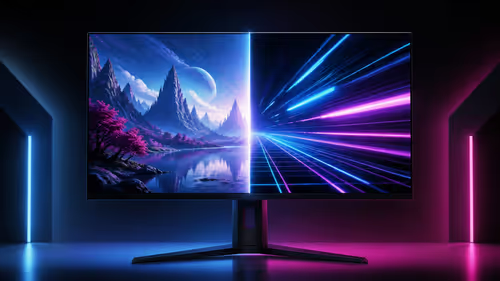
A monitor that auto-switched inputs or dropped into deep sleep can mimic a dead build. Cycle the monitor power, manually select the right source on its menu, and give the panel a few seconds to sync after each change. Modern high-refresh panels sometimes need a moment to lock onto a new signal.
Trace the signal path before anything else
Plug the display cable into the graphics card, never the motherboard port, unless you are deliberately testing onboard video. Set the monitor to the matching input such as DisplayPort or HDMI, and drop any adapter so you are testing a single clean run. A swapped input or a tired cable explains most no-signal screens.
Test with a second screen or cable
Borrow a known-good cable and a second display to split the problem in two. If the spare screen lights up, the original monitor or its cable is the suspect; if it stays dark, the output side is where to look. This single swap saves hours of guessing and stops you returning healthy parts.
FAQ
Does a driver update fix a no-signal screen?
Sometimes, because a corrupt or generic display driver can stop Windows from waking the panel. Get any picture first, then do a clean driver reinstall to lock in the fix.
How much should I budget if a part is actually faulty?
For this class of gear plan on roughly R3,500 to R9,500 depending on tier and brand, and only buy after the free checks rule out cables, settings, and seating. Most readers never reach this step.
Why does my screen work on the motherboard port but not the card?
That means video is leaving through onboard graphics instead of the discrete card, usually because of a BIOS display priority or a cable in the wrong socket. Move the cable to the card and set the PCIe slot as the primary output.
Quick Win
Note the exact refresh rate, cable, and port that work today; a screenshot of your display settings turns any future regression into a thirty-second comparison.