Stage 4... the lights flicker... and then darkness. Your Discord call cuts out, your ranked match is abandoned, and that crucial piece of work is gone. We’ve all been there. Was actively designed to fight back? Building a outage-resilient PC isn't about expensive inverters; it's about smart, power-efficient components. It starts with choosing the right processor.
Why Power Efficiency is Your Secret Weapon
When the power goes out, every watt counts. Your Uninterruptible Power Supply (UPS) has a limited battery, and a power-hungry rig will drain it in minutes. The goal is to build a PC that sips power, not gulps it. This gives you more time to finish your match, save your project, or just wait for the power to return without a frantic shutdown.
A truly outage-resilient PC balances great performance with low energy consumption, and the CPU is the heart of that strategy. While many gamers focus only on raw clock speeds, efficiency is the unsung hero for any South African setup.
The Intel i5-14400: Your Efficiency Powerhouse 🚀
Enter the Intel Core i5-14400. Its magic lies in its hybrid architecture:
- Performance-cores (P-cores): These handle the heavy lifting, like running your favourite games or rendering video.
- Efficient-cores (E-cores): These little champs manage background tasks—like system processes or Discord—using a fraction of the power.
During normal use or light tasks, the E-cores do most of the work, keeping your PC's power draw incredibly low. This means less strain on your PSU and, crucially, a much longer runtime on your UPS. It’s one of the most versatile CPU processors available for builders who need both power and peace of mind.
UPS Sizing 101 ⚡
To correctly size your UPS, add up the maximum power draw (in Watts) of your PC and monitor. Multiply that number by 1.5 to get the ideal VA (Volt-Amperes) rating. For a build with an i5-14400 and a mid-range GPU (around 400W total), a 1000VA UPS is a great starting point, giving you enough time for a safe shutdown.
Practical Reliability Considerations
Every component choice contributes to the final power draw.
Key Component Choices
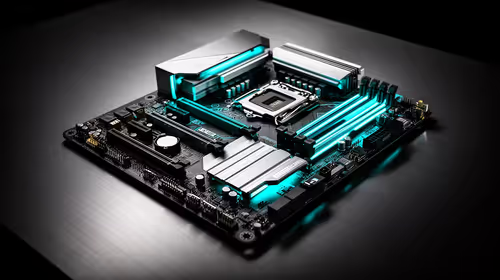
- Motherboard: You don't need a top-of-the-line Z-series board. A quality B760 motherboard provides all the features you need for the i5-14400 without unnecessary power consumption.
- Power Supply (PSU): Don't cheap out here! An 80 Plus Gold or Platinum rated PSU is more efficient, meaning less electricity is wasted as heat. It's a small investment that pays off in lower bills and longer UPS runtime.
- Graphics Card (GPU): Look at performance-per-watt metrics. Modern cards are surprisingly efficient, but choosing one that matches your needs without going overboard is key to keeping your build lean.
The i5-14400 is the perfect foundation, a standout among the latest Intel CPUs for its blend of performance and thriftiness.
How Does it Compare to Other Options?
So, why not just grab the fastest chip on the market? While top-tier processors are incredible, their high power draw can be a liability during a power cut. The i5-14400 hits the sweet spot.
Of course, the competition is fierce. Many modern AMD CPUs also offer excellent efficiency, particularly at idle. However, the P-core and E-core design of the i5-14400 gives it a distinct advantage in mixed-use scenarios common in South Africa, where your PC is often doing more than one thing at a time. For those optimising every watt, it's a compelling choice.
You can find many powerful and efficient CPUs available for under R7000, making this a smart and accessible strategy for any gamer. ✨
Ready to Improve Your Pc Setup?
Don't let Eskom dictate your gaming schedule. A smart, efficient build is your key to uninterrupted power.