Quick Answer
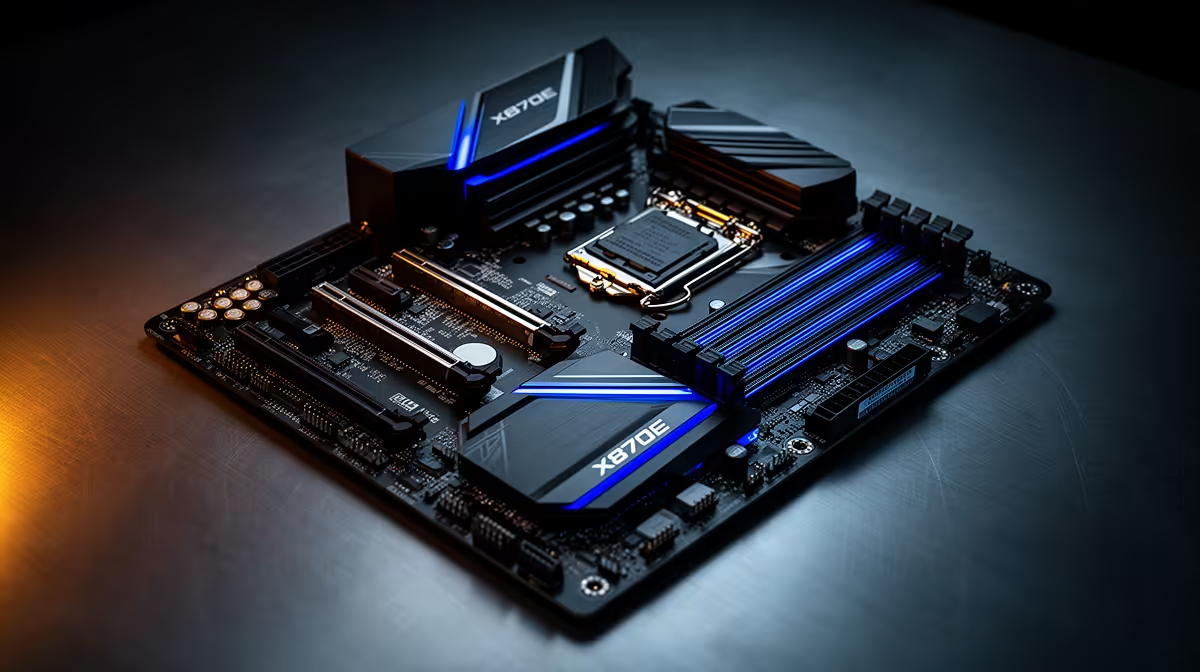
X870E rebooting usually points to PSU protection, unstable RAM, BIOS settings, thermals, or a driver fault. Test stock BIOS, one RAM stick if needed, and a known-good power cable path before assuming the motherboard has failed.
Practical Checks for This Symptom
Record the stop code or Event Viewer entry, then test BIOS defaults, one memory profile, storage health, and PSU cabling. WHEA errors often point toward CPU, memory, PCIe, or power stability; storage errors point toward the NVMe drive or driver. Do not compare replacement boards until the same failure survives stock settings.
SA Buying Context
X870E boards such as ASUS ROG Strix X870E-E, MSI MPG X870E Carbon WiFi, and Gigabyte X870E AORUS Master sit in the premium AM5 range, commonly around R6,000-R14,000 depending on Wi-Fi, VRM, M.2 slots, and USB4 support. For gaming, a Ryzen 7 9800X3D or Ryzen 9 9950X3D with 32GB DDR5-6000 CL30 and a modern NVMe drive is a sensible baseline; unstable tuning can hurt 1% lows more than it improves peak FPS.
Before spending, write down the exact X870E motherboard keeps rebooting SA troubleshooting guide requirement, the part you already own, and the target monitor, workload, or delivery city. That note helps SA buyers separate a real upgrade from a return risk: confirm warranty cover, boxed accessories, cable support, wattage or clearance numbers, and physical dimensions in millimetres before comparing products. If two options look close, choose the one that solves the measured constraint instead of the one with the louder spec sheet.
FAQ
Should I replace an X870E motherboard for rebooting?
Not first. Replace it only after BIOS defaults, drivers, memory, storage, cables, thermals, and PSU checks keep pointing back to the board.
What X870E price band should SA buyers expect?
Most premium X870E options sit roughly between R6,000 and R14,000. Paying more only makes sense if you need stronger VRM cooling, USB4, extra M.2 slots, or Wi-Fi 7.
Which spec should I test before buying parts?
Test 32GB DDR5-6000, the GPU PCIe link, NVMe health, and a 144Hz or 165Hz display path. Those checks catch many faults that look like motherboard trouble.
Pro Tip
Before buying a new X870E board, save BIOS settings, test stock memory, and repeat the same 10-minute workload so the rebooting pattern is proven.