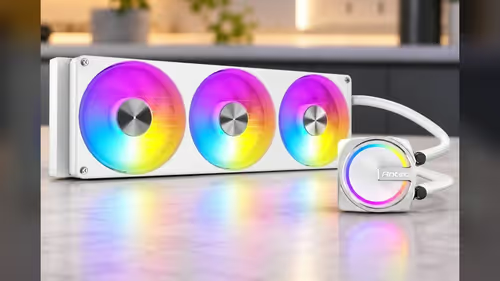
The four-sided infinity mirror effect is the reason the fans on the Omni Matrix 360 look like they go on forever. Light enters the frame at the edge, bounces between reflective surfaces and seems to repeat into the distance. It is a trick of reflection rather than extra LEDs, and it is easy to see once you know where to look. Here is what the effect is, why the frame makes it work and what you will actually see from your seat.
Quick Answer
The four-sided infinity mirror frame reflects ARGB light across layers, so each fan looks deeper than its surface. The effect comes from the frame's design, not from add-on parts. It is built into the Antec Omni Matrix 360 at R999, so the depth comes with the cooler rather than as an upgrade.
🪞 How the reflections make depth
Light from the ARGB rings enters the frame and hits a reflective surface. Part of that light bounces to the opposite side, and the bounce repeats. Each reflection carries the colour a little further, so the eye reads a series of glowing layers instead of one ring. The effect is strongest where the light has the most surfaces to bounce off. Each 120mm fan carries its own frame, so the reflections repeat on every fan in the set.
Four sides matter because the light can bounce in more directions. A frame with one or two reflective walls shows a single echo, while four walls give the light room to repeat around the hub. The result is a pattern that seems to recede towards the centre of the fan.
The pattern changes with the viewing angle. From straight on, the layers look even, and from a few degrees to one side they shift, which adds to the sense of depth. Move your head and the glow appears to move, even though the fan has not changed.
💡 What you actually see from your seat
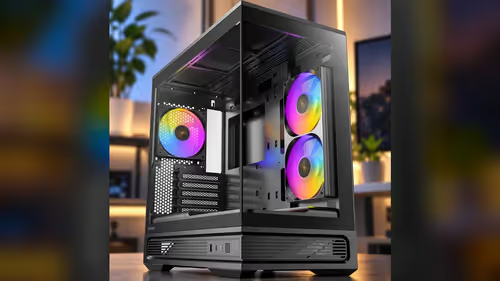
From a seat about 1 metre from a glass panel, the infinity effect is clearest. The lit rings sit behind the reflections, so the front edge of the frame looks bright and the inside looks like a tunnel. From further back, the layers blur together, and the effect reads more like a soft glow.
A solid side panel hides most of the effect. The light still shines out of the front of the fans, but the reflections are behind the panel and cannot be seen. A mesh panel sits somewhere in the middle, and a glass panel shows the whole effect.
The colour matters as well. A single steady colour shows the layers clearly, while a fast colour chase blurs the reflections into a moving band. Pick the colour and the speed of the effect in the software to suit the look you want.
🧭 Is it a real effect or a filter?
It is a real effect, produced by the frame's reflective design and the light that enters it. There is no screen or filter involved, and the depth is created by the physical layout of the reflections. That is why the effect looks different when you change the lighting in the room. Step back 3 metres to see how the layers blur into one glow. Its lead is a 3-pin ARGB connector, which a 5V header drives.
It is not extra lighting, either. The Omni Matrix 360 has ARGB rings on each fan, and the frame reflects those rings. A brighter room lowers the contrast of the effect, while a dim room makes the reflections stand out.
Our case fans range shows the fans that suit a glass panel, and the CPU coolers category shows the liquid coolers with lit fan frames.
Frequently Asked Questions
Is the infinity mirror effect a separate light?
No. It is the frame's reflective design bouncing the light from the ARGB rings. No extra LEDs are needed.
Does the effect show through a solid side panel?
Mostly not. The reflections sit behind the panel, so a glass side panel is needed to see the full depth.
Does the colour change the effect?
Yes. A steady colour shows the layers clearly, while a fast chase blurs them into a moving band.
Can I get the same look on a standard fan?
Not in the same way. A standard ring sits on one plane, so it cannot produce the layered reflections of a four-sided frame.
Want the depth inside your case?
Browse our case fans and liquid coolers, and pick a lit frame that suits your glass panel.