Full-body compositing is an unforgiving discipline. A 298x298cm green screen has roughly nine square metres of fabric to work with -- enough to cover a standing person with arms extended and still leave margin at the frame edges. A pop-up background gives you a fraction of that surface and typically maxes out well below waist height on a standing subject, which means either cropping the shot or accepting the background hard edge as a permanent fixture of every composited clip. The difference between these two formats is not subtle; it is visible in the first frame.
Quick Answer
A 298x298cm green screen covers a standing full-body frame including arm movements and feet. A pop-up background typically spans 1.1 to 1.5m, which suits a seated head-and-shoulders frame but crops a standing person at the waist or hips. Choose the 298cm screen for any standing or full-motion compositing work.
🎯 Coverage: What Each Format Actually Fits
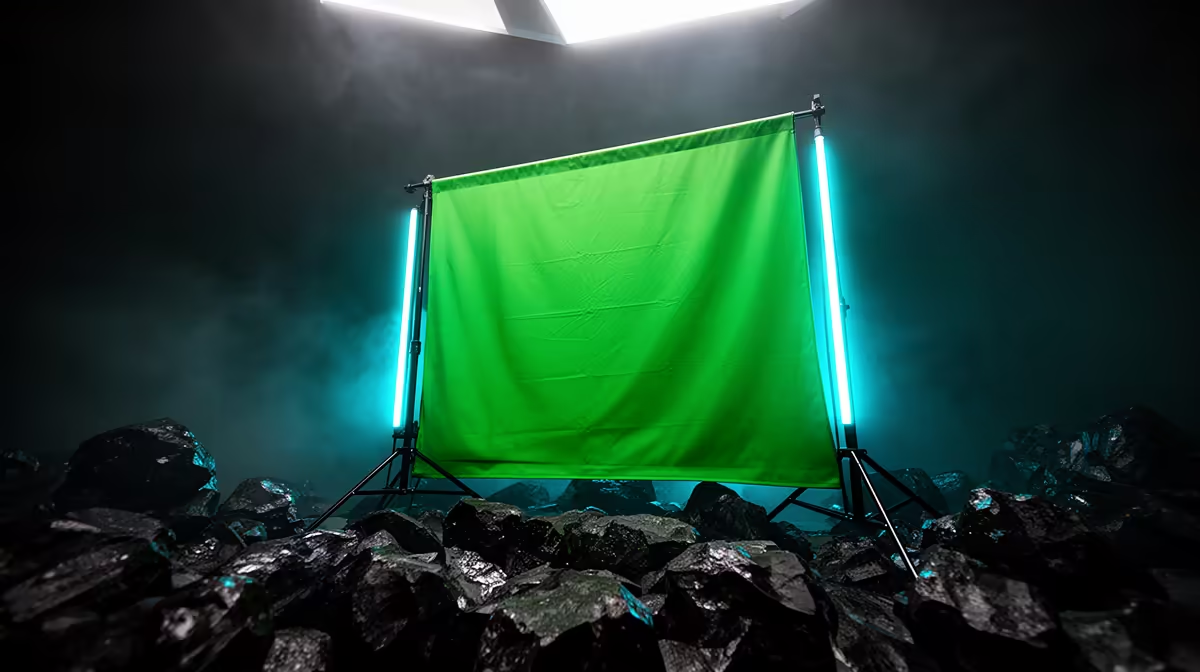
At 298cm wide and 298cm tall, the large format screen gives you close to 3m of width to work with. A person standing with arms at shoulder height and some horizontal movement is still well within the frame at a normal shooting distance of 2 to 3m. The camera sees green top to bottom and left to right, so the keyer has no hard edge to deal with inside the frame.
Pop-up backgrounds are a different category of product. Most collapse to a circular carry bag roughly 90cm in diameter, which puts an upper limit on their unfolded dimensions. A standard pop-up chroma screen opens to approximately 1.1 to 1.5m across. For a subject seated at a desk with the camera framed head-to-collarbone, that width is sufficient. The moment the subject stands, the green area does not extend to their feet, and lateral arm movement exits the background almost immediately.
What a narrow background does to the key
When part of the subject steps off the green and onto a non-green area -- a wall, a floor, the edge of the room -- the compositor has to make a decision: extend the key and lose the subject's edges in that area, or pull the key tighter and leave a visible matte line at the boundary. Neither outcome is clean. The 298cm format avoids this entirely by making the background wider than the subject's practical movement area.
🔧 Setup Time and Practical Realities
A pop-up background lives up to its name in one direction: unfolding it takes about five seconds. The fabric springs open under its own tension and is immediately ready to stand behind. Folding it back down is the part that tests patience -- the specific triple-fold technique required to collapse it back into the carry bag takes practice and is genuinely awkward the first several times.
The 298cm screen requires a crossbar, at least two 199cm stands, and several minutes to hang and tension the fabric correctly. That setup time is real. For a creator who shoots once a week in a dedicated space and leaves the studio assembled between sessions, it is irrelevant -- the screen stays up. For a creator who packs down and resets the studio every few days, the pop-up's instant deployment is a genuine quality-of-life advantage for the sessions where a seated frame is all that is needed.
💰 Cost Per Square Metre of Green
The 298cm fabric and crossbar route delivers approximately nine square metres of chroma surface. Pop-up backgrounds at equivalent or near-equivalent widths exist, but a pop-up screen approaching 1.5m wide costs significantly more than the standard 90cm-to-disc format. To cover a standing full body with a pop-up, you would typically need multiple units or a larger-format pop-up that loses the portability advantage almost entirely.
At typical South African studio accessory pricing, the fabric-and-crossbar approach gives the most chroma coverage per rand spent for full-body work. The pop-up wins on convenience at its natural size -- 1.1 to 1.5m for seated shots -- not on coverage per cost when scaled to full-body requirements.
Pro Tip ⚡
If you have a 298cm screen and a small room, you do not need to use all 3m of it. Hang it centred on the frame and let the excess fold behind the stands. The keyer only cares about what is visible in the shot -- unused fabric off the sides of the frame adds nothing and does not need to be perfectly tensioned. This lets you use the full-size screen in a room that could not accommodate a 3m fully spread setup.
🌗 Green Spill Risk at Each Format
Green spill is reflected chroma light bouncing off the fabric surface onto the subject. Standing 1.5 to 2m forward of a 298cm screen gives the spill enough distance to lose most of its intensity before it reaches the subject's hair and shoulders. The larger fabric area also means the screen lights are further from the subject's standing position, which reduces direct light reaching forward.
Pop-up backgrounds require the subject to stand relatively close to the fabric to stay within the green area. At the typical 0.5 to 1m clearance available in a standard seated pop-up setup, spill is a more immediate concern. Lighting the screen flat and keeping the subject and screen lights separate is good practice regardless of format, but the narrow clearance of a pop-up makes spill management more demanding.
Frequently Asked Questions
Which format covers a standing full-body shot?
The 298x298cm green screen covers a standing person with arm extension to spare at a normal shooting distance. Most pop-up backgrounds span 1.1 to 1.5m wide, which does not give a standing subject enough width to move laterally without exiting the frame. For any standing or full-motion compositing, the 298cm format is the correct choice.
How quickly does a pop-up background set up compared to the 298cm screen?
A pop-up springs open in seconds and needs only a stand or clamp to position. Hanging a 298cm fabric screen on a crossbar with two stands and tensioning it correctly takes three to five minutes. For a permanent or semi-permanent studio setup the difference disappears entirely. For mobile or frequently reconfigured studios, the pop-up's instant deployment is a practical advantage for seated shooting.
What is the typical width of a pop-up green screen?
Most pop-up chroma key backgrounds collapse to a 90cm carry disc and open to approximately 1.1 to 1.5m wide. This suits a seated head-and-shoulders or head-to-waist frame at normal camera distances. The format is not designed for full standing shots, and the coverage area is a direct result of the physical constraints of collapsible construction.
Does a pop-up background key as cleanly as a stretched fabric screen?
When lit evenly, yes -- the key quality depends on consistent lighting, not the format. However, pop-up backgrounds require closer subject positioning which raises the risk of green spill wrapping onto the hair and shoulders. The 298cm screen's larger surface allows more clearance between subject and fabric, making spill easier to manage with standard two-light placement.
Which is better value for full-body compositing work?
The 298cm fabric-and-crossbar approach. A pop-up screen wide enough to cover a standing subject costs considerably more and largely defeats the portability advantage. For full-body coverage at practical studio accessory pricing, the stretched fabric on a 3m crossbar delivers more usable chroma area per rand than scaling a pop-up to equivalent dimensions.
Ready to shoot composites that cover the full body without frame-edge compromises?
Browse the green screen backdrops and crossbar stand packages at Evetech to find the format that matches your shooting style and studio space.