Quick Answer
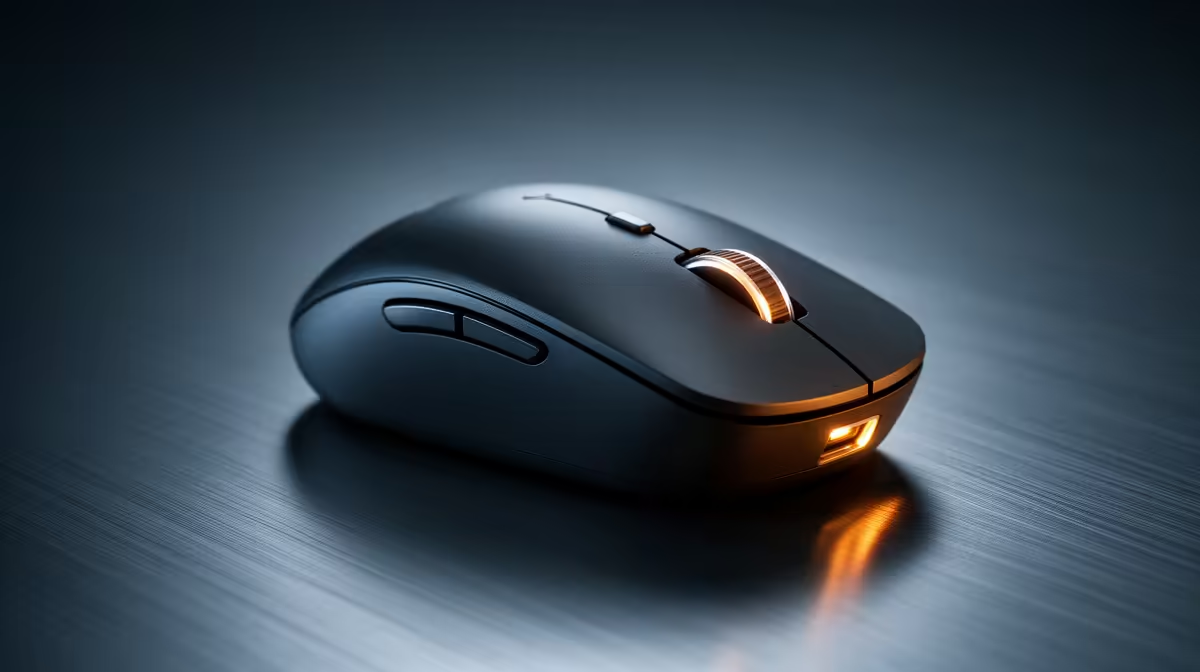
The must-have features for multi-device Windows workflows are multi-host Bluetooth or Easy-Switch pairing (connecting to two or more devices), a reliable 2.4GHz dongle option, a USB-C rechargeable battery, and a precision optical sensor. Silent clicks and a free-spinning scroll wheel are meaningful bonuses for shared office environments.
Multi-Host Pairing: The Core Feature 🔄
A multi-device mouse stores two or three Bluetooth or wireless profiles simultaneously and lets you switch between them via a button on the underside or side. In practice this means pairing to your personal Windows laptop, your work machine, and a tablet in one minute and switching between them instantly without re-pairing. For South African hybrid workers commuting between a home office and a corporate environment in Johannesburg or Cape Town, this feature alone saves five to ten minutes of setup friction per day. Look for mice that explicitly list Bluetooth multi-device or Easy-Switch support; not all Bluetooth mice support simultaneous multi-host registration.
Windows-Specific Features Worth Noting 💻
Windows 11 includes Microsoft Swift Pair, which detects compatible Bluetooth mice and pairs them in one click without navigating into settings. Not all Bluetooth mice support this protocol; models that do will complete initial pairing in under 15 seconds, which matters when setting up at a client's site or borrowing a machine. Beyond Swift Pair, look for mice with Snap Layouts optimisation if the manufacturer software supports it, as some productivity mice allow a button to trigger Windows 11's window-snapping shortcut. A high-resolution sensor at 2,400 DPI or above ensures smooth tracking on 1440p and 4K external monitors that Windows laptop users increasingly connect to.
Battery Strategy for Multi-Device Use 🔋
Multi-device mice often draw slightly more power maintaining simultaneous Bluetooth profiles. Prioritise models with USB-C charging and at least 50 hours per charge. If the mouse supports a 2.4GHz dongle alongside Bluetooth, default to the dongle for your primary machine; it uses less power and provides lower latency. Switch to Bluetooth only for secondary devices where the dongle is not inserted. This hybrid approach extends charge cycles and keeps latency optimal on your main working machine. Quality multi-device wireless mice with USB-C charging and full multi-host support sit in the R700 to R1,300 range at Evetech.
Label Your Profile Slots ⚡
Use a small sticker or a marker dot on the mouse's profile button to indicate which click corresponds to which device, for example one dot for the laptop and two dots for the desktop. After a week of muscle memory this becomes unnecessary, but during the first few days of multi-device use it prevents accidentally sending cursor input to the wrong screen.
FAQ
Does a multi-device mouse work with both Windows and a non-Windows second device?
Yes. Most multi-host Bluetooth mice are OS-agnostic. You can pair to a Windows 11 laptop on profile one and an Android tablet on profile two without any driver conflicts.
Will a 2.4GHz mouse work on a Windows laptop without a USB-A port?
You will need a USB-C to USB-A adapter or a USB-C hub to use the dongle. Some newer mice, like certain Logitech Bolt-compatible models, ship with a USB-C receiver that plugs directly into modern laptops without an adapter.
Is there a latency penalty when using multi-host Bluetooth vs a dedicated 2.4GHz dongle?
Bluetooth 5.0 multi-host operation adds roughly 5 to 12ms of latency compared to 2.4GHz. For office tasks this is imperceptible, but if you also use the mouse for casual gaming on one of your devices, switch to the 2.4GHz dongle on that machine for the lowest input lag.
Working across two or more devices every day?
Evetech stocks multi-device wireless mice that switch between your laptop, desktop, and tablet in one button press, with local warranty included.