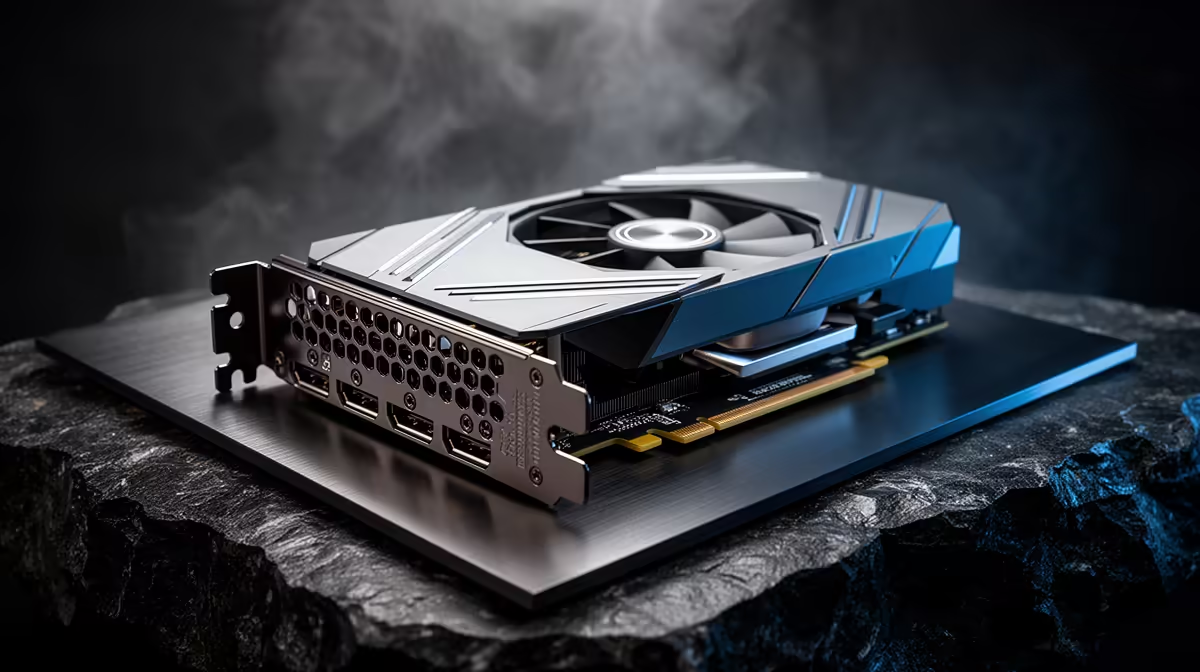
A SolidWorks assembly that crashes during a rebuild and a render that finishes ten minutes faster can both trace back to one decision: whether you bought a workstation GPU or a gaming card. CAD GPUs versus gaming GPUs is a genuine trade-off, not marketing noise, and for most South African designers the honest answer is not the expensive one.
Quick Answer
For the large majority of CAD and 3D work, a consumer GeForce RTX card does the job and saves you a substantial amount of money. Workstation RTX cards, the line formerly branded Quadro, earn their premium only in a narrow set of cases: ISV-certified drivers for applications like SolidWorks and CATIA under heavy production loads, plus ECC video memory where a single corrupted bit cannot be tolerated.
What Separates a Workstation GPU From a Gaming One
The two card families often share the same underlying graphics architecture. The differences sit in the supporting hardware and software around the silicon.
Certified Drivers
This is the headline reason workstation cards exist. Independent software vendors, the firms behind SolidWorks, Siemens NX, CATIA, and similar tools, certify specific GPU drivers against their software. Certified drivers are validated to behave predictably in viewport-heavy operations, complex assemblies, and edge cases that gaming drivers, tuned for frame rates, are never tested against. On a giant assembly with thousands of mating components, a certified driver is less likely to misdraw geometry or fall over during a rebuild.
ECC Memory
Workstation cards frequently offer error-correcting video memory. ECC catches and fixes single-bit errors in VRAM on the fly. For an animator that bit-flip is an invisible pixel. For an engineer running a multi-day finite element simulation or a scientific compute job, a silent error can quietly poison the result. If your work is mission-critical in that sense, ECC is the feature you are paying for.
Memory Capacity and Reliability
Workstation cards often ship with more VRAM and are built and binned for sustained, around-the-clock operation rather than evening gaming sessions. That extra memory matters when a scene or dataset simply will not fit in a gaming card's frame buffer.
Where a Gaming RTX Card Wins
For the overwhelming majority of designers, freelancers, and small studios, a GeForce RTX card is the smarter buy. It delivers the same or better raw rendering throughput per rand because you are not paying the certification and reliability premium.
Modern GeForce cards carry the same CUDA cores and RT cores that GPU renderers such as Blender Cycles, OctaneRender, and V-Ray lean on, so viewport navigation and final-frame rendering are quick. For product visualisation, architectural walkthroughs, motion graphics, and the vast bulk of CAD modelling, a gaming card handles it without complaint. You only feel the missing certification at the extremes: validated production pipelines, gigantic assemblies, or compute where a wrong answer is unacceptable.
Matching the Card to the Job
Be honest about which camp you fall into before you spend. A few practical groupings:
- Hobbyist CAD, 3D printing prep, and learning SolidWorks: a mid-range GeForce RTX card is plenty. Save the difference for more RAM or a faster NVMe drive.
- Freelance rendering, product viz, and motion design: a higher-tier GeForce RTX with generous VRAM is the sweet spot. Renderers reward CUDA and RT cores, and certification is irrelevant here.
- Engineering firms running certified SolidWorks or CATIA at scale: this is where a workstation RTX card and its certified drivers and ECC memory pay off, especially when downtime or a corrupted result costs real money.
If your 3D pipeline ends in physical parts, the GPU is only one link. Pairing the right card with quality 3D printing hardware keeps the workflow moving from screen to printed prototype. And when you are sizing up the rest of the rig, the supporting tools and workstation accessories round out a build that holds up under long sessions.
The Specs That Actually Move The Needle
Once you have picked a camp, the next mistake is fixating on the wrong number. Three specs decide real CAD and rendering performance far more than the badge.
VRAM Capacity
Video memory is the spec that quietly caps what you can do. A complex CAD assembly, a dense scene with high-resolution textures, or a GPU render with many objects all need to fit in the card's frame buffer. Run out and performance collapses as the system shuffles data, or the render simply refuses. For serious rendering, prioritise a card with generous VRAM over one with a marginally faster core but less memory, because capacity is the hard wall you hit first.
CUDA and RT Core Count
For GPU renderers, the number of CUDA cores roughly tracks how fast a frame finishes, and the RT cores accelerate the ray-traced lighting that makes a render look real. A card with more of both chews through final frames quicker. This is where a higher-tier GeForce card often beats a cheaper workstation card outright, because you are paying for raw cores rather than certification.
Driver Mode And Stability
On the workstation side, the value is not a benchmark figure at all, it is predictable behaviour over an eight-hour day in a certified application. If your livelihood depends on SolidWorks not misdrawing a mate or falling over mid-rebuild, that stability is the spec, even though it never shows up on a frame-rate chart.
A Real-World Buying Frame
Picture three SA professionals. A mechanical engineering student modelling parts for assignments is best served by a mid-range GeForce RTX card, with the saved budget going into 32GB of system RAM and a fast NVMe drive so SolidWorks loads and saves quickly. A freelance 3D artist rendering product shots in Blender wants a higher-tier GeForce card with plenty of VRAM, since every extra core shortens render queues that pay the bills. An engineering firm running a validated SolidWorks pipeline across a team is the one case where a workstation RTX card's certified driver and ECC memory genuinely justify the premium, because a day of downtime or a corrupted production file costs more than the card.
Notice that two of the three are better off on a gaming card. That is the pattern for most people, not the exception.
The Honest Verdict
Do not buy a workstation GPU out of caution. Buy it because your software is certified for it and your work cannot tolerate a silent error. Everyone else gets faster, cheaper, and entirely capable results from a GeForce RTX card. Spend the saved budget on memory, storage, and a CPU that keeps your viewport responsive, and your real-world productivity climbs further than the badge on the card ever would.
Frequently Asked Questions
Do I need a Quadro for SolidWorks?
Only if you rely on certified drivers for very large assemblies or production-critical stability. SolidWorks runs perfectly well on GeForce RTX cards for hobbyist, student, and most professional modelling work.
Are workstation GPUs faster than gaming GPUs?
Not in raw rendering throughput. A comparable GeForce card often renders just as fast or faster per rand. Workstation cards trade speed-per-rand for certified reliability, ECC memory, and validated drivers.
What is ECC VRAM and do I need it?
ECC corrects single-bit memory errors automatically. You need it for scientific compute or simulation where a silent error ruins the result. For rendering and visualisation, where an error is just a stray pixel, it is unnecessary.
Will a gaming GPU's lack of certification cause crashes in CAD?
Rarely for normal use. Certification mainly matters in extreme assemblies and validated enterprise pipelines. Most designers run gaming cards in CAD for years without certification-related problems.
Which GPU brand handles CAD rendering best?
NVIDIA's CUDA ecosystem is the most widely supported across GPU renderers and CAD tools, which is why both its GeForce and workstation lines dominate professional 3D workflows.
Working out which card fits your CAD or rendering workflow without overspending? Talk to the Evetech team about a workstation built around the right GPU, and gear up with the workstation tools and accessories that keep long projects running.