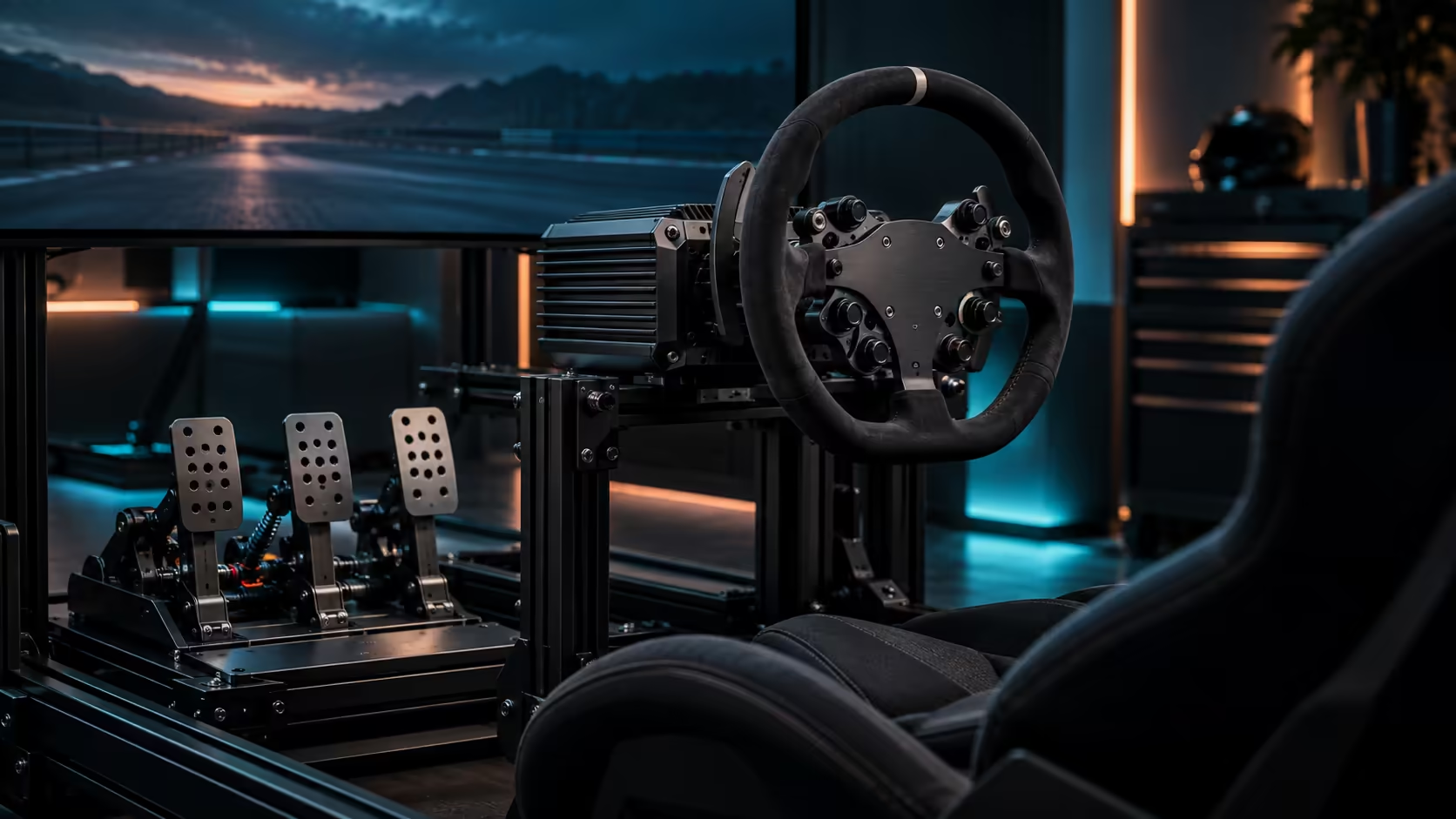
Pick up a round wheel and your hands naturally want to cross over on a tight hairpin, the way rally drivers actually do it. Pick up a flat-bottomed GT rim and that same crossover feels wrong, because the whole shape is built to keep your hands anchored at nine and three. GT-style versus round racing wheels is not a question of which is better, it is a question of which driving style your hands are actually doing.
Quick Answer
A GT-style rim, flat-bottomed with fixed grips, suits driving that rarely asks for more than a half turn of steering lock in either direction, which covers most circuit and touring car style racing. A round rim suits driving with large rotation and frequent hand crossovers, the territory of open-wheel and rally-style inputs. The flat-bottomed GT Neo wheel in the R14,999 Green Flag bundle is built for the first category.
🏁 What a GT-style rim is actually built for
Circuit racing in production-based and GT-class cars rarely uses more than 450 to 900 degrees of total steering lock, and within that fairly narrow range your hands barely need to leave the nine-and-three position at all. A GT-style rim takes advantage of that by fixing your grips at exactly those points, with a flat bottom that also gives your thighs more clearance on a rig where the wheel sits close to your lap.
The trade-off is rotation range. A GT rim's fixed grip layout works against you the moment a corner needs more lock than the grips comfortably allow, because there is no natural place to move your hands to without letting go of the shape the rim was designed around.
For reference, an ordinary road car typically needs about 2.5 to 3.5 full turns of the wheel, somewhere around 900 to 1260 degrees, to go from lock to lock, which is where the common default rotation figure in most racing titles actually comes from. A GT-style rim's comfortable half-turn range only covers a fraction of that full span, which is fine because circuit racing rarely uses anywhere near full lock outside a hairpin or a pit lane manoeuvre.
🔄 What a round rim is built for
A round rim has no fixed hand position, which sounds like a downside until you need to rotate the wheel through 900 degrees or more, close to a full lock-to-lock road car range, the territory typical of open-wheel style driving with high steering ratios, or rally-style driving where a car needs to be caught and corrected quickly through large, fast inputs. A round shape lets your hands slide and cross naturally through that full range, the same technique a rally co-driver would instantly recognise from watching a real car being driven flat out on a loose stage.
The trade-off runs the other way here: on a car that only needs a half turn of lock, a round rim gives you nothing a GT-style rim does not, and the lack of fixed grip points can actually make it harder to find your exact centre position by feel alone, particularly at speed when you cannot glance down at the wheel to check your hand placement.
🧭 Matching the rim to your actual driving, not the genre label
The honest way to decide is by how much you actually rotate the wheel in the driving you already do, not by which category of motorsport it belongs to on paper. If most of your sessions stay within roughly 450 degrees of lock either way and your hands rarely leave nine and three, a GT-style rim suits that pattern regardless of what the car on screen is officially classed as.
If you regularly find yourself crossing your hands or running out of comfortable rotation on a GT rim, that is the signal to move to a round shape rather than assuming the car or the game is the problem, and it is worth noticing before it turns into a habit of driving one-handed through tight corners just to compensate. Steering ratio and total rotation are set by the simulation itself and by your own configured rotation in software, not by the rim, so the wheel shape should follow whatever rotation range you are actually driving with.
🔧 Swapping rims without starting over
One practical advantage of a wheel base and rim being separate components, as they are on a Simagic-style bundle, is that the rim is the part you change as your taste in driving changes, while the base, its torque output and its mounting stay exactly as they were. Most aftermarket rims attach through a quick-release hub built around a standard bolt pattern, commonly a 70mm pitch circle diameter, which is why third-party rims from other manufacturers can often be fitted to a base they were never originally sold with. That keeps the cost of trying a different rim shape well below the cost of replacing an entire wheel setup. Sim racing and racing simulation both keep rim listings separate from bases for exactly this reason, and simulation accessories carries the quick-release hardware that turns swapping one for another into a five-minute job rather than a full rebuild.
Frequently Asked Questions
Can I use a GT-style rim for every kind of racing?
You can, but it works against you the moment a car needs more rotation than the fixed grip layout comfortably allows. It suits circuit and production-style driving best.
Is a round rim always better for high-rotation driving?
For anything needing large hand crossovers, yes, since a round shape has no fixed grip position to fight against as your hands move. For low-rotation circuit driving it offers no real advantage over a GT-style rim.
Does the rim shape affect torque output?
No. Torque comes entirely from the base. The rim only changes hand position and, on a smaller rim, how strong the same torque feels at your hands.
Can I switch rims without buying a new wheel base?
Yes, on a bundle with a separate base and rim connected through a standard quick-release hub. Swapping the rim changes hand position and rotation feel while torque output and mounting stay unchanged.
Ready to match the rim to how you actually drive?
Check your typical rotation range, then choose GT-style or round accordingly on the Racing Simulation shelf.