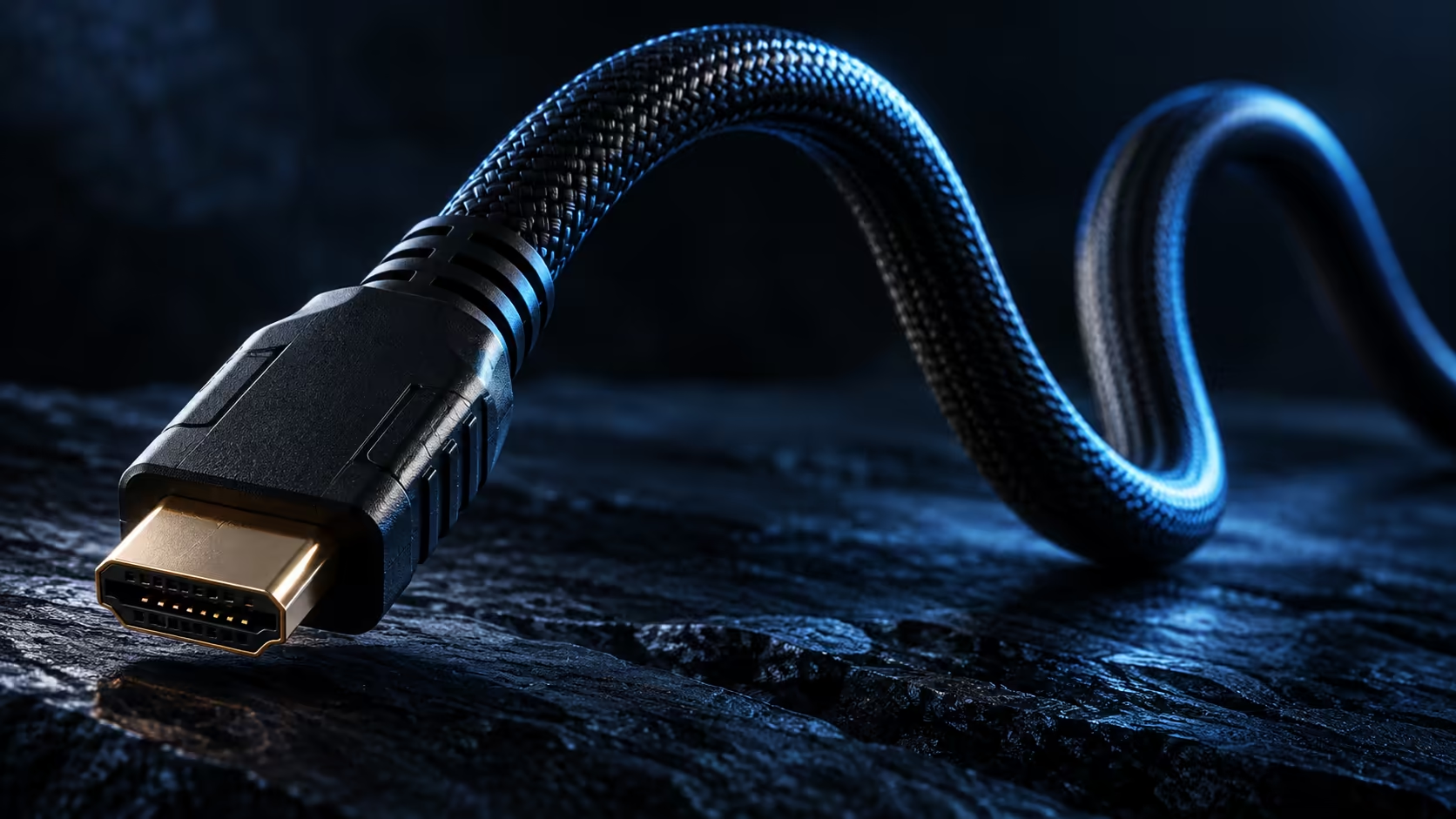
HDMI cable durability is one of the few specs sold almost entirely on trust, since nobody actually flexes their own cable a thousand times to check the number on the box. Knowing how a bend rating is measured, and what it does not tell you, makes that number far more useful.
Quick Answer
It is a lab count of how many flex cycles a wire survives. A rig swings the cable through a set angle under tension until a conductor or the signal fails, which says nothing about image quality on its own. Read what a cable's own page states, then judge the physical build in your hand before buying.
🔬 How a bend test actually works
A bend-rating test clamps a cable at both ends and repeatedly flexes it through a fixed angle, sometimes under a small amount of tension, until either a conductor inside breaks or the signal passing through it starts to fail. The count at which that happens becomes the published rating. Anker rates it for up to 1,000 bends, a figure produced this way rather than estimated from general material properties.
This kind of testing measures mechanical survival specifically, not picture quality, colour accuracy or bandwidth. A cable can fail a bend test at a low number while still carrying a perfect 4K signal for as long as it survives, and conversely a cable engineered purely for flex life is not automatically the best choice if bandwidth is the more important factor for your setup.
📊 Translating 1,000 bends into everyday use
A cable that never moves once installed, tucked behind a television or run neatly under a desk, will not come anywhere close to its bend rating over years of normal life, since it is simply not being flexed at all in that particular scenario. A cable that gets coiled and uncoiled daily, such as one carried in a bag between locations, can rack up 300 or more flex cycles a month without anyone noticing, accumulating toward a published rating far faster than a cable that never leaves the back of a television, and this is where the number actually starts to matter as a practical measure of expected lifespan rather than a marketing figure.
For a typical console or desk setup where the cable is routed once and left alone, bend rating is a secondary consideration behind bandwidth rating. For a cable that moves with equipment regularly, it becomes a genuinely useful number to compare between options.
🧵 Bend rating sits alongside other durability claims, not above them
A braided jacket resists surface abrasion and looks tidier over time, which is a different kind of durability from bend resistance at the connector, where most cable failures actually originate. A sleeved cable combines both, but each one is answering a separate failure mode, so neither stands in for the other. Connector strain relief, which protects the joint where the cable meets the plug at roughly a 90-degree angle during a typical unplug, matters more for a cable that gets repeatedly plugged and unplugged than either bend rating or jacket material alone.
🏷️ Why some cables never mention a bend rating at all
Not every cable maker publishes a bend rating, and its absence does not necessarily mean the product performs poorly on that measure, only that the manufacturer chose not to run or publish the test. A published number is a genuine data point worth comparing when it is available, but treating its absence as automatic proof of poor build quality goes further than the evidence actually supports. Where two otherwise similar R299-range cables differ only in whether one states a bend rating, that alone is a reasonable enough tie-breaker in favour of the one that does, since publishing the figure at all suggests the maker was confident enough in the result to make it public.
🛒 Using the number without over-relying on it
Read the bend rating as one data point among several: the bandwidth rating from the comprehensive cable range still determines whether the cable carries the signal you need at all, and the bend rating tells you roughly how much physical handling it is built to survive. For a cable that sits still on a desk mat and rarely moves, that number matters less than for one thrown into a bag weekly. Feel the connector and the jacket in your hand where possible, since a cable that feels solidly built often backs up its published numbers, though the rating itself is the only figure you can actually compare across different products before buying.
Frequently Asked Questions
Does a cable's bend rating relate to how thick or flexible it feels by hand?
Not directly. A cable can feel stiff yet still carry a high bend rating if its internal conductors are engineered for flex resistance, while a soft, pliable jacket says nothing on its own about what is happening underneath it.
Does a higher bend rating mean a cable is better overall?
Not necessarily. It measures one specific kind of durability, mechanical flex life, separately from bandwidth, connector quality and other factors that also determine how well a cable performs.
How is a bend rating actually tested?
A rig clamps the cable and repeatedly flexes it through a fixed angle, sometimes under tension, until a conductor breaks or the signal fails, and the number of cycles reached at that point becomes the published rating printed on the box.
Does bend rating matter for a cable that never moves once installed?
Less so. A cable routed once and left in place, such as behind a television, will rarely approach its bend rating regardless of the number printed on the box.
Is a braided cable automatically more durable than a bend-rated one?
They address different failure modes. Braiding resists surface wear and looks tidier; bend rating measures how many flex cycles the internal conductors survive, and a cable can offer one without the other.
Does a cable's bend rating ever get retested after it leaves the factory?
Not in any way visible to a buyer. The published figure comes from testing done on a sample before manufacture at scale, so treat it as a design target the whole product line was built to meet rather than a guarantee attached to the specific unit you receive.
Can I test a cable's bend resistance myself before buying it?
Not meaningfully. A proper bend test runs the cable through hundreds or thousands of controlled cycles under a fixed angle and tension, far beyond what handling a cable briefly in a store or checking it at home could ever hope to replicate.
Ready to judge cable durability by more than just the marketing?
Weigh the bend rating against how much your own cable actually gets handled day to day.