Quick Answer
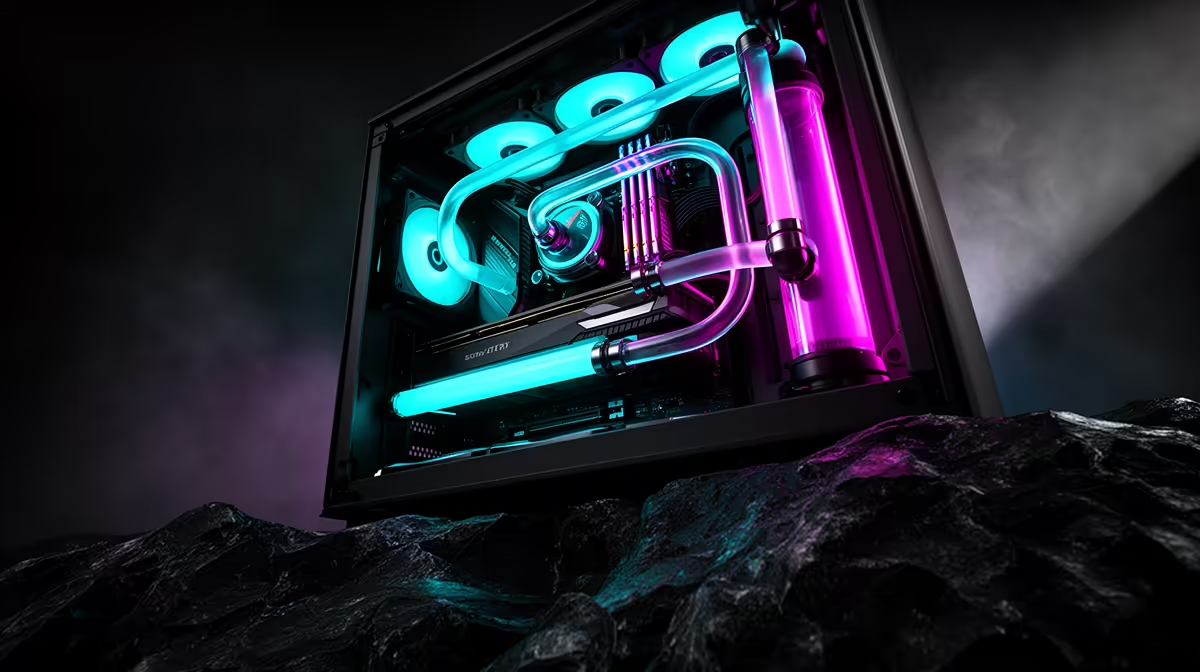
For 8-core gaming CPUs under 105W TDP, a quality dual-tower air cooler performs comparably to a 240mm AIO and within 5 degrees Celsius of a 360mm AIO, at lower cost and zero pump failure risk. Liquid cooling makes more sense for CPUs above 125W TDP, for builders prioritising quiet operation at minimal fan speed, or where case clearance prevents a large air cooler.
Where Air Cooling Wins for an 8-Core Gaming Build 🌬️
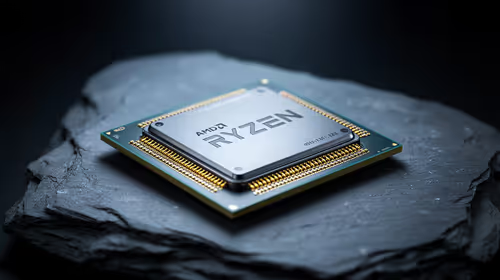
8-core gaming CPUs are thermally moderate by design. The Ryzen 7 7800X3D maintains package power below 65W during gameplay because 3D V-Cache reduces the need for high clock speeds. The Ryzen 7 9700X runs at 65W in eco mode or up to 105W in performance mode. A DeepCool AK620 at around R900 to R1,200 in South Africa handles a sustained Ryzen 7 9700X at full all-core load with temperatures below 82 degrees Celsius, well within safe limits. Air coolers have no pump to fail, no tubes to kink, and no coolant to degrade. Over a 5-year gaming PC lifespan, the reliability argument for air cooling on moderate TDP CPUs is a genuine practical benefit.
Where Liquid Cooling Adds Real Value 💧
Liquid cooling separates itself in two specific scenarios. First, acoustic performance: a 240mm AIO running its fans at 800 RPM can match the temperatures of a dual-tower at 1,200 RPM with a different and often quieter perceived noise. For a South African home office or lounge-room build where noise matters, a 280mm or 360mm AIO with a smart fan curve is noticeably quieter than even a premium dual-tower. Second, clearance: in cases with a CPU cooler height limit below 160mm, a large dual-tower like the Noctua NH-D15 (165mm tall) does not fit. AIOs are excellent in ITX and small mATX builds where tower clearance is the constraint.
Cost and Reliability Comparison in ZAR 🔧
A quality 240mm AIO costs R1,800 to R2,800 in South Africa. A premium dual-tower air cooler costs R900 to R1,400. A 360mm AIO runs R2,000 to R3,500. For a Ryzen 7 9700X at 65W eco mode in a well-ventilated case, any of these performs identically in gaming. The air cooler option saves R900 to R1,400 over a comparable AIO, funds a higher-capacity SSD or better case fans, and eliminates pump risk. The AIO option buys quieter full-load operation and compatibility with lower-clearance cases.
Check CPU Cooler Clearance Before Buying ⚡
Every PC case specification lists a maximum CPU cooler height in millimetres. The Noctua NH-D15 G2 stands 168mm tall; the DeepCool AK620 is 163mm. Confirm the case spec lists clearance above your chosen cooler height before ordering. For small form factor cases below 250mm wide, liquid cooling is almost always the practical choice for a 65W-plus CPU.
FAQ
Does liquid cooling improve gaming fps over air cooling?
No. Both methods keep the CPU within safe temperature limits and below thermal throttle thresholds for 8-core gaming CPUs. Frame rate differences between adequately cooled builds come from CPU clock speed, GPU performance, and RAM speed, not the cooler type.
How long do AIOs last in South African conditions?
Quality AIOs from Corsair, DeepCool, ASUS ROG, and NZXT are rated for 50,000-plus hours. At 8 hours daily use, that exceeds 17 years. South African summer heat increases coolant evaporation through tubing walls over many years, but a quality AIO typically outlasts the gaming PC around it.
Can I mount a 360mm AIO in a standard mid-tower?
Only if the mid-tower explicitly lists 360mm front or top radiator support. Many standard mid-towers max out at 280mm front or 240mm top. Confirm the case specification before ordering a 360mm AIO.
Deciding between air and liquid cooling for your build?
Evetech stocks dual-tower air coolers, 240mm AIOs, 280mm AIOs, and 360mm AIOs with local stock and warranty for AMD and Intel platforms.