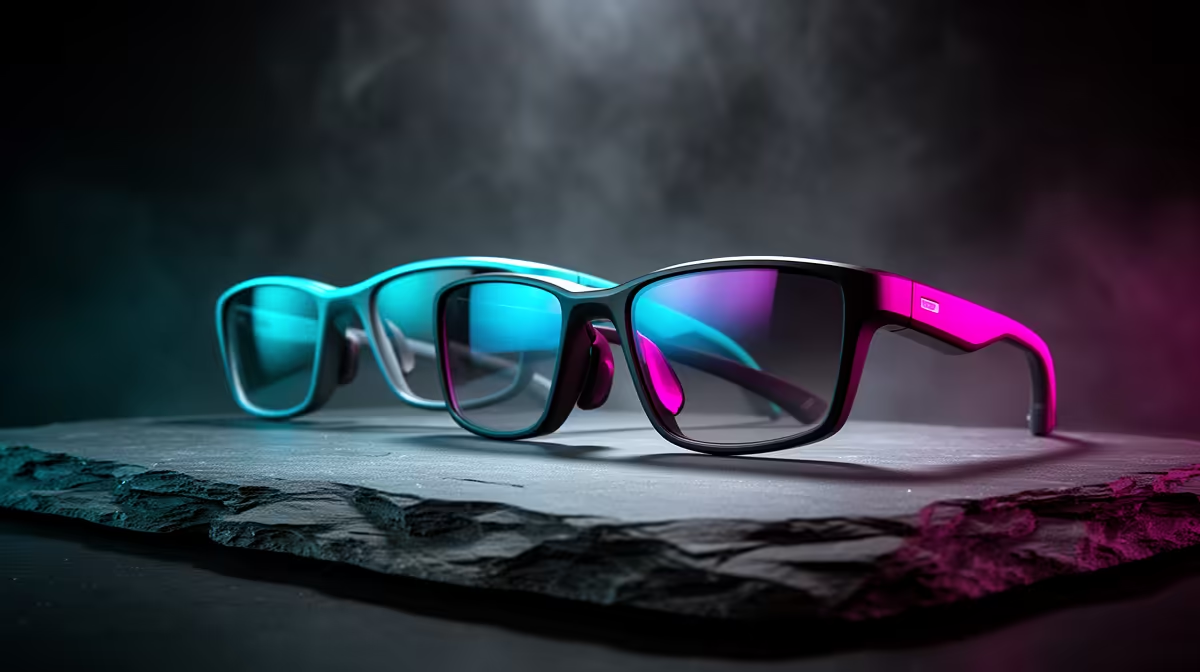
Both pairs run the same Meta AI brain, the same camera, and the same open-ear audio, so the Ray-Ban Meta vs Oakley Meta decision is really a question about your face and your lifestyle, not your feature list. Ray-Ban leans into everyday style with familiar Wayfarer and Headliner shapes. Oakley's Vanguard wraps around for sport, sweat, and movement. Pick the one that fits the life you actually live, because the smarts inside are nearly identical.
Quick Answer
Choose Ray-Ban Meta if you want classic everyday frames and the widest choice of lens and colour options. Choose Oakley Meta if you want a wraparound sport build with louder speakers, an IP67 dust-and-water rating, and around 9 hours of battery versus the Ray-Ban's 8. Same 12MP ultra-wide camera, same 3K video, same Meta AI on both.
The Hardware They Share
Before the differences, it helps to know how much is common ground. Both glasses carry a 12-megapixel ultra-wide camera that now shoots up to 3K video at 30fps, with a 60fps option for smoother motion and improved stabilisation. Both use open-ear speakers paired with a five-microphone array for calls and voice commands. Both answer to Meta AI for hands-free questions, translation, and capture. If your only goal is a good pair of camera glasses with an assistant, either model delivers the same core experience.
Ray-Ban Meta: Built for Everyday Wear
The Ray-Ban line is the lifestyle choice. The Gen 2 frames weigh around 49 grams, sit naturally on most faces, and come in the broadest spread of frame shapes, colours, and lens options, including prescription. Battery life on the Gen 2 runs to roughly 8 hours, with the charging case extending total use to around 48 hours. If you want glasses you can wear to the office, to coffee, and out for the evening without looking like you strapped on sports gear, Ray-Ban is the comfortable default. The AR and smart glasses category at Evetech is where to compare the wearable options side by side.
Oakley Meta: Built for Sport and Weather
Oakley's appeal is durability and performance in motion. The Vanguard model uses a wraparound frame that stays put during running, cycling, and training, and it is noticeably more rugged. It carries an IP67 rating for full dust and water resistance where the Ray-Ban Gen 2 stops at IPX4 splash resistance. Its speakers run about six decibels louder, useful outdoors with wind and traffic, and battery life stretches to roughly 9 hours on a charge. The trade-off is weight and looks: the Vanguard is heavier, around 66 grams, and the sporty styling is less suited to a boardroom than a bike path.
Which one fits your week
Map it to how you spend your time. Mostly indoors, social, and style-conscious points to Ray-Ban. Outdoors, active, and sweating through workouts points to Oakley. There is no wrong answer on capability, only on context. The accessories best-seller list at Evetech is handy for the cases and charging extras that keep either pair topped up.
The SA Buying Angle
Smart glasses are a considered purchase, so think past the spec sheet. Lens and prescription options matter if you wear glasses daily, which favours the broader Ray-Ban catalogue. Sweat and weather resistance matter if you train outdoors, which favours Oakley. Battery difference is small, an hour, so let fit and use case lead the decision rather than that single figure.
Price reality in South Africa
Neither Ray-Ban Meta nor Oakley Meta is sold through official Meta channels in South Africa, so local pricing depends on which importer has stock and what the Rand is doing at the time. As a guide, Ray-Ban Meta frames have been seen locally in the R10,700 to R13,500 range and Oakley Meta frames around R12,000 to R14,000, but those figures move. Always confirm current local listings before budgeting.
The price gap between the two ranges is narrower locally than US dollar figures suggest, because import duties and logistics costs close some of the difference. Frame shape and water-resistance rating should drive the choice more than trying to optimise on a few hundred Rand.
Frame comfort for all-day wear
If you already wear prescription glasses, the key question is whether your prescription can be fitted to either frame. Ray-Ban offers a broader lens catalogue with more shapes compatible with optical fitting, while Oakley's wraparound sports frames are harder to fit with progressive or high-power lenses. Confirm with the retailer before ordering, since fitting options vary by importer.
For standard lens wearers, the 49-gram Ray-Ban Gen 2 is noticeably lighter to wear through a full day than the 66-gram Oakley Vanguard. That weight difference matters more on a commute or in an office than during a focused 90-minute run, which is why daily-carry buyers lean Ray-Ban and active buyers lean Oakley for consistent reasons.
Frequently Asked Questions
Do Ray-Ban Meta and Oakley Meta use the same Meta AI features?
Yes. Both run the same Meta AI assistant with the same camera and audio hardware, so voice commands, capture, and AI responses behave identically. The differences are in frame design, durability rating, speaker volume, and battery, not the intelligence.
Which has better battery life?
Oakley edges it. The Vanguard lasts around 9 hours on a charge versus roughly 8 hours for the Ray-Ban Gen 2. The gap is small, so it should not be the deciding factor on its own.
Can I get prescription lenses in either pair?
Yes, both lines support prescription lenses, but Ray-Ban offers the wider range of frame shapes and lens options overall. If daily prescription wear is your priority, the larger Ray-Ban catalogue gives you more to choose from.
Are the Oakley Meta glasses better for exercise?
For sport, yes. The wraparound fit, IP67 dust-and-water resistance, and louder speakers are built for running, cycling, and training. The Ray-Ban Gen 2 is splash resistant only and styled for everyday rather than athletic use.
Is the camera quality the same on both?
Effectively identical. Both carry a 12MP ultra-wide sensor recording up to 3K at 30fps with a 60fps mode and improved stabilisation. Any difference in your footage comes from how and where you wear them, not the sensor.
Trying to decide between everyday style and sport-ready durability? Browse the smart glasses range at Evetech and match the frame to how you actually spend your days.