Quick Answer
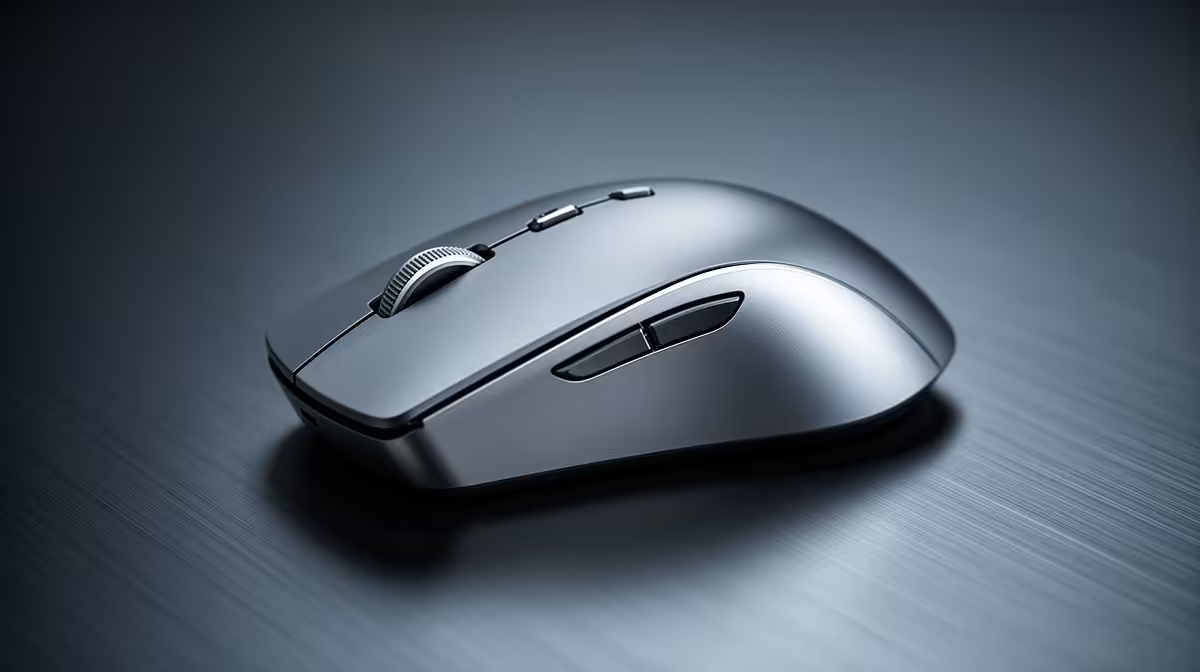
For daily office and study use, a rechargeable mouse with USB-C or wireless charging wins on long-term cost and convenience. Disposable-battery mice only make sense if you travel constantly and cannot guarantee access to a charger.
The Real Cost of Each Approach 💰
A wireless mouse rated at 24 months of battery life on two AA cells sounds impressive, but that assumes around four hours of use per day. A full-time worker or student clocking eight-plus hours daily will exhaust those batteries in roughly 10 to 12 months. Quality alkaline AAs cost around R60 to R100 for a four-pack in South Africa, so you are spending R120 to R200 per year on batteries alone. A rechargeable mouse eliminates that ongoing spend entirely. The internal lithium cell is rated for several hundred charge cycles, and at one charge per week, that translates to five or more years of useful life before noticeable capacity loss.
Charging Habits and South African Desk Life 🔌
Most rechargeable office mice deliver 40 to 70 hours per charge via USB-C. Plug in for 10 minutes during a lunch break and recover two to three hours of runtime. Some premium models include a charging cable that also works while the mouse is in use, so downtime is essentially zero. The one genuine drawback is forgetting to charge. If your workflow is unpredictable, a mouse like the Logitech MX Master 3S, which provides roughly 70 hours per charge, gives you enough buffer to charge every Sunday evening and never run flat mid-presentation.
Travel, Load and Longevity Considerations ✈️
For South Africans who commute between campus residences and home, the rechargeable option travels lighter since there is no need to pack spare batteries. The only scenario where AA-powered mice have a genuine edge is extended travel to remote areas where reliable USB charging is unavailable, such as rural field work or multi-day outdoor assignments. For home, office, and campus use, rechargeable is the practical choice. Budget for a USB-C rechargeable model between R500 and R900 at Evetech and you will likely not replace it for three to four years.
Charge Once a Week, Work All Week ⚡
Set a weekly reminder to plug your mouse in on Friday afternoon before you leave your desk. Most modern rechargeable mice recover from near-empty to full in under two hours, so a short top-up during lunch on Monday also works well.
FAQ
Can I replace the battery in a rechargeable wireless mouse if it degrades?
Most rechargeable mice use sealed internal batteries that are not user-replaceable without voiding the warranty. After several years, if capacity drops noticeably, contacting the local warranty agent is the right first step. Evetech stocks replacement models when the time comes.
Are rechargeable mice more expensive to buy upfront?
Yes, by roughly R150 to R300 compared to entry-level AA-powered alternatives. But when you factor out one to two years of battery purchases, the rechargeable model is typically cheaper over a two-year horizon.
Does wireless charging affect connection quality during use?
No. Wireless charging on mice like the Logitech G Pro X Superlight 2 DEX uses a separate power circuit that does not interfere with the 2.4GHz radio signal. Connection quality during charging on a compatible pad is identical to normal wireless operation.
Tired of buying batteries every few months?
Evetech carries a full selection of rechargeable wireless mice with USB-C and wireless charging, from everyday office options to premium productivity picks.